Key Points
- A free, large-scale interactive art installation titled Reflections I is coming toEast Village, Stratford, East London, for the whole of January.
- The work is by London-based artist Russ Jones, known for playful, participatory and reflective public art projects.
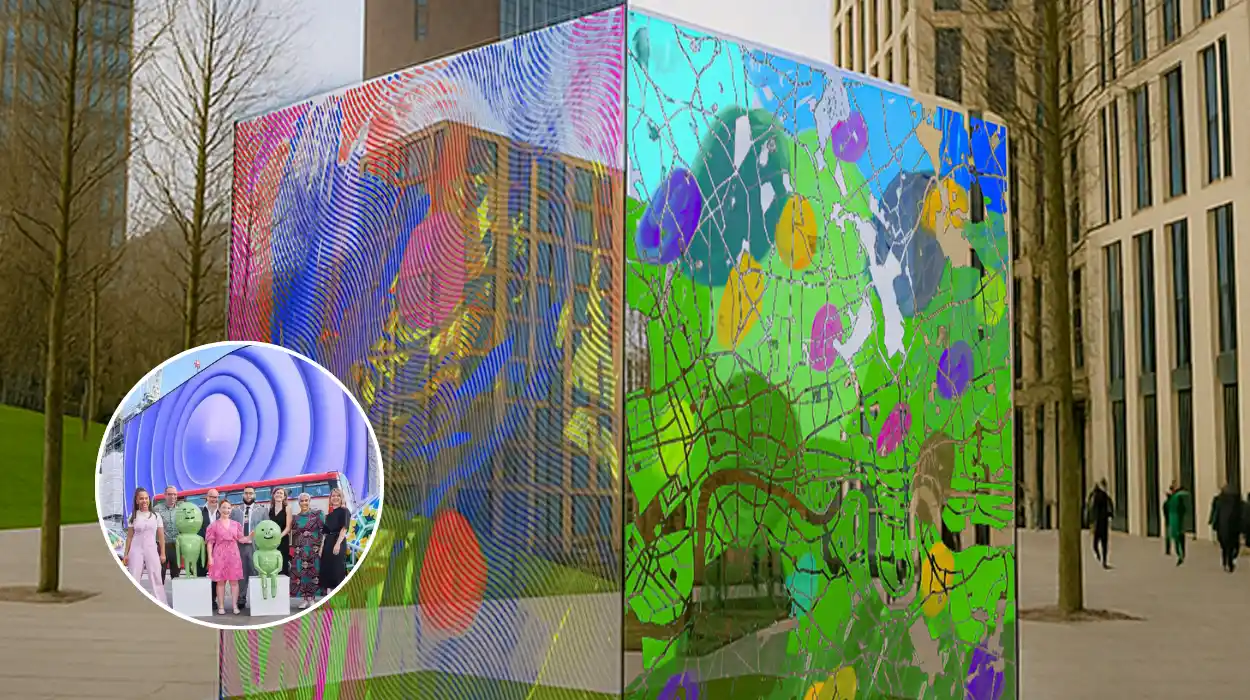
- The installation consists of a 2.4‑metre mirrored cube that members of the public are invited to write and draw on directly.
- Each face of the cube features a different prompt, ranging from personal self‑reflection to the provocative question “Is this art?”.
- The artwork is free to visit and aims to turn a simple mirror into a collective, evolving artwork made up of words, doodles and thoughts from passers‑by.
- Organisers say the piece is intended to encourage introspection, community dialogue and playful public engagement with contemporary art.
- The cube will be installed in a public outdoor space in East Village, Stratford, making it accessible to residents, commuters and visitors.
- The project forms part of a broader trend in London of interactive, immersive and participatory art experiences in public spaces.
- The installation raises questions about who creates art, the value of public contribution and how cities use open spaces for cultural programming.
- Local stakeholders suggest it could support community cohesion and mental wellbeing by giving people a space to pause and reflect in the New Year.
What is the Reflections I installation coming to East London?
Reflections I is described as a large-scale interactive art installation by London-based artist Russ Jones, set to appear in East Village, Stratford in January. According to the original announcement text provided to this publication, the centrepiece of the work is a 2.4‑metre mirrored cube that will be “in situ throughout January, inviting passers-by to stop, reflect and add their own notes, doodles and thoughts directly onto the surface.”
- Key Points
- What is the Reflections I installation coming to East London?
- How will the mirrored cube work as an interactive artwork?
- Who is artist Russ Jones and what is his vision for Reflections I?
- Why is Reflections I being installed in East Village, Stratford?
- How does the installation invite self-reflection and public dialogue?
- What questions does ‘Is this art?’ raise for visitors?
- How does Reflections I fit into London’s wider public art and immersive trends?
- What can visitors expect when they encounter the cube in January?
- Why does a free, writable artwork matter for East London communities?
- What details are known so far and what remains to be confirmed?
As outlined in the same description, each side of the cube features a different written prompt, ranging
“from self-reflection to questioning ‘Is this art?’ – turning a simple mirror into a colourful, collective artwork shaped by everyone who takes part.”
The work is conceived as an open invitation rather than a traditional gallery piece, with no ticket price and no barrier between the public and the artwork itself.
While a full technical specification has not been publicly detailed in the text provided, the emphasis is clearly on accessibility, interaction and visibility in a busy urban setting. Situated in East Village, the former London 2012 Olympic Athletes’ Village now turned residential neighbourhood, the installation is positioned to be seen by local residents, commuters and visitors moving through Stratford.
How will the mirrored cube work as an interactive artwork?
The description supplied to this outlet explains that the cube’s mirrored exterior serves a dual purpose: it reflects the viewer and receives their mark-making. Members of the public are encouraged to
“add their own notes, doodles and thoughts directly onto the surface,”
effectively making them co-authors of the piece. Over the course of January, this is expected to build into a dense overlay of text and imagery.
The prompts displayed on each face are central to the concept. As stated in the original briefing,
“each side of the cube poses a different prompt – from self-reflection to questioning ‘Is this art?’.”
By juxtaposing inward-looking questions with more conceptual, art-historical provocations, the installation attempts to engage both emotion and critical thought.
In practical terms, the work will function as a public writing wall with a reflective backdrop. People passing by can briefly pause, see themselves, respond to the prompt in front of them, and move on. Over time, the cube is expected to shift from a clean mirrored object to a layered, colourful surface, bearing traces of many different individuals and moments.
Who is artist Russ Jones and what is his vision for Reflections I?
The announcement identifies Russ Jones as a London-based artist behind Reflections I. While the provided text does not include a direct quotation from Jones, the structure and framing of the piece, as outlined in the description, suggest a sustained interest in audience participation, public space and shared authorship in art.
The decision to pose prompts such as “Is this art?” directly on the work invites the public to question not only the installation itself but also the boundaries of contemporary art more broadly. By using a mirrored cube rather than a conventional flat wall, Jones places the viewer literally within the artwork’s field, reflecting them back as they write, doodle or comment.
The approach aligns with a wider movement of artists and curators seeking to democratise the art-making process, allowing non-specialists and non-artists to leave visible, documented contributions. The brief for Reflections I, as supplied, underscores this intention by describing the final outcome as a
“colourful, collective artwork shaped by everyone who takes part.”
Why is Reflections I being installed in East Village, Stratford?
The chosen setting of East Village, Stratford is significant. The area, developed from the former Olympic Athletes’ Village, has become a mixed residential and commercial neighbourhood with a growing emphasis on cultural programming and public art. By locating the installation outdoors in a freely accessible space, organisers are positioning Reflections I as a community-facing project rather than a gallery-bound exhibition.
Although the supplied text does not attribute specific comments to local bodies or curators by name, the framing of the project – a free, interactive work in a high-footfall area – reflects broader objectives often cited by local authorities, developers and cultural organisations in East London: to use public art as a means of reinforcing place identity, supporting wellbeing and fostering community interaction.
The timing is also notable. The cube will be “in situ throughout January,” a month frequently associated with new beginnings, resolutions and reflection. In that sense, the work’s focus on self-reflection and questioning could resonate with people considering changes or reassessing priorities at the start of the year, even in small, spontaneous encounters on their daily routes.
How does the installation invite self-reflection and public dialogue?
According to the provided description, Reflections I is “designed to be written all over,” and the prompts on each side “turn a simple mirror into a colourful, collective artwork.” This transformation hinges on two linked experiences: seeing oneself and adding one’s voice.
The mirror’s surface encourages visitors to confront their own image within the urban environment. The self-reflective prompts may lead to short, personal statements or drawings that capture an individual’s mood, hopes or doubts in that moment. Because these marks remain visible, at least for a time, subsequent visitors encounter not only the mirror and the prompt but also the accumulated thoughts of others.
In this way, the cube acts as a public conversation board, even if contributors never meet face-to-face. People might respond to previous notes, contradict them or build on them visually. The question “Is this art?” explicitly foregrounds debate about artistic value and authorship, inviting both affirmative and sceptical responses. The piece therefore serves as a platform for informal civic dialogue as much as a visual spectacle.
What questions does ‘Is this art?’ raise for visitors?
The inclusion of the prompt “Is this art?” on one of the cube’s faces, as stated in the original material, is a deliberate provocation. It invites people to consider whether a mirrored cube covered in public scribbles fits their own definition of art, or whether art must be more fixed, curated or authored by a recognised practitioner.
By placing this question within a work that is itself a public, interactive installation, artist Russ Jones effectively turns the cube into a live case study in contemporary art theory. Visitors are not merely reading or hearing the question; they are physically engaging with the object that prompts it.
This can lead to a range of reactions: some may write emphatic endorsements of the work’s artistic status; others may express doubt or humour; still others may ignore the question altogether and simply use the surface as an outlet. In all cases, the presence of the question on the artwork emphasises that art today can be as much about process, participation and context as about fixed, traditional forms.
How does Reflections I fit into London’s wider public art and immersive trends?
While the supplied text is focused specifically on Reflections I, the project sits within a broader pattern of immersive and participatory art experiences in London and other major cities. In recent years, various institutions and developers have supported installations that encourage visitors to touch, walk through, write on or otherwise interact with artworks.
Reflections I builds on this trend by placing interactivity at the heart of its concept. The fact that it is a free, open-air installation in East Village distinguishes it from ticketed immersive exhibitions taking place in dedicated venues. Instead, it integrates art into daily life, blurring the line between intentional cultural visits and incidental encounters.
The mirrored cube form also recalls a lineage of reflective public sculptures, though the supplied description makes clear that here the emphasis is on user-generated surface content rather than purely on form and reflection. By combining mirror, text prompts and public mark-making, the installation adds a participatory layer to familiar urban sculptural tropes.
What can visitors expect when they encounter the cube in January?
Based on the information shared in the original announcement, visitors to East Village, Stratford, in January can expect to come across a 2.4‑metre cube with mirrored sides, each bearing a different prompt. They will be free to stop, read the prompt, look at their reflection and, if they wish, leave a note, drawing or other mark directly on the surface.
As the month progresses, early visitors are likely to experience the cube in a relatively minimal state, with more mirror visible. Later in January, the cube could appear almost entirely covered in layered writing and doodles, creating a dense visual field that partially obscures the reflective surface but increases the sense of collective contribution.
The installation is intended to be informal and drop-in, with no booking system and no fixed time commitment. People may spend only a few seconds with the work or linger longer to read what others have written. Because it is outdoors, the appearance of the cube may also change with different weather and light conditions, altering reflections and visibility.
Why does a free, writable artwork matter for East London communities?
Though the provided text does not contain direct quotations from community representatives, the nature of Reflections I suggests several potential impacts for local residents and visitors. A free, writable public artwork can act as a low-threshold entry point to contemporary art for people who might not visit galleries or museums regularly.
By inviting people to write about themselves, their surroundings or the very definition of art, the cube can offer a modest but meaningful form of expression and release, particularly in the often subdued month of January. In a diverse area like Stratford, contributions may appear in multiple languages and from a wide range of age groups, reflecting the plurality of East London’s communities.
Furthermore, the work provides a shared point of focus in a public space, which can encourage momentary connections between strangers as they read or comment on each other’s additions. Even fleeting exchanges at the cube may support a sense of belonging and curiosity within the neighbourhood, complementing other cultural and social initiatives in East Village.
What details are known so far and what remains to be confirmed?
At the time of writing, the details confirmed in the supplied text are:
- The title of the installation is Reflections I.
- The artist is London-based Russ Jones.
- The work consists of a 2.4‑metre mirrored cube.
- The installation will appear in East Village, Stratford, in January, and will be “in situ throughout January.”
- The public is invited to add “notes, doodles and thoughts directly onto the surface.”
- “Each side of the cube poses a different prompt – from self-reflection to questioning ‘Is this art?’ – turning a simple mirror into a colourful, collective artwork shaped by everyone who takes part.”
- The piece is framed as a free public artwork and “designed to be written all over.”
Certain practical details are not specified in the available text, including the exact date in January when the cube will be installed, the precise location within East Village, daily access hours (if any), and the materials to be used for writing on the cube. Information about associated programming, such as guided tours, workshops or artist talks, has also not been included in the material provided to this publication.
As further announcements are made by the organisers or by artist Russ Jones, additional details about logistical arrangements, accessibility provisions and environmental considerations may emerge. For now, the core premise is clear: a large mirrored cube in East Village will become a temporary, participatory canvas for public reflection and debate at the start of the year.