Key Points
- Owners Redical and development partner HUB have formally submitted a planning application to Havering Council to transform The Liberty Shopping Centre in Romford.
- The application outlines the first phase of a multi‑stage redevelopment aiming to revitalise the town centre.
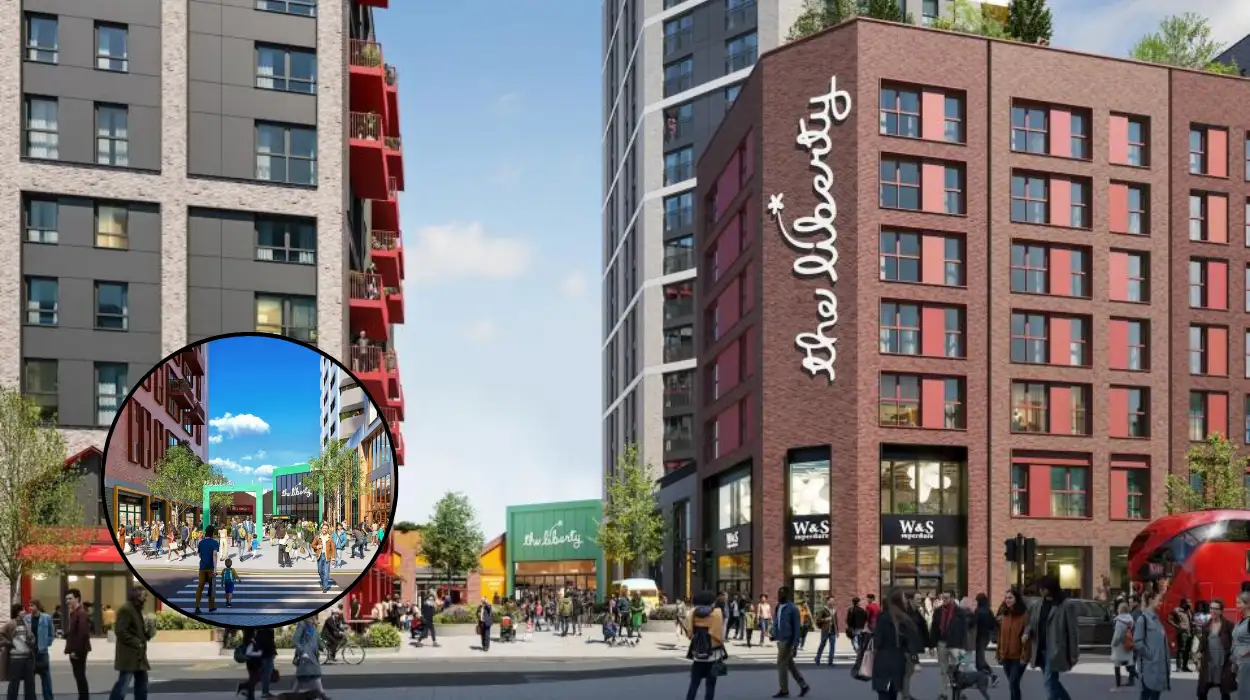
- Phase one focuses on the Western Road/South Street area and includes 380 new homes, new retail and leisure units, and a major new public square.
- Subsequent phases, to be detailed later, will address the remaining parts of the shopping centre.
- Stephen Daniels, Head of Asset Management and Regeneration at Redical, termed the application “a major milestone” for the project.
- The development aims to blend new residential space with retail, food, and community areas.
- Local stakeholders and the council are expected to review the proposal in early 2026.
- Community engagement sessions preceded the submission, with Redical and HUB pledging continued consultation throughout the planning process.
What does the redevelopment plan include?
According to documentation submitted to Havering Council and shared on Redical’s website, the developers intend to deliver the transformation over several phases. The initial phase targets the Western Road and South Street frontage — a central urban zone that connects the shopping centre to much of Romford’s civic and transport network.
- Key Points
- What does the redevelopment plan include?
- Why is this project significant for Romford?
- How will the transformation take shape?
- What has the developer said about community impact?
- How are local authorities responding?
- How does this align with regional development goals?
- What happens next?
- What concerns or challenges have been raised?
- Could this reshape Romford’s identity?
As reported by Romford Recorder journalist Emma Palmer, the proposal outlines 380 new homes, a mix of shops, restaurants, and cafés, and a new public square designed as a pedestrian-friendly hub. The new space is expected to act as both a social and commercial magnet, attracting residents and visitors back into the heart of Romford.
In documents seen by BBC London, Redical emphasised that the intention is not simply to modernise existing retail space but to reinvigorate the wider town centre, integrating commerce, housing, and community functions in a cohesive plan.
Why is this project significant for Romford?
As outlined by Stephen Daniels, Redical’s Head of Asset Management and Regeneration, this application represents “a major milestone” in Redical’s long-term investment programme for The Liberty. In a statement quoted by The Havering Daily, Mr Daniels said:
“Building on our investment to date, it will bring exciting new elements to the centre to deliver a lasting legacy for Romford town centre.”
The Liberty redevelopment is one of the largest urban renewal projects ever proposed for Romford, a major metropolitan centre within the London Borough of Havering. The shopping centre, originally opened in 1968, has faced increasing pressure from changing retail trends, online shopping, and post-pandemic shifts in footfall.
As reported by Ben Lynch of Local Democracy Reporting Service (LDRS), the borough council’s regeneration framework identifies The Liberty as a “key opportunity site” for new homes and modern retail environments.
An economic assessment submitted with the planning application projects that hundreds of jobs could be created in construction, retail, and hospitality during the project’s first phase.
How will the transformation take shape?
The outline provided in the planning documents suggests a phased approach.
- Phase one: Western Road/South Street area – 380 residential units, ground-floor retail and food spaces, and a new civic square.
- Future phases: Redevelopment of other parts of The Liberty, though these are not part of the current submission.
As reported by Lucy Norris for Essex Live, each phase will be subject to its own detailed planning submission to allow for “responsive collaboration with both council and community stakeholders.”
Redical and HUB have described the architectural vision as “human‑centred,” with new open spaces and pedestrian links designed to improve connectivity with the existing market area and transport interchange.
What has the developer said about community impact?
In comments quoted by Construction News, a HUB spokesperson said the development would “breathe new life into Romford’s retail and social landscape while delivering much-needed housing supply.” The company added that it would continue to engage with residents through drop-in events and public consultations throughout 2026.
Stephen Daniels echoed that message, noting that Redical’s aim is to create “a place that people live in, shop in, and identify with – not just a commercial complex.”
Recent engagement sessions, reported by Romford Recorder, included displays of preliminary design models, where residents provided input on open space design, building heights, and traffic flow. Feedback, according to Redical, has been incorporated into the revised submission.
How are local authorities responding?
A spokesperson for Havering Council, quoted by BBC London News, confirmed receipt of the planning documents earlier this month and indicated that the application “will now proceed through the statutory review process, including public consultation.”
The council is expected to deliberate on the proposal in mid‑2026, with a decision possibly due before the end of the year. Should approval be granted, construction could begin in 2027.
Councillor Gillian Ford, speaking to Local Democracy Reporting Service, described the scheme as “an ambitious opportunity to reimagine one of Romford’s most important town centre assets.” However, she emphasised that the council would scrutinise all “community, infrastructure, and environmental impacts” before making a decision.
How does this align with regional development goals?
The Liberty scheme aligns with Havering’s Local Plan, which prioritises urban densification and the creation of housing-led regeneration zones.
According to Inside Housing, the borough has a target to deliver more than 17,000 new homes by 2031 — a goal complicated by space constraints and heritage concerns in some districts. Redical’s proposal, integrating nearly 400 homes in its first phase alone, contributes significantly toward that target.
Urban regeneration expert Professor Mark Tewdwr-Jones of University College London told The Guardian that projects like this, “if carefully managed, can redefine suburban town centres as vibrant mixed-use communities,” contrasting with the “single-purpose shopping zones” typical of mid‑20th‑century design.
What happens next?
The application will now undergo the statutory planning process, including environmental assessments, traffic modelling, and feedback periods for residents and businesses.
If approved, Redical and HUB anticipate a development timeline extending over several years. Construction on the initial phase could begin by late 2027, with completion expected in the early 2030s.
In a joint statement released to Property Week, the two companies reaffirmed their long-term commitment, stating:
“The Liberty’s transformation is not just about physical regeneration — it’s a vision to ensure Romford continues to thrive as a regional destination for living, working, and leisure.”
What concerns or challenges have been raised?
Local residents have expressed mixed reactions. As Romford Recorder reported, some community members welcomed the promise of “modern spaces and much-needed housing,” while others voiced concern over increased density, traffic, and potential loss of heritage character.
The local traders’ association, quoted by Havering Daily, warned that redevelopment must be managed carefully to prevent disruption to small businesses currently operating in The Liberty.
Environmental campaigners, referencing London Evening Standard coverage, also urged the council to ensure sufficient green infrastructure and low-carbon design standards.
Could this reshape Romford’s identity?
If approved, the Liberty redevelopment would arguably mark the most significant physical transformation of Romford’s town centre in over half a century.
Analysts cited by Property Week argue that mixed-use schemes like this are critical for reviving suburban retail hubs across Greater London, many of which have suffered from declining footfall and changing shopper behaviour.
In the words of Stephen Daniels, as reported by Romford Recorder, the effort is part of a wider mission to “adapt Romford for the next generation while staying true to its civic heart.”