Key Points
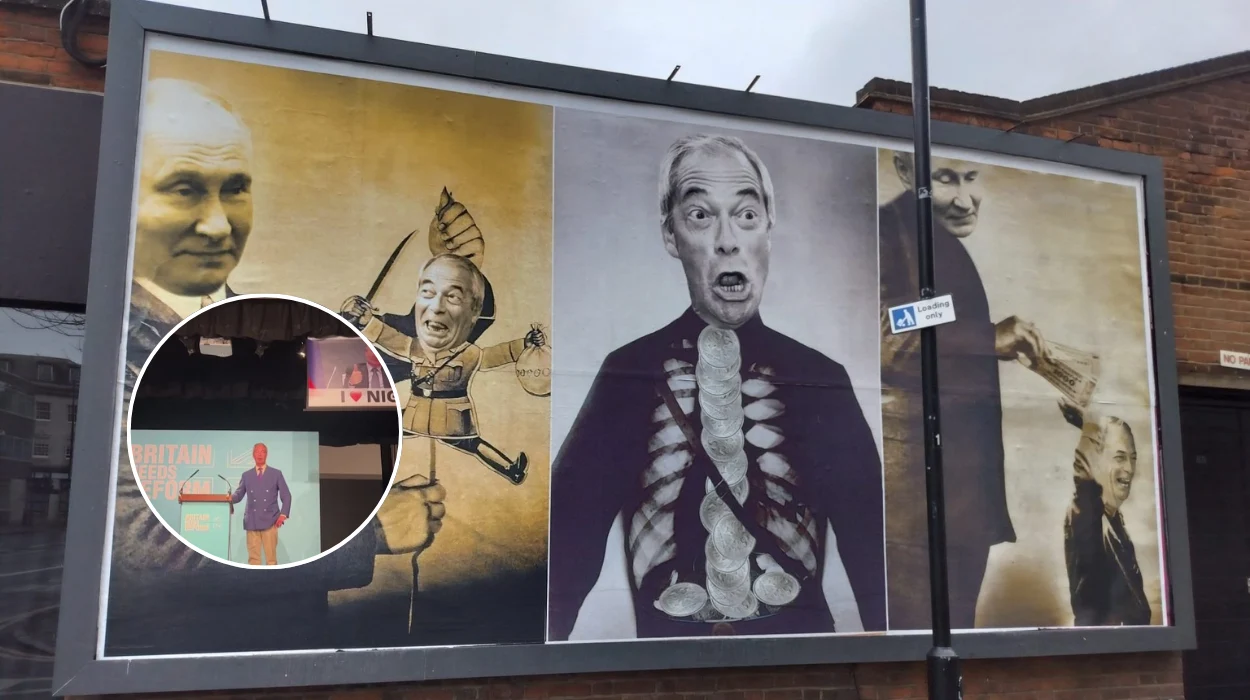
- A billboard depicting Nigel Farage as a puppet of Vladimir Putin and receiving money from him appeared in Hackney, East London, over the weekend.
- The poster shows Farage as a puppet, then as an x-ray revealing coins instead of a spine, and finally receiving a backhander from Putin.
- The identity of the billboard’s creator remains unknown, and there is no suggestion that Farage or his party has received support from Putin.
- The billboard follows the jailing of Nathan Gill, a former Reform UK Wales leader, for accepting bribes from Russia.
- Labour Party has previously unveiled similar billboards accusing Farage of “fighting for Putin”.
- Activist group Led by Donkeys has targeted Farage with similar stunts in the past, including unfurling a Putin banner at his rally.
- Farage has faced criticism for his past remarks on Putin, including stating in 2014 that Putin was the world leader he most admired.
- Labour and other parties have warned of the risks of Farage’s views on Putin and the potential national security implications.
- Internal polling suggests a significant portion of voters view Farage’s affinity for Putin as a threat to national security.
Mystery Over Billboard Creator
Who is responsible for the provocative billboard ad in Hackney showing Nigel Farage as a puppet of Vladimir Putin? As reported by The New World, the poster was installed over the weekend and features three striking images: Farage as Putin’s puppet, an x-ray revealing coins instead of a spine, and Farage receiving a backhander from the Russian president. Despite widespread speculation, the creator remains unidentified, and there is no evidence linking Farage or his party to Russian financial support.
Farage’s Past Statements on Putin
Farage has previously faced backlash for his comments about Putin. As noted by The Independent, Farage admitted in 2014 that Putin was the world leader he most admired, although he clarified he did not approve of him politically or as a person. These remarks resurfaced amid ongoing tensions over the Ukraine conflict, with Farage suggesting the West provoked Russia’s invasion, a view condemned by Boris Johnson and other political figures as “morally repugnant”.
Nathan Gill’s Bribery Case
The billboard’s timing follows the jailing of Nathan Gill, Farage’s former colleague and Reform UK Wales leader, for accepting bribes from Russia in exchange for pro-Russian speeches. Farage has denied knowing Gill, but the case has intensified scrutiny over Reform UK’s links to Russia.
Labour’s Campaign Against Farage
Labour has previously run billboard campaigns accusing Farage of “fighting for Putin,” particularly during by-elections. According to Labour sources, internal polling shows 57% of voters believe Farage’s views on Putin pose a national security risk, and the party plans to intensify attacks on this issue. Labour spokespersons have claimed that Farage’s admiration for Putin and the party’s energy policies could benefit Russia’s oil and gas interests, endangering British jobs and energy security.
Led by Donkeys’ Activism
The activist group Led by Donkeys has a history of targeting Farage with stunts. As reported by Reuters and The Independent, the group unfurled a banner featuring Putin behind Farage at a recent rally, with the words “I (heart emoji) Nigel”. Led by Donkeys claimed responsibility for the banner, stating,
“We just dropped in on Farage’s election rally with a beaming picture of Putin. Nigel was not pleased.”.
Farage responded by jokingly calling for staff to be sacked over the incident, but tensions remained high amid criticism from across the political spectrum.
Allegations of Russian Propaganda
There have been broader concerns about Russian influence in UK politics. As Byline Times reported, Farage’s largest donor, Christopher Harborne, is financially linked to Rumble, a video platform that has hosted Russian state media and Kremlin-backed influence operations. Harborne’s lawyers deny any support for Putin, but Labour and the Liberal Democrats have called for investigations into potential conflicts of interest.
Social Media and Disinformation
Investigations have also revealed networks of pro-Russian Facebook pages sharing content supporting Farage’s party, with disinformation experts suggesting these activities have the hallmarks of Russian influence operations. Farage has dismissed these claims as “cobblers,” but the controversy continues to fuel debate over the integrity of UK elections.
What’s Next for Farage and Reform UK?
With the billboard mystery unresolved and ongoing scrutiny over Farage’s views on Putin, the political landscape remains volatile. As reported by Labour sources, the party is preparing to further highlight the perceived risks of Farage’s stance, while Farage continues to defend his positions and distance himself from any direct links to Russia. The situation underscores the sensitivity of foreign influence in British politics and the role of media and activism in shaping public perception.