Key Points
- Tower Hamlets’ household recycling rate rose to 19.9% between July and September 2025, up 2.82 percentage points compared to the same period in 2024.
- Contamination levels in recycling bins fell to 23.36%, a 2.93 percentage point decrease from the previous quarter.
- The borough was previously the lowest performing local authority in England for recycling rates, according to government statistics.
- Tower Hamlets Council credits investment in facilities, community engagement, and pilot programmes for the improved results.
- Cllr Shafi Ahmed, Cabinet Member for Environment and the Climate Emergency, said that the results show “investment and engagement work is paying off.”
- The Council plans to reduce contamination to below 20%, expand successful pilots, and hold landlords accountable for waste management compliance.
- A boroughwide rollout of food waste collections is planned for April 2027.
- A dedicated communications and public education campaign has been launched to sustain and build upon the progress.
Why did Tower Hamlets struggle with recycling in the past?
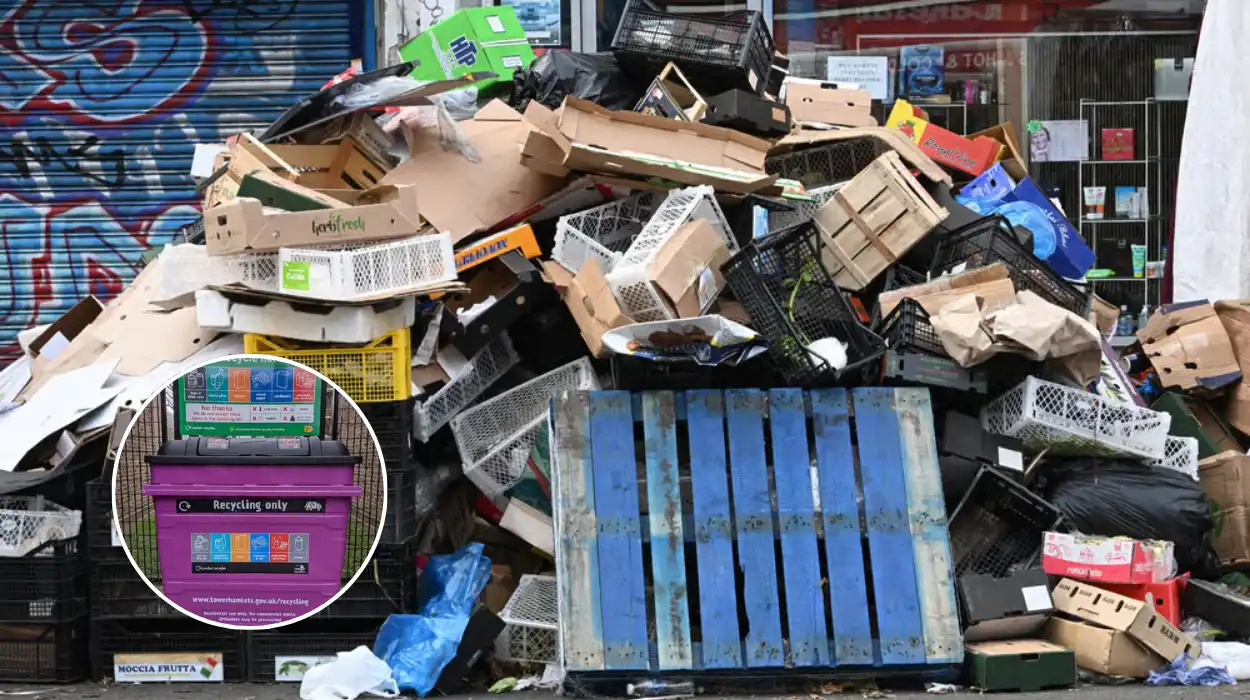
As reported by BBC London’s Local Democracy Reporting Service (LDRS) earlier this year, Tower Hamlets had long dealt with unique challenges linked to high-rise housing, transient populations, and limited space for recycling facilities. Many residents, particularly in privately rented and high-density blocks, lacked easy access to well-managed recycling areas.
- Key Points
- Why did Tower Hamlets struggle with recycling in the past?
- What measures led to the improved recycling rate?
- How is the Council addressing contamination in recycling?
- What future initiatives are planned to improve recycling further?
- How does Tower Hamlets plan to maintain momentum?
- How do Tower Hamlets’ recycling figures compare with other London boroughs?
- What does this improvement mean for residents?
A 2024 Evening Standard report by Noah Vickers highlighted that inconsistent bin labelling and contaminated recycling bins had also contributed to the borough’s poor performance. Items such as food waste, plastic films, and nappies were commonly found in recycling containers, rendering otherwise recyclable materials unsuitable for processing.
The Council’s response included stricter collaboration with housing associations and landlords, improved monitoring, and public information drives focusing on “right bin” behaviour.
What measures led to the improved recycling rate?
As confirmed in the Council’s official Q2 2025/26 Environment Performance Report, several key measures were implemented earlier in the year:
- Expansion of pilot recycling projects across housing estates in Mile End, Bow, and Poplar.
- Investment in upgraded recycling facilities, including secure communal bins and clearer signage.
- Community engagement campaigns, featuring local recycling champions and school outreach sessions.
- Deployment of a new mobile reporting tool that allows residents to flag overflowing or contaminated recycling sites directly to the Council’s waste team.
Speaking to the East London Advertiser, Cllr Shafi Ahmed, Cabinet Member for Environment and the Climate Emergency, said:
“These results are encouraging and show that our investment and engagement work is paying off. We’ve seen positive movement across the board, from cleaner, better-managed recycling facilities to enthusiastic participation by residents. But we know there’s still much more work to be done.”
How is the Council addressing contamination in recycling?
Contamination levels—when residents place non-recyclable items in recycling bins—remain a significant challenge. However, the latest quarter saw a decline to 23.36%, a 2.93 percentage point drop from the first quarter of the 2025/26 financial year.
As reported by Yasmin Rufo of MyLondon News in a related update, Tower Hamlets’ environmental officers identified the most common contaminants as takeaway packaging, textiles, and black plastic food trays. The Council is now deploying additional recycling liaison officers in high-density estates to support awareness around correct sorting habits.
Cllr Ahmed told the East London Advertiser:
“Our next phase of work will tackle key challenges, including reducing contamination rates to below 20%, scaling up successful pilot projects across the borough, and holding all landlords accountable for maintaining proper waste and recycling arrangements.”
What future initiatives are planned to improve recycling further?
The Council has confirmed plans to roll out food waste collections to all households by April 2027, aligning with the government’s national food waste collection strategy. This programme, referenced in the DEFRA Waste and Resources Strategy update (November 2025), aims to divert a substantial portion of biodegradable waste from landfill.
According to a Council press release cited by the Tower Hamlets Reporter, the borough is currently conducting procurement for specialist collection vehicles and bins to support the rollout. Pilot food waste schemes already operating in Bethnal Green and Shadwell have shown strong resident participation.
As The Guardian’s environment correspondent Helena Horton noted in a broader national report in October, local food waste initiatives can raise overall recycling rates by as much as 6–8 percentage points once fully established.
How does Tower Hamlets plan to maintain momentum?
To sustain and build upon this quarter’s success, the Council has launched a new communications campaign across social media, local radio, and community venues. According to Tower Hamlets’ Head of Communications, David Clegg, the campaign will focus on “reinforcing small, everyday recycling habits that add up to boroughwide results.”
A major component of the programme includes multilingual information materials distributed in partnership with community centres and housing associations. This outreach recognises the borough’s diverse population and aims to close knowledge gaps that have historically hindered participation.
The Council also intends to publish quarterly performance updates, ensuring transparency in its progress towards the London Environment Strategy targets set by the Mayor of London. These updates will be presented to the Environment and Climate Emergency Scrutiny Committee and made public on the Council’s website.
How do Tower Hamlets’ recycling figures compare with other London boroughs?
Although Tower Hamlets’ rate of 19.9% remains below the London average of 33.4% (according to the latest London Councils Waste Dataflow statistics), the improvement is significant given its starting point. Similar inner-London boroughs such as Westminster (with 24.1%) and Hackney (25.3%) have comparable challenges linked to urban density and mixed housing.
According to Dr Rachel Norton, policy lead at the Chartered Institute of Waste Management (CIWM), the borough’s recent progress “marks a turning point” in demonstrating that tailored community engagement can reverse entrenched low performance. Speaking to BBC London, she said that
“Tower Hamlets’ success shows what can be achieved when local authorities invest in both infrastructure and public trust.”
What does this improvement mean for residents?
Residents already report cleaner communal waste areas and improved access to recycling points. Local community organisations such as Friends of Tower Hamlets Environment have praised the Council’s partnership approach. In comments shared via East London Lines, the group’s spokesperson, Aisha Khan, said:
“For the first time, residents feel like recycling is convenient and worthwhile. The presence of dedicated recycling ambassadors in estates has made a big difference.”
However, campaigners also stress that long-term success depends on continued investment and consistent enforcement among landlords and private waste contractors.
Tower Hamlets Council has stated that the borough’s progress this year represents only the first step towards a sustainable waste management future. The authority remains under pressure to meet its medium-term goal of 25% recycling by 2027, which would bring it in line with the capital’s overall performance.
In the words of Cllr Shafi Ahmed, as quoted by the East London Advertiser:
“We’re proud of what’s been achieved so far, but we’re not complacent. The real success will be when recycling becomes second nature to everyone in Tower Hamlets.”