Key Points
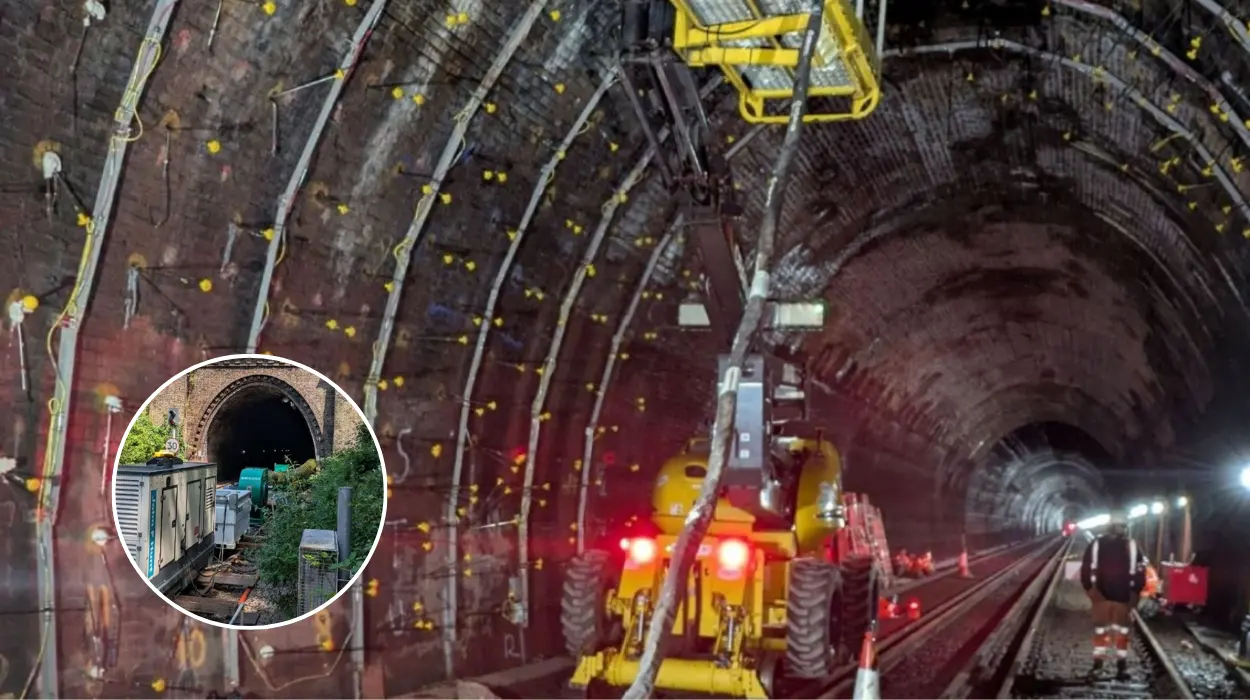
- Finland-based Geobear completed a £10 million stabilisation and water-sealing project on the historic Blackheath Tunnel in south-east London.
- The North Kent line tunnel, which dates back to 1849, experienced severe water ingress and degradation over decades.
- The project required a ten-week closure between May and July 2025, managed by main contractor VolkerFitzpatrick.
- Engineers drilled over 1,000 core holes and injected 55 tonnes of geopolymer foam via 13 km of pipework.
- Geobear’s geopolymer technology, five times lighter than cement-based materials, was used to seal, stabilise, and strengthen the tunnel lining.
- The project aims to end recurring delays caused by flooding and corrosion on the railway line.
- The Blackheath Tunnel is a vital link connecting the Bexleyheath and North Kent lines, serving thousands of passengers daily.
- Geobear claims the method saved time, reduced environmental impact, and extended tunnel life by several decades.
- Southeastern Rail confirmed a smoother service post-reopening in July 2025.
Why was the Blackheath Tunnel stabilisation project needed?
According to RailAdvent’s report on 21 May 2025, the Blackheath Tunnel was closed for a ten-week period starting that month to address long-standing structural problems. Originally opened in 1849, the mile-long tunnel had suffered from severe water ingress, which eroded fine sediments and compromised the brickwork lining.
- Key Points
- Why was the Blackheath Tunnel stabilisation project needed?
- How did Geobear’s geopolymer technology help solve the issue?
- What impact did the stabilisation project have on railway services?
- How does Geobear’s method compare to traditional repair systems?
- What does this project mean for the future of railway infrastructure?
- What’s next for the Blackheath Tunnel and its rail operators?
- How was the £10 million project funded and managed?
As Peter Hughes of New Civil Engineer reported in June 2025,
“Decades of water damage had deteriorated the structure, with water seeping through joints and pooling on the rail bed, corroding metal components and damaging the overhead line equipment.”
A spokesperson for Network Rail told Construction News that the problem was not only structural but also operational:
“Persistent leaks caused approximately one thousand minutes — that’s nearly seventeen hours — of delays for Southeastern passengers last year alone.”
Ongoing deterioration threatened both service reliability and passenger safety, prompting urgent intervention.
How did Geobear’s geopolymer technology help solve the issue?
As explained by Geobear UK Managing Director Alex Green in an interview with Rail Engineer (July 2025), the company employed its proprietary geopolymer injection process — a ground improvement technology that fills voids and stabilises soil without adding water.
Green told Rail Engineer:
“Unlike cement grouting, geopolymer expands chemically to seal cracks and displace water. Because it’s five times lighter than traditional methods, we can achieve the same level of stabilisation in half the time.”
Preparation work was extensive. Engineers drilled 1,000 core holes along 900 metres of the tunnel lining, before installing over 4,000 injection tubes — approximately 13 kilometres of pipework — as confirmed by Rail Business Daily (28 July 2025). In just five weeks, crews injected 55 tonnes of geopolymer foam, carefully designed to react and harden within minutes of application.
According to Geobear’s official press release (29 July 2025), the material’s rapid-setting properties allowed work to continue with minimal disruption, ensuring the tunnel reopened on schedule by late July.
What impact did the stabilisation project have on railway services?
After completion, Southeastern Rail reported a “marked reduction in delay incidents” on the reopened line. As RailAdvent confirmed on 30 July 2025,
“the project prevented further corrosion, eliminated major leakage points, and improved service reliability across the North Kent corridor.”
A Southeastern spokesperson said via BBC London News (1 August 2025):
“Passenger experience has already improved significantly since reopening. Water ingress problems that used to impact signalling have been resolved.”
VolkerFitzpatrick’s Project Director, Fiona Clark, emphasised environmental benefits as well:
“This project demonstrates how innovative materials can strengthen Victorian infrastructure sustainably. The lightweight nature of geopolymer reduced material use, cut carbon, and avoided adding unnecessary weight to the tunnel crown.”.
How does Geobear’s method compare to traditional repair systems?
Traditional cementitious grouting methods depend heavily on added water and long curing times, making them less environmentally efficient and slower to deploy. In contrast, Geobear’s process, often described as a “chemical alternative to concrete,” needs no water during installation.
As Civil Engineering Today noted (August 2025),
“Geopolymer injection achieves similar compressive strength to concrete but emits up to 70% less CO₂.”
The report also pointed out that, because geopolymer expands on contact with voids, it effectively pushes out trapped moisture, thereby sealing the lining from further ingress.
According to Dr Sanna Mäkelä, Geobear’s Head of R&D,
“Each injection expands up to 30 times its liquid volume, creating a dense waterproof barrier behind the bricks. The end result is a dry, structurally sound tunnel lining capable of withstanding hydrostatic pressure for decades.”
What does this project mean for the future of railway infrastructure?
Experts suggest this trial could set a precedent for other Victorian-era tunnels across the UK. Infrastructure Journal Europe (August 2025) reported that Network Rail is considering geopolymer stabilisation for additional tunnels in Kent and Surrey.
Network Rail’s Southern Region Engineering Manager, Matthew Partridge, said in a statement quoted by Rail Technology Magazine (2 August 2025):
“The Blackheath Tunnel project has proven geopolymer solutions can deliver structural integrity, operational efficiency, and sustainability in one package. We’re exploring future applications on similar assets.”
The technology’s speed and reduced manpower requirements also mean cost savings in long-term maintenance cycles. As New Civil Engineer summarised,
“Geobear’s technique could revolutionise asset management for water-affected tunnels, offering a viable alternative to century-old repair methods.”
What’s next for the Blackheath Tunnel and its rail operators?
Post-repair inspections will continue over the next 18 months. According to RailAdvent’s follow-up coverage (October 2025), Network Rail engineers are now monitoring the tunnel’s moisture levels and structural stability through embedded sensors installed during the project.
Geobear’s Project Supervisor, Tom Wright, told Railway News UK:
“The injected material has performed exceptionally so far. Early data shows no recurrence of water seepage, confirming a successful outcome.”
Meanwhile, Southeastern’s operations team expressed optimism that the project would eliminate previous annual maintenance shutdowns.
“We expect passenger disruption to drop dramatically,”
Southeastern’s Head of Infrastructure, Linda Harris, said via BBC Radio London on 5 August 2025.
How was the £10 million project funded and managed?
The £10 million cost was shared between Network Rail and the Department for Transport under an emergency maintenance and resilience budget. VolkerFitzpatrick acted as the Tier 1 contractor, with Geobear serving as specialist subcontractor.
According to Construction News (May 2025), the project remained within budget and schedule, despite the tunnel’s logistical challenges. Much of the work occurred at night to meet Network Rail’s ten-week delivery requirement.
VolkerFitzpatrick’s Managing Director, Mark Ingram, highlighted the joint achievement:
“To stabilise a Victorian tunnel in less than three months without service overruns is no small feat. Collaboration was key, and Geobear’s innovative technology made all the difference.”