Key Points
- The Victoria and Albert Museum’s new branch, V&A East, will open to the public in April 2026 at Stratford’s East Bank.
- Designed by Irish architects O’Donnell + Tuomey, the building aims to represent East London’s unique identity and diverse cultural character.
- The East Bank complex originated from the “Olympicopolis” regeneration project, proposed in 2015 after the 2012 London Olympics.
- The museum joins a growing cultural district that includes Sadler’s Wells East, University College London (UCL) East, and the London College of Fashion’s Stratford Campus.
- Its companion site, the V&A East Storehouse, designed by Diller Scofidio + Renfro, opened in May 2025.
- The project is part of a wider plan to decentralise London’s cultural life from South Kensington to the east.
- V&A East will showcase new museum concepts encouraging public interaction and reinterpretation of collections.
- The £1 billion East Bank development is co-funded by the Mayor of London, the UK Government, and the London Legacy Development Corporation (LLDC).
What is the vision behind the V&A East Museum?
According to Kieran Long of Domus, the vision for V&A East is to “reimagine what a museum can be in the 21st century – not a temple for quiet contemplation, but a social, experimental space open to dialogue, diversity, and exchange.” Established under the leadership of Tristram Hunt, Director of the V&A, the museum seeks to highlight new perspectives within design, culture, and identity.
- Key Points
- What is the vision behind the V&A East Museum?
- How did Olympicopolis evolve into East Bank?
- What role does O’Donnell + Tuomey play in shaping the project?
- How does the V&A East connect with its companion building, the Storehouse?
- How will V&A East impact East London’s identity and regeneration?
- What exhibitions and experiences will define its opening year?
- How does the project fit London’s wider urban future?
Hunt explained to The Guardian art correspondent Charlotte Higgins that V&A East
“will not replicate South Kensington; it will be an entirely different experience – more porous, more democratic, and more engaged with how things are made, used, and remade.”
The museum’s programming will focus on co-curation, inviting East London creatives and communities to shape exhibitions that reflect their heritage and voices.
“We are building a museum with East London, not just in East London,”
Hunt said in an interview with BBC Culture.
How did Olympicopolis evolve into East Bank?
The V&A East Museum forms part of a broader cultural regeneration project that has transformed Stratford since the 2012 Olympic Games.
As detailed by Oliver Wainwright in The Guardian, the name “Olympicopolis” was initially coined as a nod to “Albertopolis” — the 19th-century cluster of national museums and institutions in South Kensington named after Prince Albert’s vision for a cultural district. Launched in 2015, the Olympicopolis project aimed to replicate that success in London’s East End.
The concept eventually evolved into “East Bank,” officially adopted by the London Legacy Development Corporation (LLDC). This rebranding reflected a commitment to inclusivity, accessibility, and community-driven development rather than top-down planning.
According to BBC News London (October 2025), East Bank represents one of the UK’s largest cultural investments in a generation. Partners include the BBC, Sadler’s Wells, UCL, and the London College of Fashion (UAL). The partnership is expected to contribute an estimated £1.5 billion to the economy and create 2,500 jobs.
What role does O’Donnell + Tuomey play in shaping the project?
Irish architecture duo Sheila O’Donnell and John Tuomey, founders of O’Donnell + Tuomey, were appointed through an international competition held in 2015.
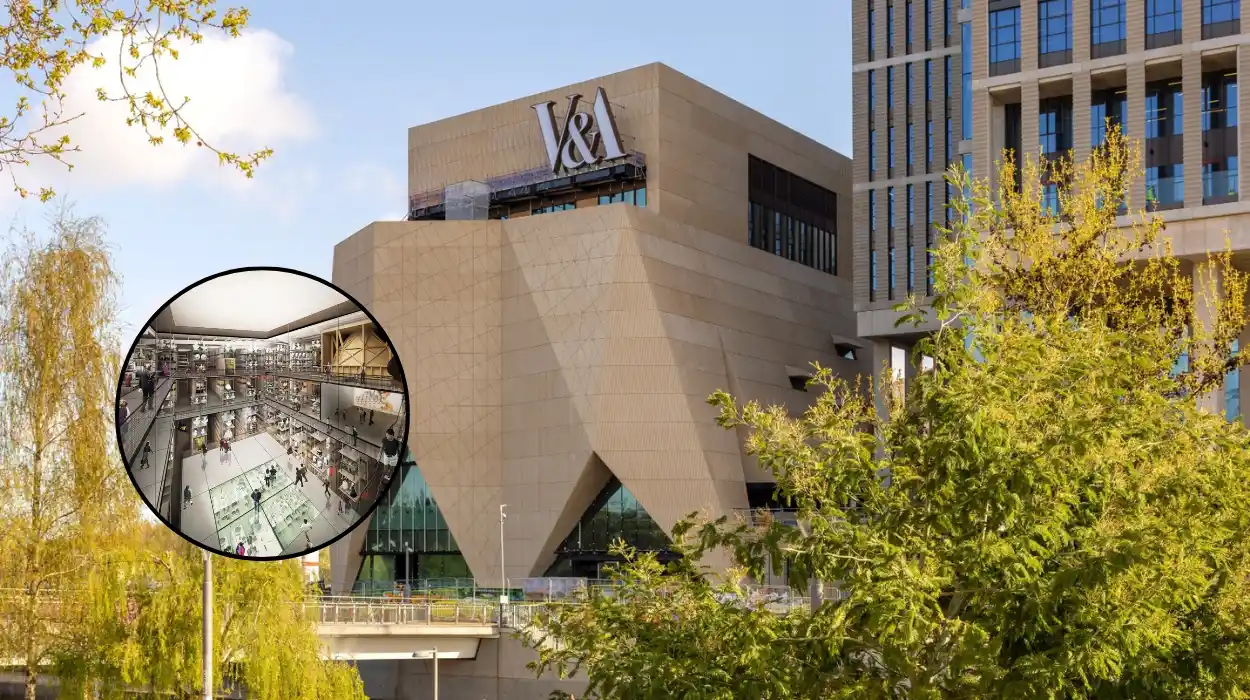
As reported by Domus (December 2025), their winning proposal impressed judges from the V&A and LLDC for its sensitivity to Stratford’s evolving urban landscape and its sculptural, geometric aesthetic. The building’s angular form, clad in red terracotta tiles, references both the earthiness of East London’s industrial past and the vibrancy of its contemporary streetscape.
Speaking to The Architects’ Journal, Sheila O’Donnell said:
“Our aim was to create a permeable space – a place that feels open, not monumental. We imagined a museum where the boundary between inside and outside blurs.”
John Tuomey added, in conversation with Dezeen, that
“the design responds to the horizontality of the Olympic Park and the vertical density of the city beyond. It’s a building that feels both civic and neighbourly.”
The museum’s five-storey interior will host a large atrium, flexible exhibition areas, a café, a learning lab, and collaborative spaces. Its open-plan layout encourages exploration and dialogue between artists, curators, and visitors.
How does the V&A East connect with its companion building, the Storehouse?
Located nearby, the V&A East Storehouse officially opened on 31 May 2025. Designed by New York firm Diller Scofidio + Renfro, it acts as a hybrid between a museum and a working archive.
As reported by Anna Winston in Wallpaper, the Storehouse houses over 250,000 objects and 350,000 books from the V&A’s main collection, many of which were previously in long-term storage. Visitors can “go behind the scenes” to see how conservation and curation work in practice.
According to Nina Power of The Art Newspaper, the Storehouse offers a transparent, interactive model that complements the forthcoming museum by demystifying the processes of collecting and preserving art.
Tristram Hunt described both sites as “twin engines of creativity” – with the Storehouse focusing on access and research, and the Museum serving as a platform for storytelling and experimentation.
How will V&A East impact East London’s identity and regeneration?
The opening of the V&A East Museum represents more than an architectural milestone; it symbolises East London’s cultural reawakening.
As Ellie Stathaki wrote for Wallpaper (September 2025), Stratford’s transition from post-industrial wastelands to a thriving cultural quarter “illustrates how architecture can drive social optimism.” The district’s transformation has redefined perceptions of East London, historically marked by economic hardship and underinvestment.
Director of the LLDC, Rosanna Lawes, told BBC News:
“East Bank was never about monumental buildings alone. It’s about building opportunity — skills, education, and creativity for local communities.”
Critics, however, have noted concerns about gentrification. Urban planner Professor Penny Bernstock of the University of East London warned in The Guardian that
“while cultural investment brings vitality, it must not displace the very communities it seeks to engage.”
The LLDC and V&A have insisted local consultation has been central to the project from inception.
What exhibitions and experiences will define its opening year?
V&A East’s inaugural exhibition, announced by Domus in December 2025, will be titled “Making East London”, exploring the area’s cultural evolution through design, music, fashion, and digital creativity. The showcase will feature artists including Yinka Ilori, Lubaina Himid, and Grayson Perry, alongside newly commissioned works inspired by Stratford’s historical narratives.
The museum also plans to collaborate with youth-led creative collectives, offering residencies, workshops, and maker labs. Tristram Hunt told Time Out London that
“our ambition is to make V&A East a home for experimentation — a place where young people feel they own the space, not just visit it.”
Educational programmes will run in partnership with UCL East and local schools in Newham and Tower Hamlets, linking design thinking with social innovation.
How does the project fit London’s wider urban future?
The emergence of V&A East confirms a wider dispersal of London’s cultural capital. As Oliver Wainwright wrote in The Guardian,
“The East-West axis of London’s cultural geography has finally realigned”
a strategic response to overcrowding and rising costs in central districts.
O’Donnell + Tuomey’s museum, in this sense, is both a product and a catalyst of London’s 21st-century urban policy: decentralisation through creativity. The architects describe it as
“a building that reflects how cities now grow — not by walls or gates, but by networks of participation.”
As London’s Mayor Sadiq Khan concluded during a 2025 site visit, reported by BBC London:
“East Bank is a project for young Londoners, for culture without postcode privilege. The V&A East is its beating heart.”