Key Points
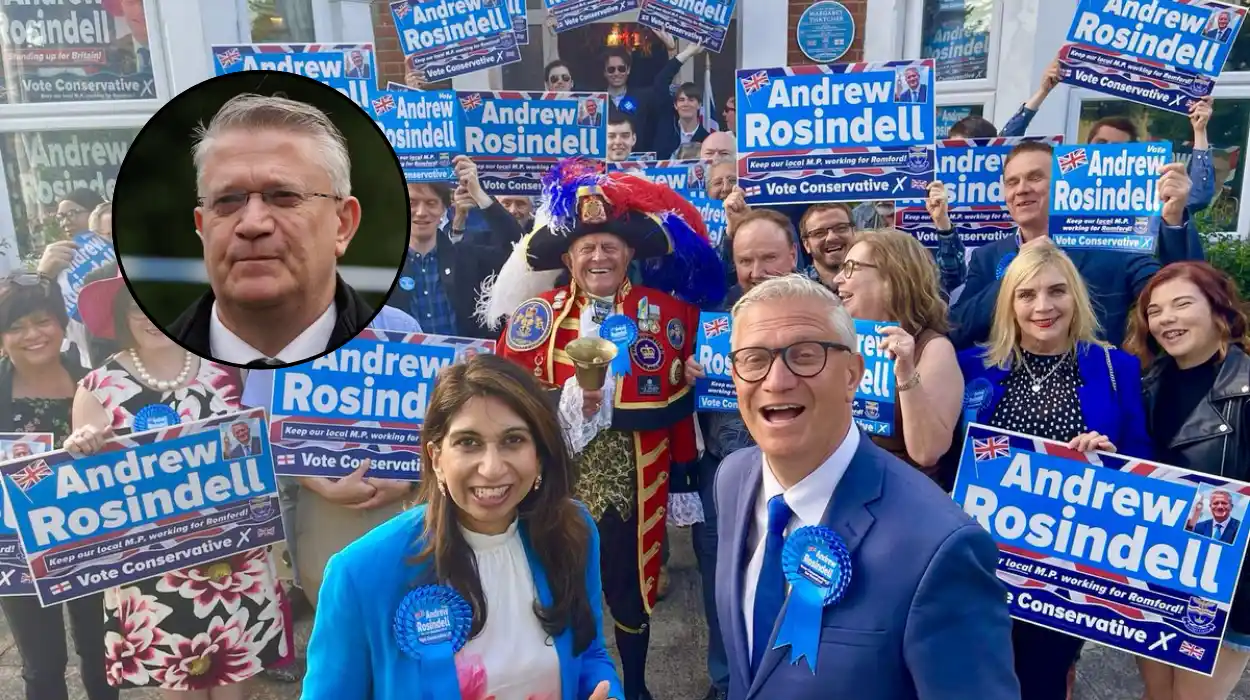
- Conservative MP Andrew Rosindell warns that Reform UK could take his seat of Romford at the next general election.
- Rosindell told GB News that “the whole of Essex could go to Reform” in 2029.
- He said he “has no problem” serving alongside Nigel Farage in a Conservative–Reform coalition government.
- Rosindell accused Labour under Prime Minister Sir Keir Starmer of leading the country to “ruin.”
- Reform UK leader Nigel Farage has previously said his party is targeting traditional Tory heartlands in the South-East.
- Political analysts suggest Reform’s rising support poses an existential threat to the Conservatives’ post-Brexit voter base.
- Recent polling shows Reform ahead of the Conservatives among working-class voters in several regions.
- Rosindell’s comments come amid growing Conservative unrest over immigration policy and party unity.
Why did Andrew Rosindell say Reform could win Romford?
As reported by Nicholas Cecil of the Evening Standard, Andrew Rosindell — who has represented Romford since 2001 — conceded that Reform UK now poses a credible challenge to the Conservative Party in one of its most reliable London constituencies.
- Key Points
- Why did Andrew Rosindell say Reform could win Romford?
- What did Rosindell say about a potential Conservative–Reform coalition?
- Why is Reform UK gaining traction in Essex and East London?
- What has been the reaction within the Conservative Party?
- How did Nigel Farage respond to Rosindell’s comments?
- What is the wider political implication of this statement?
- Could Reform really capture “the whole of Essex”?
- Could the Conservatives and Reform eventually merge?
- What happens next for Romford — and the Tories?
“My seat would almost certainly go to Reform if there were a general election today,”
he told GB News in a televised interview this week.
Rosindell explained that voter discontent with the pace of change under Prime Minister Sir Keir Starmer’s Labour government and what he called the “lack of Conservative conviction” on key issues such as immigration and sovereignty were fuelling Reform’s momentum.
“People are angry. They feel no one is standing up for Conservative values anymore,”
he said.
“They look at Nigel Farage, and they see someone who says what he thinks and doesn’t back down. Whether you agree or not, that authenticity resonates — especially here in Essex and East London,”
he added, as quoted by GB News political correspondent Tom Harwood.
What did Rosindell say about a potential Conservative–Reform coalition?
In the same interview, Rosindell suggested he would be “open to working” with Reform UK in a coalition government, should the two parties emerge as potential partners in a hung parliament. As reported by The Telegraph’s Political Editor Ben Riley-Smith, Rosindell stated plainly: “I have no problem with that.”
According to Sky News analysis, while Reform MPs have frequently denied being an offshoot of the Conservatives, both parties share overlapping agendas on national sovereignty, the European Court of Human Rights, and stricter border enforcement. Rosindell echoed that alignment, telling GB News that
“we’re already seeing the two movements coming together in values, if not in name.”
Nigel Farage, Reform UK’s leader, has previously hinted that some form of post-election collaboration with “old-school Conservatives” could be possible, remarking earlier this month that “the door is open for any MP who shares Reform’s principles.”
Political observers, including Professor Sir John Curtice of Strathclyde University, have noted that this ideological overlap could play a pivotal role in how the political right reorganises itself during and after the next election cycle.
Why is Reform UK gaining traction in Essex and East London?
As highlighted by John Stevens of The Daily Mail, Reform UK’s appeal across Essex and outer London boroughs like Havering — where Rosindell’s seat lies — has grown significantly over the past year. A combination of economic frustration, immigration concerns, and nostalgia for Brexit-era nationalism has shifted voter sentiment away from the mainstream Conservatives.
Recent polling by YouGov found that Reform UK now polls at around 23% nationally, edging ahead of the Conservatives among working-class voters. In the South-East region, the figure has reached as high as 28%, according to Savanta’s December survey, published in The Independent.
Local voters interviewed by BBC London’s Political Correspondent Tim Donovan expressed fatigue with the Conservative Party’s perceived lack of delivery, while associating Farage’s Reform UK with “plain speaking” and “patriotism.” One Romford resident, identified as Lisa Bryant, told the BBC:
“People here are fed up with politicians — Reform sounds like they’ve got the guts to shake things up.”
What has been the reaction within the Conservative Party?
Inside Westminster, Rosindell’s remarks have sparked discomfort among senior Conservatives, with some party strategists warning against “legitimising” Reform as a credible ally. As reported by Harry Cole of The Sun, one unnamed Cabinet source stated:
“It’s extraordinary for a sitting Tory MP to talk up a rival party like this. It sends all the wrong signals.”
However, others within the Conservative back benches privately sympathised with Rosindell’s concerns. According to The Times’ Deputy Political Editor Steven Swinford, one long-serving MP from Kent said:
“He’s only saying what everyone is thinking. We’ve lost touch with the people who used to vote Tory out of instinct.”
Rosindell has long positioned himself on the right wing of the party, known for his pro-Brexit stance, support for animal welfare causes, and advocacy for British cultural heritage. While not part of the official Conservative “Common Sense Group,” he has often championed similar populist causes.
How did Nigel Farage respond to Rosindell’s comments?
As reported by Politico Europe, Nigel Farage welcomed Rosindell’s “honest assessment,” saying it “reflects what millions now believe — that the Conservative brand has lost its soul.” In a statement to GB News, Farage added:
“When decent, patriotic MPs like Andrew start telling the truth, it shows we’re winning the argument.”
Farage further suggested that a Conservative–Reform realignment was “inevitable,” highlighting shared goals such as scrapping the European Convention on Human Rights and significantly reducing net migration. However, he did not explicitly endorse any formal pre-election arrangement.
What is the wider political implication of this statement?
Political analysts argue that Rosindell’s comments are emblematic of a deeper crisis facing the Conservative Party, with internal divisions widening as Reform UK continues to pull support from the right. Dr Catherine Haddon, a senior fellow at the Institute for Government, told The Guardian that
“Conservatives now face a dual squeeze — Labour consolidating the centre ground, and Reform eating into their base.”
A Redfield & Wilton Strategies poll cited by The Express earlier this month found that only 38% of 2019 Conservative voters still identify with the party, while 27% said they would consider voting Reform.
The erosion of loyalty among older, working-class, and small-town voters — once the bedrock of the Tory coalition — has prompted increasing talk of electoral catastrophe at the next general election.
Could Reform really capture “the whole of Essex”?
When pressed by GB News on how realistic his prediction was that Reform could dominate Essex by 2029, Rosindell stood firm:
“I see what’s happening on the ground. Essex people are proud, patriotic and practical — they want a government that listens to them. If our party doesn’t, Reform will.”
As noted by Essex Live political reporter Matt Lee, local Conservative branches across the county have reported declining membership and fundraising difficulties since Reform began contesting council seats. In the Basildon and Billericay area, Reform came second in multiple wards during this year’s local elections — a dramatic surge from their negligible support just two years ago.
While the next general election remains several years away, analysts warn that the Tories’ ability to retain “blue wall” seats across Essex, Kent, and East London may depend on whether they can reclaim the populist, pro-Brexit energy that initially propelled them to victory in 2019.
Could the Conservatives and Reform eventually merge?
Speculation about a future Conservative–Reform merger has swirled in Westminster circles. As reported by The Spectator’s Katy Balls, several backbench MPs have privately discussed “some form of electoral accommodation” with Farage’s party, should the Conservatives face wipeout in the next general election.
Rosindell declined to directly address that scenario but told GB News that uniting around shared “patriotic values” was more important than party branding. “Names and labels change,” he said.
“What matters is saving this country from socialist destruction.”
Yet as ITV News Political Correspondent Carl Dinnen reported, senior figures in Rishi Sunak’s government have consistently ruled out any pact with Reform UK, branding it “a protest movement, not a governing party.”
What happens next for Romford — and the Tories?
With boundary changes and political uncertainty ahead, Romford remains one of the many seats to watch in the next election. Rosindell’s admission underscores the precarious state of Conservative support in England’s outer boroughs.
As summarised by BBC Political Editor Chris Mason,
“When a long-standing Tory MP says he could lose his seat to a party founded only a few years ago, it sends shockwaves through his party’s ranks. It’s a symptom of deeper voter disillusionment.”
For now, Andrew Rosindell continues to sit as a Conservative MP — but his candid warning has opened a raw debate within his party about its future direction. Whether that path leads to rapprochement with Reform or a full-scale electoral showdown remains uncertain, but the political winds in Essex seem to be shifting dramatically.