Key Points:
- London’s streets are lined with seemingly ordinary objects—fences, bollards, and posts—that have extraordinary historical origins.
- Many garden fences in East London once served as World War II stretchers used during the Blitz to save the lives of bombing victims.
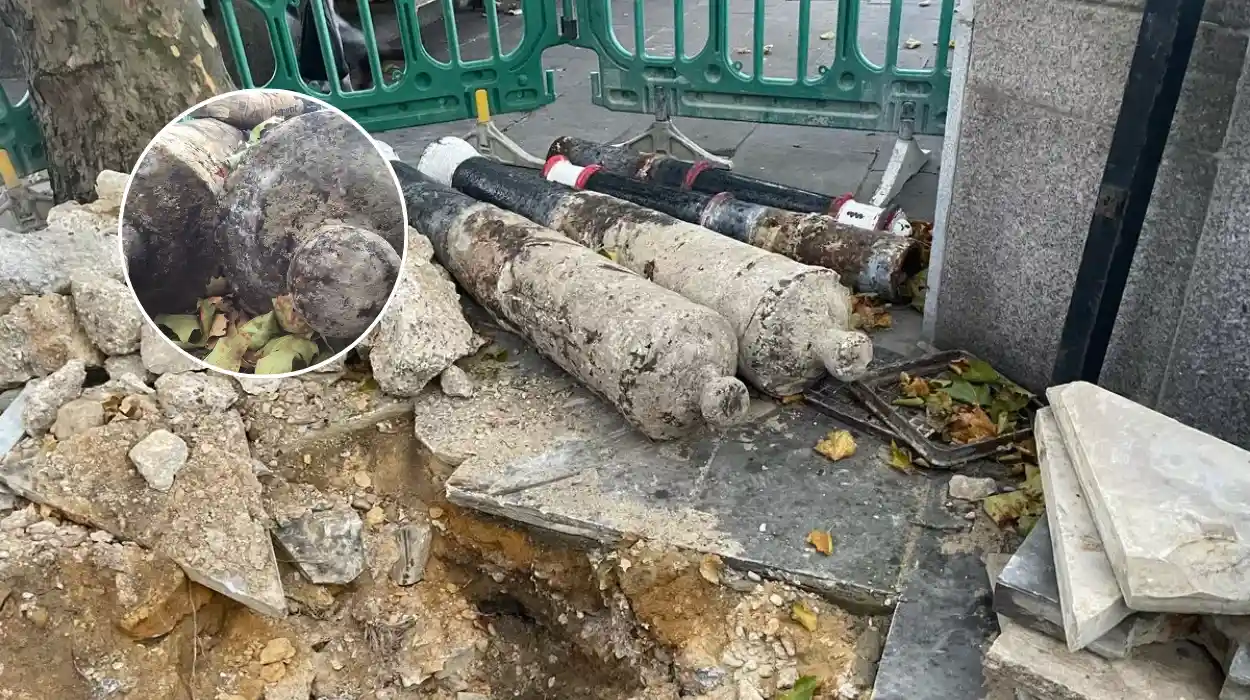
- Bollards across the capital were repurposed from military equipment, including cannons and decommissioned naval artefacts.
- Some street structures date back millions of years, while others were once owned by royalty or linked to major British conflicts.
- Local historians, including Alice Loxton, have warned that these relics risk being replaced and forgotten as modern infrastructure expands.
- London authorities and heritage councils are working to identify and preserve these unnoticed memorials of heroism.
- The ongoing rediscovery of these objects reflects a wider trend of urban archaeology and growing public interest in Britain’s tangible war heritage.
What are London’s “stretcher fences” and where did they come from?
As reported by James Reynolds of the Daily Mail, thousands of garden and estate fences in London’s East End — particularly across Tower Hamlets, Bethnal Green, and Poplar — have origins dating back to the Second World War.
- Key Points:
- What are London’s “stretcher fences” and where did they come from?
- How were wartime stretchers transformed into fences?
- Why are these fences disappearing today?
- What about those odd metal bollards used as ashtrays in Southwark and beyond?
- How old are London’s oldest street artefacts?
- Why do these relics matter for modern London?
- Is anything being done to preserve them?
- What can Londoners learn from these hidden pieces of history?
These fences, often grey or painted black, were originally steel stretchers used by Air Raid Precautions (ARP) wardens and medical staff during the Blitz (1940–1941) to carry the wounded from collapsed buildings and bomb sites to hospitals and shelters.
According to Alice Loxton, a historian and author specialising in British heritage, each fence is “a tangible reminder of Londoners’ courage during the war” but many “walk past them without realising their heroic past.”
Loxton noted in an interview with the BBC History Magazine that
“after the war ended, thousands of stretchers were left in government stores. In the postwar rebuilding period, steel was scarce but demand for affordable fencing in local housing estates was high. Councils saw an opportunity to reuse them — and they remain among the best examples of postwar upcycling.”
How were wartime stretchers transformed into fences?
As described by Alison Flood of The Guardian, the process was straightforward yet ingenious. The stretchers, made from galvanised steel mesh, featured two tubular poles with round handles at either end.
When attached upright and joined side by side, they formed strong, durable railings that required minimal modification.
Reports from the Imperial War Museum (IWM) archive confirm that over half a million stretchers were produced for London’s civil defence during the height of the Blitz. Each was built to support up to 200 kilograms and withstand bombsite debris — making them virtually indestructible as household structures.
Local councils, most notably the London County Council (LCC), began converting them into railings from 1945 to 1950, utilising them in council estates, schools, and parks to save on steel procurement during reconstruction.
Why are these fences disappearing today?
Despite their heritage importance, many of the original stretcher fences have been lost. The Evening Standard reported in September 2024 that various boroughs have replaced them with modern fencing as they deteriorate from decades of weather exposure.
Conservationist Dr. David Lawrence told The Telegraph that fewer than 20 per cent of the original structures remain.
“Because they appear modern and utilitarian, local authorities have often prioritised safety upgrades without realising what they’re removing,” Dr. Lawrence explained.
“In some cases, new housing redevelopments have led to their complete disappearance.”
The Heritage of London Trust has since launched projects to identify and tag such fences with plaques, in collaboration with local archives and community historians.
A statement from the Trust, cited by BBC London News, emphasised that “these fences are not just urban relics but symbols of solidarity that carried London through its most difficult chapter.”
What about those odd metal bollards used as ashtrays in Southwark and beyond?
According to Ross Lydall of the Evening Standard, the stout, iron bollards that line parts of Southwark Bridge, Whitehall, and Covent Garden have a much older origin — many were repurposed naval cannons from the Napoleonic Wars.
In post-war London, city planners used decommissioned ordnance as street barriers to prevent traffic encroaching onto pavements. Over time, as pollution and pedestrian habits changed, some of these converted cannons gained a new purpose: the tops were hollowed out for use as public ashtrays.
Heritage officers from the City of London Corporation confirm that some of these reused cannon bollards date as far back as the early 19th century, while others were recreated as replicas during Victorian times using melted-down originals.
“The practice of recycling war materials into civic architecture is quintessentially British,”
said Professor Richard Holmes, a late military historian cited in The Telegraph’s 2018 feature on “Hidden Monuments of Empire”.
“It reflects a society determined to build peace from the remnants of war.”
How old are London’s oldest street artefacts?
Some ordinary-looking street features date back far beyond modern times.
Geologist Dr. Martin Gray told National Geographic UK that several granite bollards and kerbstones used in Central London were formed from rocks aged over 20 million years, sourced from prehistoric quarries scattered across Scotland and Cornwall.
In Westminster and Hampton Court, visitors can even find drain covers and paving stones once installed under royal instruction, bearing insignia from the reigns of George III and Queen Victoria.
These were highlighted in a 2023 heritage survey by Historic England, which catalogued
“overlooked artefacts that connect everyday Londoners to royal and geological history alike.”
Why do these relics matter for modern London?
“These everyday objects form the fabric of our memory,”
said Alice Loxton in an interview with Heritage Daily.
“When we forget their origins, we lose a part of our collective story — how London rebuilt itself from ashes, quite literally.”
Urban archaeologist Tom Chivers, author of London Clay, wrote in the Financial Times that London’s streets are “a sedimentary record of human triumph and tragedy.” For him and others, acknowledging such features can nurture deeper civic pride while reminding Londoners that history is not confined to museums.
Is anything being done to preserve them?
The Museum of London and Historic England have begun cataloguing surviving stretcher fences and cannon bollards using advanced LiDAR scanning and 3D modelling technologies.
This project, partially funded by the National Lottery Heritage Fund, aims to create an accessible digital archive for schools and tourists.
A spokesperson for the Greater London Authority (GLA) told The Independent that future public works projects will attempt to “balance infrastructure safety with cultural preservation.” Some boroughs, including Hackney and Southwark, have already pledged to retain original sections of historic railing where safe to do so.
Meanwhile, community initiatives like Walking with History London Tours, founded by local researcher Patrick Wright, are gaining popularity for their focus on “objects hidden in plain sight”. Wright told Metro UK that
“every ordinary Londoner walks by the extraordinary every day. Knowing that a fence could once have carried a human being out of air-raid rubble gives a powerful sense of connection.”
What can Londoners learn from these hidden pieces of history?
London’s unnoticed relics — whether they began life as wartime stretchers, naval guns, or royal kerbstones — are silent storytellers of resilience, reinvention, and resourcefulness.
As highlighted by The Daily Mail’s feature, these elements continue to
“blend into the background yet stand as steel witnesses to the courage, suffering, and perseverance that shaped Britain’s modern era.”
The challenge now, heritage experts agree, is ensuring those witnesses are not erased in the name of modernisation.
“These aren’t just fences,” historian Alice Loxton concluded.
“They’re monuments of compassion forged from conflict — simple but profound reminders that even in ordinary places, extraordinary history lies all around us.”