Key Points
- A Metropolitan Police pursuit on 28 December along the A12, A406 and M11 in Redbridge ended with a police car heavily damaged.
- The chase followed concerns about a suspected dangerous driver, who was subsequently arrested on suspicion of multiple driving offences, including drink-driving.
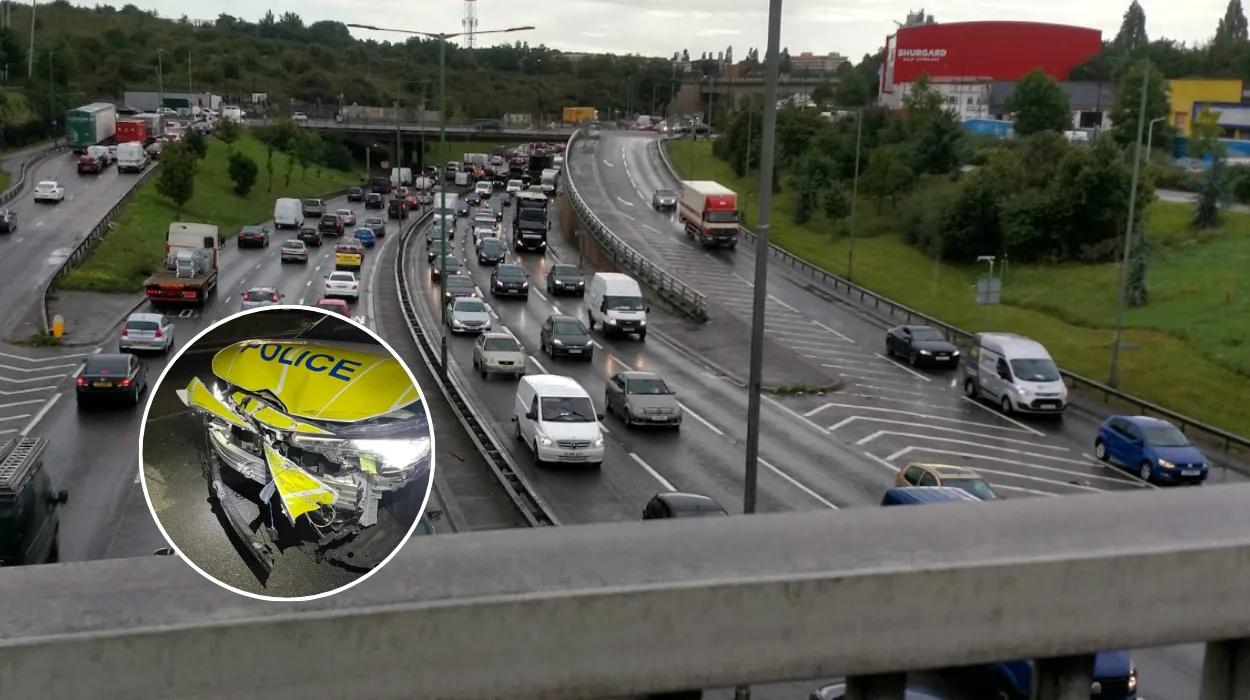
- A striking image, first published by London Now, shows the front of the police car badly damaged, with the bumper hanging off and the bonnet crumpled.
- The Met Police confirmed that no one suffered serious injuries in the collision, despite the severity of the impact and the car spinning into the central reservation.
- According to a Metropolitan Police spokesperson, officers’ “bravery” and “fantastic work” ensured the driver was brought to a stop and removed from the road.
- The incident took place on Sunday, 28 December, and involved a pursuit across major arterial routes in and around Redbridge, including the A12, A406 and M11.
- The vehicle being pursued reportedly collided with a police car during the final phase of the pursuit, causing it to spin into the central reservation.
- The Met has highlighted the incident as an example of the risks faced by officers when tackling suspected dangerous and drink-drivers on busy London roads.
- The image of the damaged police vehicle has prompted renewed discussion over road safety, police pursuit tactics, and the dangers posed by suspected intoxicated drivers.
- Enquiries into the full circumstances of the incident and the alleged offences remain ongoing, with the arrested driver expected to be interviewed further.
A heavily damaged Metropolitan Police car was left with its bumper hanging off and bonnet crumpled after a high-speed pursuit through Redbridge and surrounding routes on Sunday, 28 December, ended in a collision, with the driver arrested on suspicion of multiple driving offences including drink-driving, according to a report by London Now and a statement from the Met Police.
- Key Points
- What happened during the Redbridge police chase?
- How badly was the police car damaged?
- Were there any injuries in the Redbridge crash?
- Why did the Metropolitan Police praise their officers’ bravery?
- What offences is the driver suspected of committing?
- How did the pursuit unfold across the A12, A406 and M11?
- What does the shocking image from the scene show?
- What has the Metropolitan Police said about public safety and dangerous driving?
- What happens next in the investigation?
What happened during the Redbridge police chase?
As reported by the unnamed reporter of London Now, citing the Metropolitan Police, the incident unfolded on Sunday, 28 December, when officers began pursuing a car along several key routes in and around Redbridge. According to the Metropolitan Police statement quoted by London Now, “On Sunday, 28 December, officers’ pursuit a car on A12, A406 and M11.” These are some of the busiest arterial roads serving East and North-East London, linking Redbridge with the wider capital and motorway network.
The Met Police said that officers were engaged in an active pursuit after concerns were raised about the manner in which the vehicle was being driven. Although the exact starting point of the chase has not been disclosed, the routes named by the Met Police suggest that the pursuit crossed multiple junctions and interchanges, increasing the potential risk to other road users.
As reported by London Now, the force later confirmed that the pursuit came to a dramatic conclusion when the pursued vehicle “collided with a police car, causing it to spin into the central reservation”. This collision brought the chase to an end and allowed officers to detain the driver. The Met has not, at this stage, disclosed the speed of the vehicles at the time of the impact, nor has it detailed the precise location of the collision beyond naming the affected roads.
How badly was the police car damaged?
The severity of the collision is illustrated in a photograph carried by London Now, which shows the shocking aftermath of the crash. As reported by the London Now journalist, the image depicts a Metropolitan Police response vehicle with heavy front-end damage. The bumper is hanging off, and the bonnet has been visibly crumpled, indicating a significant frontal impact.
According to the account relayed by London Now, the crash damage appears to be consistent with a high-force impact, likely as the police car spun and struck the central reservation following contact with the suspect vehicle. Debris is visible around the front of the car in the photograph, underscoring the level of force involved in the collision.
The Metropolitan Police have not released a detailed engineering assessment of the damage, but based on the image described by London Now, the police car will almost certainly require extensive repairs, if not write-off, before it can be returned to operational duty. Police vehicles used in pursuits are typically reinforced and maintained to a high standard, which further underlines the seriousness of any collision that can cause such visible structural damage.
Were there any injuries in the Redbridge crash?
Despite the heavy damage to the police vehicle, the Metropolitan Police have confirmed that there were no serious injuries as a result of the crash. As reported by London Now, the force stated that “Nobody was seriously injured in the crash.” This brief but important clarification indicates that, while the incident was serious enough to cause major vehicle damage, it did not result in life-threatening or critical harm to officers, the driver, or members of the public.
At this stage, neither the Met Police statement, as quoted by London Now, nor any other publicly available report has detailed whether any minor injuries were treated at the scene or in hospital. It is common in such cases for officers or occupants to be checked over by paramedics as a precaution, but the Met’s focus on the absence of serious injuries suggests that the incident did not escalate into a major casualty event.
The confirmation that no one was seriously hurt is significant, given the risks associated with any collision involving vehicles travelling at speed on major A-roads and motorways. The police car’s spin into the central reservation, as described by the Met and relayed by London Now, could easily have resulted in a more serious outcome had traffic conditions or impact angles been different.
Why did the Metropolitan Police praise their officers’ bravery?
As reported by the London Now reporter, the Metropolitan Police spokesperson issued a strong statement praising the conduct of the officers involved in the pursuit. According to the Met’s statement,
“The bravery of our officers saw a dangerous motorist taken off our roads.”
By using such language, the force has framed the pursuit and its outcome as an example of officers putting themselves at risk to protect the public from a suspected dangerous driver.
The same spokesperson, as quoted by London Now, went on to say:
“Fantastic work by everyone involved ensured that the driver was stopped, unfortunately not before it collided with a police car, causing it to spin into the central reservation.”
This statement both acknowledges the successful conclusion of the pursuit and the unfortunate damage to the police vehicle that resulted.
The emphasis on “bravery” and “fantastic work” is consistent with the Metropolitan Police’s broader messaging around pursuits and frontline policing. Officers involved in such incidents must often make split-second decisions, balancing the need to stop a suspected offender against the risks of continuing a pursuit through busy urban routes. Here, the Met is clearly keen to highlight that, in its view, officers acted decisively to remove a “dangerous motorist” from the roads, even at personal and operational risk.
What offences is the driver suspected of committing?
Although the Metropolitan Police have not released the driver’s identity, they have confirmed, as reported by London Now, that the individual was arrested “on suspicion of various driving offences including drink driving.” This means the suspect faces at least one allegation relating to driving while under the influence of alcohol, and potentially several additional charges stemming from the pursuit and collision.
The phrase “various driving offences” typically encompasses a range of possible allegations in cases like this, including dangerous driving, failing to stop when required by police, and potentially driving without insurance or while disqualified, depending on the circumstances. However, as of the information reported by London Now and made public in the Met’s statement, only the general description of “various driving offences including drink driving” has been confirmed.
The arrest on suspicion of drink-driving is particularly significant. If tests confirm that the driver was over the legal alcohol limit, this will likely be central to any subsequent prosecution. Drink-driving is regarded by police and courts as an aggravating factor, especially when combined with high-speed pursuits on busy roads such as the A12, A406 and M11.
How did the pursuit unfold across the A12, A406 and M11?
As reported by the London Now journalist, quoting the Met Police statement,
“On Sunday, 28 December, officers’ pursuit a car on A12, A406 and M11.”
While the brief wording reflects the official statement, it strongly indicates that the pursuit moved across at least three major routes.
The A12 is a key artery linking East London with Essex, while the A406 (North Circular) forms one of the capital’s main ring roads, and the M11 provides motorway access between London and Cambridge. A pursuit traversing these roads would likely involve multiple changes of speed, junctions, slip roads, and interactions with other traffic.
Although the Met has not provided a turn-by-turn account, the mention of these specific roads suggests that officers may have deployed additional units and coordination from local command centres and possibly the Met’s Roads and Transport Policing Command. Pursuits on such routes often involve risk assessments at different stages to determine whether to continue or modify tactics, all with the goal of stopping the suspect safely.
According to the Met’s account, as carried by London Now, the pursuit only reached its conclusion when the pursued vehicle “collided with a police car, causing it to spin into the central reservation.” This indicates that officers were actively attempting containment or tactical positioning when the collision occurred.
What does the shocking image from the scene show?
The visual impact of the incident has largely been shaped by the photograph published by London Now. As reported by the London Now reporter, the image
“shows the shocking aftermath of a chase in Redbridge that left a police car heavily damaged.”
In the photograph, the police vehicle is seen with its front section destroyed, the bumper largely detached and the bonnet visibly folded and crushed.
Although the Met Police have not released additional imagery within their statement, the London Now photograph provides clear visual evidence of the intensity of the collision. Such images are often used by both police and media to illustrate the dangers associated with pursuits and to underline the potential consequences of refusing to stop for officers.
For readers and local residents, the photograph underscores that the incident was not a minor fender-bender but a serious collision that could have had far worse outcomes. The central reservation, mentioned by the Met as the point where the police car came to rest after spinning, appears in the background, emphasising the vehicle’s loss of control after impact.
What has the Metropolitan Police said about public safety and dangerous driving?
Within the statement quoted by London Now, the Metropolitan Police spokesperson did not go into extended commentary on policy, but the phrasing used offers insight into the force’s stance. The description of the suspect as a “dangerous motorist” and the emphasis that their removal from the road was a positive outcome indicates the Met’s view that such pursuits can be necessary to protect the wider public.
By stating that
“The bravery of our officers saw a dangerous motorist taken off our roads,”
and adding that
“Fantastic work by everyone involved ensured that the driver was stopped,”
the Met is underlining that officers are expected to intervene decisively against suspected drink-drivers or those refusing to stop, provided that risk assessments justify continuing a pursuit.
The incident aligns with the force’s broader message that driving under the influence or attempting to evade police will be treated seriously. While the Met’s formal pursuit policy is not detailed in this specific statement, their decision to publicise the incident, including the collision and damage to their own vehicle, suggests a desire to demonstrate both transparency and deterrence.
What happens next in the investigation?
As is standard in such cases, the arrested driver will be subject to further investigation and likely questioning under caution. Although the Met has not publicly outlined the full next steps, it is typical for officers to carry out forensic analysis of the scene, review body-worn video and in-car footage, and obtain statements from all officers and any witnesses.
The reference, as reported by London Now, to “various driving offences including drink driving” implies that roadside tests may already have been conducted, with samples possibly sent for further analysis. If evidence supports the suspicion of drink-driving and dangerous driving, the case is likely to be referred to the Crown Prosecution Service for charging decisions.
Given that no serious injuries were reported, internal scrutiny will still examine whether all pursuit procedures were followed, especially since a police vehicle was involved in a collision and sustained heavy damage. However, the immediate public messaging from the Met, praising officers’ bravery and “fantastic work”, indicates that, at this stage, the force is standing firmly behind the actions taken on the night.