Key Points
- The Brewery shopping centre in Romford occupies the site of the former Star Brewery, founded in 1708 behind the Star Inn pub in South Street by George Cardon, gaining a national and international reputation for its beers.
- The brewery changed hands multiple times, becoming Ind Coope in 1845 after Octavius and Edward Coope joined Edward Ind; it expanded significantly with Romford station opening in 1839 nearby.
- In the 1860s, a tunnel connected the brewery to the goods yard at Romford station in South Street, enabling major growth; by 1889, it employed 400 people on 40 acres, producing 200,000 barrels annually.
- The brewery faced floods in 1888 that caused colossal losses, including thousands of casks swept away; it won numerous gold medals, including at Antwerp in 1894 for English beers.
- Financial difficulties in 1910 led to reconstruction as Ind Coope and Company (1912) Ltd; merged with Samuel Allsopp in 1934, later part of Allied Breweries in 1961, with modernisations like a £9 million redevelopment in 1987 boosting capacity to one million barrels per year.
- Employed up to 1,000 workers by 1970 on 20 acres; closed in 1993 after shifting to keg beers like Skol and John Bull Bitter; site demolished for redevelopment.
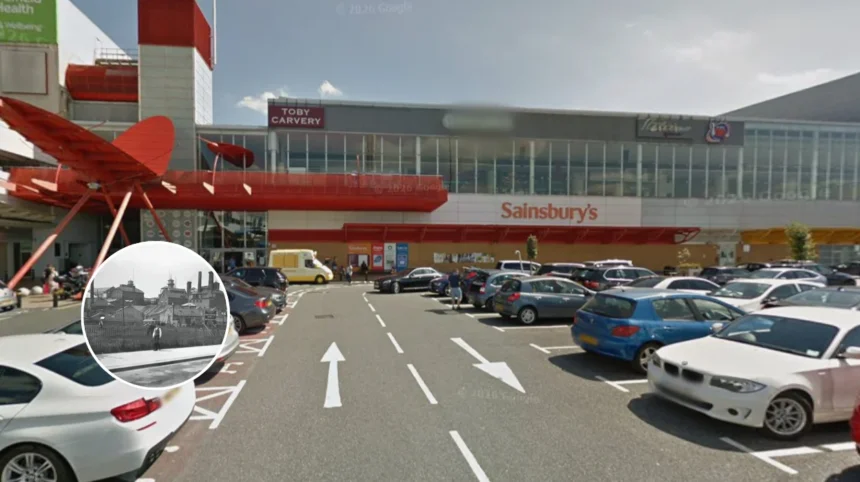
- Construction of The Brewery shopping centre began in 1999 on the old site, opening in May 2001 with Sainsbury’s (relocated from The Mercury), Ster Century Cinemas (later Vue in 2005), bowling, restaurants, and more; covers 530,000 sq ft with leisure facilities.
- Features a repaired 50m chimney as a landmark beacon with a spiralling sculpture for the car park ramp; 25% stake sold in 2010 for £44.25m to Prudential amid recession resilience due to location and Sainsbury’s anchor.
- Remains a key Romford town centre hub near the station, served by buses including route 165; celebrated 21 years in 2022 with community events.
Romford (East London Times) March 2, 2026 – The Brewery, Romford’s prominent shopping and leisure centre, stands on the historic site of the Star Brewery, which began humbly in 1708 behind the Star Inn pub and grew into a major employer with national and international acclaim before closing in 1993 and transforming into a modern retail hub.
As reported by the Romford Recorder in its history series, the brewery originated behind the Star Inn in South Street, close to the River Rom, founded by Mr George Cardon who served as both licensee and brewer. The Recorder notes that although it eventually became a major employer, the original brewery had humble beginnings in 1708. The pub and brewery changed hands several times in the 18th century.
When Was the Star Brewery Founded?
The Star Brewery was established in 1708 at the Star Inn and brewery in South Street by Mr George Cardon, who carried out the joint calling of licensee and brewer, as detailed in “Essex Brewers – The Malting and Hop Industries of the County” by Ian P Peaty, cited on Brewery History Society records. The Star Inn was situated close to the River Rom, and later by 1839, the Eastern Counties Railway station, providing key access for expansion. Some histories, such as those on Wikipedia, confirm it served as Romford’s main industry for 285 years.
In 1799, the Star Inn and Brewery were purchased by Mr Edward Ind and Mr J.Grosvenor, who remained partners for 17 years until John Smith replaced Grosvenor, according to the Brewery History Society. The Head Brewer at that time was Mr Turner, who later left with Smith to form Fuller, Smith and Turner in West London. Edward Ind died in 1848 at age 68, succeeded by his two sons.
How Did Ind Coope Shape the Brewery’s Name?
In 1845, Mr C.E. Coope joined the firm, which then became known as Ind, Coope and Company, as reported across multiple sources including the Romford Recorder and Wikipedia. Less than a decade before, Romford station opened to the south of the site in 1839, providing the brewery with means for significant expansion. In 1853, a railway wagon hoist was built from the high-level main railway track into the brewery’s private sidings, replaced in 1862 by an incline, leading to the purchase of the first steam locomotive in 1872.
In the 1860s, a connection was made between the goods yard at Romford station in South Street and the brewery via a tunnel underneath the railway line, enabling significant expansion, per Wikipedia and Romford Recorder. By 1908, with its own network of railway sidings totalling 2 miles handling 400 wagons daily, the brewery employed 450 workers.
What Challenges Did the Brewery Face?
August 1888 brought the worst floods Essex had ever known, hitting Ind Coope’s brewery as the River Rom ran through it, with flood waters three feet deep demolishing a 50-foot wall section, as chronicled by Ian P Peaty. Between twenty and thirty thousand casks, mostly empty, were swept away, found as far as Rainham and Dagenham; 400 kilderkins from the previous day’s brewing were lost without bungs, causing colossal financial loss.
In 1910, the company faced financial difficulties and was reconstructed as Ind Coope and Company (1912) Ltd, retaining this title until 1934 when it merged with Samuel Allsopp Brewery Co of Burton, reverting to its prior name. Wartime bomb damage in the 1940s required post-1945 rebuilding; a temporary bottling hall burned down in 1947.
What Was the Brewery’s Peak Operations Like?
By 1889, on a 40-acre site, it employed 400 producing 200,000 barrels annually, with eight wells (deepest 300ft into chalk) yielding 300 barrels per hour, six coppers (largest 900 barrels), and fermenting squares of 7,625 barrels capacity. The hop store held 11,000 Kentish pockets; power evolved from horse tread wheels to a 16 H.P. beam engine in 1846, then seven 30 H.P. Lancashire boilers by 1889. Employees received a 5-pint daily beer allowance in 1882, equating to 45 barrels weekly.
Numerous gold medals were awarded from 1862 at London, Philadelphia 1876, Paris 1878, Calcutta 1884, and highest for English Beers at Antwerp 1894. Acquisitions included Hill & Co. Ltd, Budden & Biggs Ltd, Colchester Brewing Co. Ltd, Benskins Ltd, Taylor Walker & Co. Ltd, and Friary Meux Ltd. At the 1949 150th anniversary, 700 employees, 370 lorries, 543 horses served 44 depots and 32 overseas agencies, with 600,000 casks in trade.
In 1961, a new bottling hall covered former sports grounds, coinciding with joining Allied Breweries; traded as Ind Coope (East Anglia) Ltd 1958-1966, then Allied Breweries (Production) Ltd to 1978. By 1980, as Romford Brewery Company with 30 tied pubs, 870 employees produced 500,000 barrels on 25 acres; mid-1980s saw workforce at 570 but output at 800,000 barrels. A £9 million redevelopment opened 20 March 1987 by R.G. Martin, Chairman of Allied Breweries, capable of one million barrels annually.
Why Did the Brewery Close?
The private railway closed mid-1960s; by late 1980s, only keg beers like XXXX, Lowenbrau, Skol, John Bull Bitter. The Romford brewery closed permanently in 1993 (some sources note 1992), part of Carlsberg-Tetley from January 1993, after peaking at 1,000 workers on 20 acres in 1970. The site was demolished, ending 285 years of brewing central to Romford’s identity.
How Was the Site Redeveloped into a Shopping Centre?
Construction began in 1999 on the old Star Brewery plot, a £180 million, 600,000 sq ft mixed-use development by Chetwoods architects, completed May 2001. Opened with Sainsbury’s (moved from The Mercury), Ster Century Cinemas (replaced by Vue 2005 post-buyout), bowling, amusement arcade, restaurants, health club, Europe’s largest indoor play area, cinema, surface/multi-storey parking for 1,700 cars.
A 50m high chimney was repaired, re-clad as a landmark beacon, fulcrum for a wraparound spiralling sculpture doubling as car park ramp, respecting the site’s history in sustainable renaissance. Managed by Henderson Group, 25% stake sold 2010 for £44.25m to Prudential Property Investment Managers, citing east London location, retail-leisure mix, Sainsbury’s anchor for recession success.
What Facilities Does The Brewery Offer Today?
The Brewery, one of Romford’s three main centres alongside The Liberty and The Mercury, spans 530,000 sq ft over two floors at 10 Brewery Walk, Waterloo Road, RM1 1AU, near Romford station. Leisure includes Vue cinema, bowling/amusement, restaurants; served by London Buses, route 165 terminates in car park.
It thrived through the global pandemic, introducing safety measures like enhanced cleaning, maintaining community role with new tenants. Celebrated 21 years in July 2022 with a big birthday event by management and retailers, 11am-3pm on 23 July. Remains integral to Romford’s town centre identity.