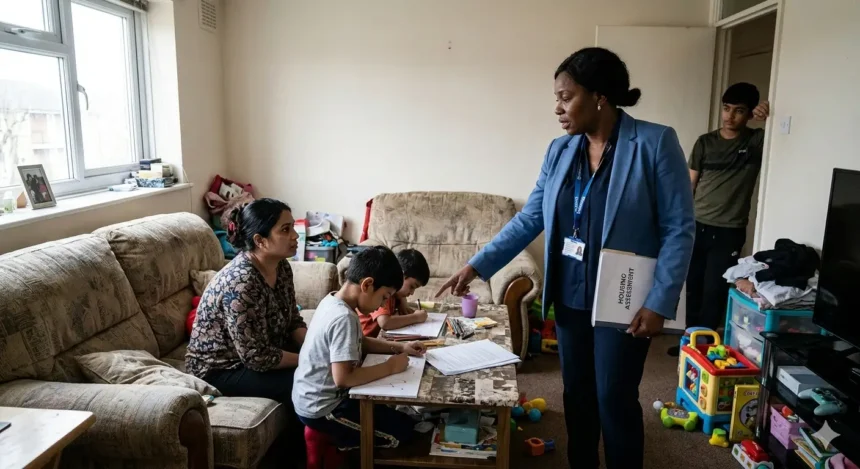
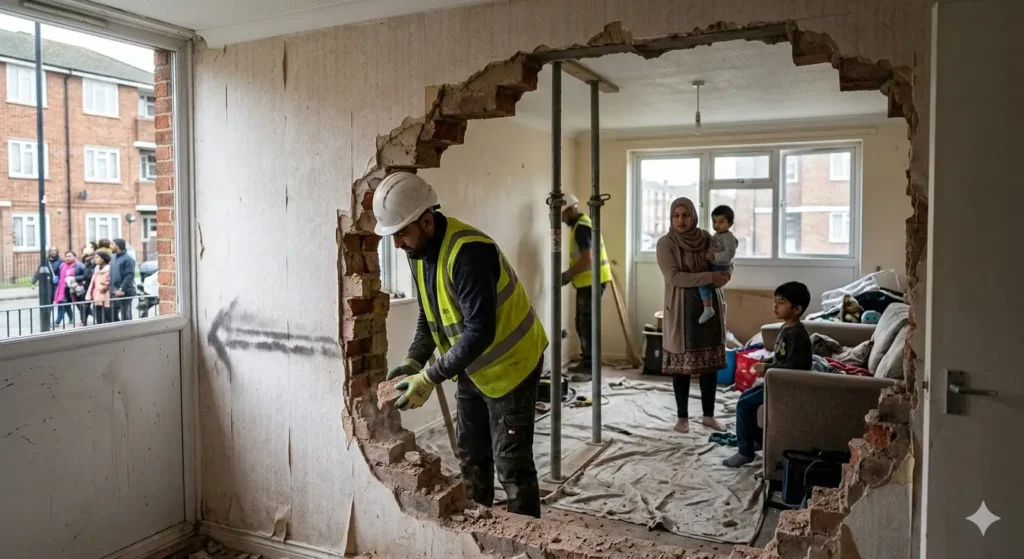
A “knockthrough” is where two neighbouring council homes are combined into one larger property so an overcrowded family can have more space. In East London, this is usually organised by the landlord (for example, the council or housing association), not by tenants directly. To start the process, you normally need to report overcrowding to your local housing team, ask for an overcrowding assessment and discuss whether a knockthrough is a realistic option for your building.
- What is a “knockthrough” and who is it for?
- Why this issue matters to local residents
- Which council service handles it
- Step‑by‑step: how to apply for a “Knockthrough”
- 1. Confirm your landlord and tenancy
- 2. Report overcrowding formally
- 3. Request an overcrowding assessment
- 4. Ask about a knockthrough as a specific option
- 5. Allow technical checks and surveys
- 6. Receive a decision in writing
- 7. Agree access and practical arrangements
- Information and documents you may need
- Expected response time
- What to do if follow‑up is required
- Rights and responsibilities under UK rules
- Practical tips to avoid overcrowding problems in future
What is a “knockthrough” and who is it for?
In social housing, a knockthrough means joining two existing flats or houses into one bigger home by removing internal walls and reconfiguring rooms. It is mainly used to help severely overcrowded households, particularly larger families already on the housing register.
In boroughs like Newham, Tower Hamlets, Hackney, Waltham Forest, Redbridge, and Barking & Dagenham, knockthroughs are relatively rare and usually only considered when there is a suitable empty property next door and the building is structurally suitable. Your landlord (council or housing association) decides if a knockthrough is possible, safe, and value for money under its housing and asset management policies.
Why this issue matters to local residents
Overcrowding is a long‑term problem in many parts of East London, with families often sharing bedrooms, living rooms doubling as sleeping space, and children lacking quiet study areas. This can affect health, education, and general wellbeing.
A successful knockthrough can:
- Create extra bedrooms and living space without forcing a family to move far from schools, work, or community networks.
- Make better use of existing social housing stock when new large homes are limited.
- Reduce stress and conflict within the home by giving everyone more room.
For local residents already settled in an area, being able to stay in the same block or street while gaining more space can be a major advantage compared with moving to a different part of London.
Which council service handles it
The exact team name varies, but knockthroughs usually sit between:
- The Housing Needs or Housing Options service (who manage overcrowding cases and the housing register), and
- The council’s Housing Management or Asset Management service (who manage existing council homes and building works).
If your landlord is:
- Newham council: contact the housing or lettings team and explain your overcrowding situation.
- Tower Hamlets council: contact Housing Options or the social housing landlord (for example, Tower Hamlets Homes or another housing association).
- Hackney, Waltham Forest, Redbridge, Barking & Dagenham: start with the general housing enquiries team, then ask to speak to the officer dealing with overcrowding or housing allocations.
If your home is managed by a housing association, you should contact the association first. They will decide whether to explore a knockthrough and then liaise with the relevant East London council where planning, building control or housing‑register decisions are needed.
Step‑by‑step: how to apply for a “Knockthrough”
Because you cannot usually “apply” for a knockthrough in the same way as a standard council service, it is best to treat it as part of your overcrowding case. The steps below are designed for Newham, Tower Hamlets, Hackney, Waltham Forest, Redbridge, and Barking & Dagenham residents.
1. Confirm your landlord and tenancy
- Check your tenancy agreement or a recent rent letter to see if your landlord is the council or a housing association.
- Note your tenancy type (secure, introductory, assured, etc.) and your address, including flat and block numbers.
2. Report overcrowding formally
- Contact your landlord’s housing team and explain that your home is overcrowded.
- Ask them to record this as an overcrowding case and to arrange an overcrowding assessment or home visit.
- If you are not already on the housing register, ask to complete a housing application so your overcrowding is recognised in the banding or points system.
3. Request an overcrowding assessment
During the assessment, the officer will usually:
- Count how many people live in your home and their ages.
- Look at how many bedrooms and living rooms you have.
- Check how the space is used and whether there are health or safety issues.
Make sure you clearly explain how the overcrowding affects daily life (for example, children sharing with adults, no private space for older children, equipment for disabled residents being blocked).
4. Ask about a knockthrough as a specific option
At or after the visit, you can say you are interested in a “knockthrough” to reduce overcrowding. It is helpful to:
- Mention if the flat or house next door seems empty or has been vacant for a long time.
- Explain why staying in your current area is important (schools, medical care, caring responsibilities, work).
- Ask the officer to check with the asset management or development team whether your building could technically allow a knockthrough.
The council or housing association will then decide whether to investigate this further. This may include checking tenancy records for the neighbouring property, reviewing the building layout, and looking at cost and value for money.
5. Allow technical checks and surveys
If your landlord is open to the idea, they may:
- Arrange a surveyor or structural engineer to assess whether internal walls can be removed and what works would be needed.
- Check fire safety, building regulations and any planning issues, especially in older buildings or conversions.
- Estimate the cost and compare it with other options (such as rehousing you to a larger existing property).
You will usually not need to apply for planning permission personally. Any planning or building control applications would normally be made by the landlord or their contractor if they decide to go ahead.
6. Receive a decision in writing
If the landlord decides to approve a knockthrough in principle, they should send you a written decision explaining:
- What works they propose to do.
- Whether you need to move out temporarily during the works.
- How your tenancy will change after the knockthrough (for example, moving into a new, larger address).
If they decide not to proceed, they should explain the reasons and outline alternative options, such as a management transfer, a move through the housing register, or other adaptations.
7. Agree access and practical arrangements
If the works go ahead, you will need to agree with the landlord:
- Dates and times for surveys and building works.
- Arrangements for temporary relocation if needed, or how your household will live around the works.
- How long the project is expected to last and what support will be offered (for example, packing, storage, or disturbance payments if applicable under their policy).
Information and documents you may need
Having clear information ready will make it easier for the East London council or housing association to consider your situation. Commonly requested items include:
- Proof of identity for all adults in the household (passport, driving licence, biometric residence permit).
- Proof of all household members living at the address (birth certificates, school letters, benefit letters, GP letters).
- Your tenancy agreement and recent rent statement.
- Evidence about overcrowding impacts, such as letters from schools, GPs, social workers, or occupational therapists.
- Any disability‑related assessments or care plans showing why extra space or specific layouts are needed.
You usually do not need to provide technical drawings or building plans yourself. Those are arranged by the landlord if they explore a knockthrough.
Expected response time
Timeframes vary between boroughs and landlords, but you can generally expect:
- An initial response to your overcrowding report or housing application within a few weeks.
- An overcrowding assessment or home visit within a few weeks to a few months, depending on demand.
- A decision on complex options like a knockthrough can take several months or longer, as it involves surveys, costing, and sometimes planning or building control approvals.
Because knockthroughs are major works and relatively uncommon, you should treat them as a medium‑ to long‑term solution. In the meantime, you may still be able to seek temporary remedies, such as a higher priority on the housing register or a move to another suitable property if one becomes available.
What to do if follow‑up is required
If you have not heard anything or you are unhappy with the progress:
- Chase the case in writing
- Email or write to the officer or team dealing with your overcrowding, summarising what has been discussed and asking for an update.
- Keep copies of all correspondence.
- Ask for timescales and next steps
- Request a clear outline of what the landlord is currently doing (for example, waiting for a survey, costing the works, or considering alternative rehousing options).
- Ask when you can expect the next decision.
- Use the complaints process if needed
- If you believe the council or housing association has delayed unreasonably or not followed its own policies, you can use their formal complaints procedure.
- If the complaint is not resolved, you may later contact the Housing Ombudsman, but you must usually go through the landlord’s own stages first.
- Seek independent advice
- Local advice agencies, law centres or housing charities may be able to help you understand your rights, draft letters, and consider other options alongside a potential knockthrough.
Rights and responsibilities under UK rules
When exploring a knockthrough, it is important to remember the legal framework:
- You do not have an automatic right to a knockthrough. Councils and housing associations have a duty to manage their housing stock reasonably, but they decide whether a specific building is suitable and whether the cost is justified.
- You do have rights to be treated fairly under housing allocation schemes, equality law, and, if you are a secure or assured tenant, under the terms of your tenancy.
- Any works must comply with building regulations, fire safety, and, where relevant, planning rules. The landlord is responsible for ensuring this.
- You must not carry out structural works yourself without written permission from your landlord and any required approvals. Doing so could breach your tenancy and raise serious safety risks.
- During and after a knockthrough, you must continue to use the property in line with your tenancy conditions, including paying rent, avoiding unauthorised subletting, and not causing damage.

Practical tips to avoid overcrowding problems in future
Not every household will be offered a knockthrough, so it is sensible to manage your housing situation proactively:
- Keep your housing application up to date, including changes in family size, medical needs, or support requirements.
- Consider bidding regularly for larger properties through your borough’s choice‑based lettings system if you are eligible.
- If younger adult children can afford to move into their own accommodation, discuss realistic options early to reduce future overcrowding.
- Use your home’s space as safely and efficiently as possible while you are waiting for longer‑term solutions (for example, safe bunk beds, storage solutions, and avoiding blocking fire exits).
- Inform your landlord promptly if the overcrowding becomes severe, particularly if it impacts health, safeguarding, or disability‑related needs.
For many local residents, a knockthrough may be one part of a wider conversation with the East London council or housing association about the best long‑term way to reduce overcrowding, alongside transfers, new builds and other space‑saving measures.
How much does it cost to knock a wall through in the UK?
The cost of a knockthrough in the UK typically ranges from £1,500 to £5,000 or more, depending on whether the wall is load-bearing, if structural supports like steel beams are needed, and the complexity of the work. If you are applying for a council-approved knockthrough to reduce overcrowding, costs and permissions may vary and usually require approval from your local council and building control.