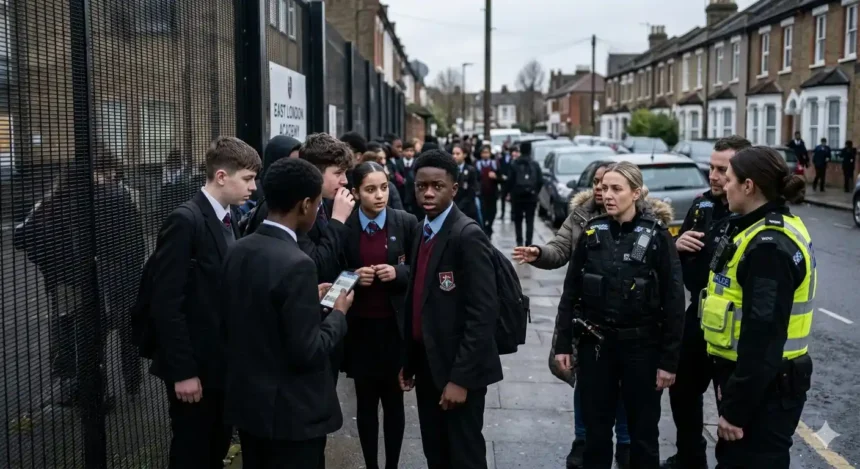
The “School Wars East London: Red vs Blue” phenomenon refers to a 2026 social‑media‑driven trend that categorised London schools into red‑ and blue‑coded “sides” and promoted or implied organised fights between pupils. This viral pattern generated widespread fear among parents, schools and police, even though confirmed violent incidents directly tied to the online “red vs blue” posts remain limited or unverified.
- What are the “School Wars” in East London?
- Why are the “red vs blue” posters a threat?
- How did the red vs blue school wars start?
- What do the red vs blue posters typically include?
- How are schools and police responding to the red vs blue threat?
- What role does social media play in spreading the trend?
- How are schools differentiating between real fights and online hype?
- What are the psychological and social effects on students?
- How can parents and guardians protect their children?
- What might the long‑term impact on youth violence look like?
Below, the article explains the background, mechanisms, and implications of this trend in East London and across the UK education system.
What are the “School Wars” in East London?
The “School Wars” label describes a wave of social‑media posts that split London schools into two rival groups—red and blue—and called on students to meet at specific times and locations for fights. These messages usually took the form of digital posters circulated on TikTok, Snapchat and Instagram, styled after US gang‑related imagery such as the Los Angeles Bloods and Crips.
The core idea is not a formal organisation but a meme‑style coordination: users copy a template that assigns schools to red or blue lists, then drop punch‑timed brawls or “scores” for each fight. In practice, this created a viral script that schools such as those in Hackney, Islington, Redbridge, Croydon and South London were repeatedly named under either red or blue “sides.”
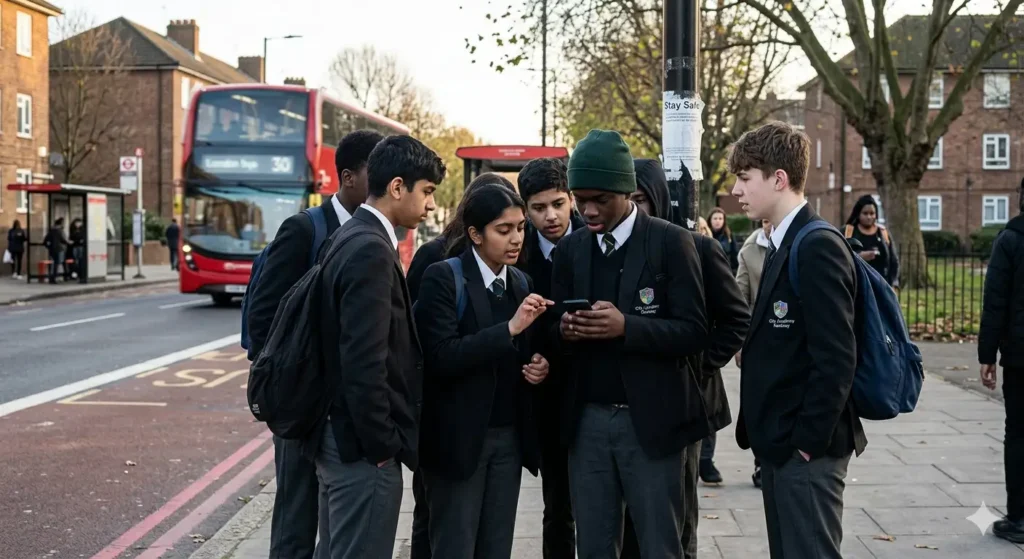
Why are the “red vs blue” posters a threat?
The “red vs blue” threat comes from the way these posts frame school‑on‑school violence as a game or competition rather than a crime. They list specific schools, dates, times and sometimes “weapon” suggestions (e.g., rulers, compasses), which can trigger real‑world aggression even if only a small number of students act on them.
From a security and safeguarding perspective, the risk has three main components:
- Normalisation of violence: Describing brawls as “battles” and “scores” weakens pupils’ perception of physical assault as a serious offence.
- Copy‑cat mobilisation: Local students reshare or slightly edit the same templates, then recruit friends from specific schools or year groups to attend.
- Weapon‑related escalation: Posts that mention everyday classroom tools as “weapons” can prompt young people to carry sharps or improvised items, increasing the risk of serious harm.
Even where direct violence has not materialised, police and schools treat the trend as a genuine safeguarding issue because the narrative can turn into a self‑fulfilling prophecy.
How did the red vs blue school wars start?
The red vs blue school wars emerged in mid‑February 2026, with the first notable posts circulating around 11 February among accounts based in east and south London. These early graphics followed a simple template: a split‑colour background (red on one side, blue on the other), a set of school names, and a call to “war” at a named location and time.
Evidence suggests the original accounts were likely run by local teenagers rather than a single central group, since the style, phrasing and depicted schools vary but share the same basic structure. Over the following weeks the pattern spread to other regions, including Bristol, Cardiff, Birmingham and Northampton, often with locally adapted school lists.
The timing coincided with heightened social‑media activity around school‑related content, including TikTok profiles focused on “school drama” and “fight club”‑style challenges, which gave the template a ready audience. Authorities later described the phenomenon as a meme‑driven panic rather than a coordinated criminal conspiracy, though the potential for real‑world harm kept it in the national news cycle.
What do the red vs blue posters typically include?
Red vs blue posters rely on a standard visual and textual formula that makes them easy to replicate. Most versions feature:
- A two‑tone background divided into red and blue halves, occasionally with gang‑style symbols or silhouettes of figures in balaclavas.
- A list of schools grouped under “Red” or “Blue,” often mixing east London, south London and occasionally west‑London institutions.
- A time and location (for example, “meet at the station after school” or “outside the shopping centre at 16:00”), sometimes with a warning that earlier‑year pupils should “stay away.”
- A scoring or “game” mechanic, such as “points for punches landed” or “whoever wins the most schools gets bragging rights,” which explicitly frames violence as a contest.
Some variants also include references to body‑count imagery, mock‑gang lingo (e.g., “truce over,” “no talk”), or emojis that evoke weapons, all of which reinforce the aggressive tone. Because the templates are simple and shareable, countless edited copies can appear under different usernames, making it difficult for platforms to trace an originator.
How are schools and police responding to the red vs blue threat?
Schools and police in East London and other affected areas have responded with a mix of operational measures and communication strategies. Measures include:
- Cancellation of after‑school activities: Many secondary schools in south and east London suspended or shortened after‑school detentions and clubs to get pupils home earlier on days when “red vs blue” posts claimed a fight was scheduled.
- Increased patrols and dispersal orders: Hundreds of Metropolitan Police officers were deployed near schools and transport hubs on key dates, using dispersal powers to clear groups of young people loitering in potential conflict zones.
- Parent‑information campaigns: Local authorities and police sent letters to parents explaining the trend, warning against sharing or amplifying the posts, and advising that carrying any weapon is illegal and can lead to arrest.
Technically, police have emphasised that, as of early‑March 2026, no confirmed incidents of violence have been directly linked to the red vs blue templates, though they treat the risk seriously because of the potential for escalation. Schools in Hackney, Croydon, Islington and Redbridge have all reported that students were talking about being “red” or “blue” and anticipating confrontations, even if mass brawls did not materialise.
What role does social media play in spreading the trend?
Social‑media platforms are central to the school‑wars dynamic because they provide the infrastructure for rapid copying, resharing and remixing of the red vs blue template. TikTok and Snapchat are the most frequently cited channels, since they support short‑form video, stickers, and quick‑response reactions that suit youth‑driven memes.
The process works in stages:
- A user uploads a graphic or video with a red‑blue school list and a call to “war,” often tagging nearby schools or using local‑area hashtags.
- Other users copy or subtly edit that post, changing school names or locations, then reshare it to their own networks, which can include school‑specific pages or groups.
- Algorithms on TikTok and Snapchat promote content that generates high engagement, so posts involving conflict, suspense or “battle” themes can reach vastly larger audiences than the original creator anticipates.
This environment also allows anonymous or semi‑anonymous accounts to circulate more extreme versions, sometimes including explicit references to weapons or past fights, which in turn can influence how pupils interpret the “game.” Although platforms have deleted some posts and restricted certain hashtags, the low bar to recreating the template makes eradication difficult.
How are schools differentiating between real fights and online hype?
Schools in East London distinguish between the online “red vs blue” rhetoric and tangible incidents by triangulating three sources of evidence: staff reports, student disclosures, and police advice. For example, on 27 February 2026, educators in south London reported that pupils were discussing planned fights, but police later confirmed no confirmed violent incidents tied to that date.
Common indicators schools look for include:
- Verbal or text‑based planning: Students talking in corridors about “meeting” a rival school “after school,” or sharing screenshots of red vs blue posters in group chats.
- Increased tension between groups: Pupils from different institutions or year groups treating each other as “enemies” in a way that departs from normal rivalry.
- Weapons or suspicious items: Reports of compasses, rulers, knives or other objects being brought into school in anticipation of a “battle,” which teachers are required to escalate to police.
When such signs appear, schools may implement temporary measures such as early‑dismissal protocols, stricter bag checks, or temporary lock‑downs of certain areas, always in coordination with local police. Authorities stress that while the online threat is often larger than the offline violence, even a small number of planned fights can justify substantial preventative action.
What are the psychological and social effects on students?
For students, the red vs blue school wars can create a mix of excitement, fear and social pressure. Some pupils see participation as a way to gain status or prove toughness, especially if peers are openly discussing “sides” and “scores,” while others feel anxious about being targeted because their school is on a red or blue list.
The main psychological effects observed include:
- Heightened anxiety: Young people report worrying about being ambushed, stabbed or filmed during a fight, even when no incidents have occurred in their area.
- Group polarisation: The red vs blue frame can push students to define themselves strictly by their school or colour, reducing tolerance for cross‑school friendships and amplifying “us vs them” thinking.
- Exposure to violence‑related content: Regularly viewing or resharing fight‑promoting posts can desensitise some pupils to physical aggression and lower their threshold for seeing it as normal.
Schools and youth‑safeguarding services have responded by increasing mental‑health support, running classroom discussions on online safety, and encouraging students to report concerning posts instead of engaging with them.
How can parents and guardians protect their children?
Parents and guardians can reduce the impact of the red vs blue trend by combining clear communication with practical safeguards. Key steps include:
- Open conversations: Ask children what they have seen online about “school wars,” explain the legal consequences of carrying weapons or joining fights, and encourage them to talk to a trusted adult if they feel pressured.
- Monitoring and boundaries: Agree on rules for social‑media use (for example, not reposting or saving fight‑related content), and use parental‑control tools where appropriate for younger teens.
- Contacting the school: If a child mentions a planned “red vs blue” meeting or receives a direct threat, report it immediately to the school and the police, preserving any screenshots as evidence.
Parents are also advised not to amplify fear by sharing sensationalised screenshots on their own social‑media accounts, because this can spread panic and inadvertently validate the trend’s visibility. Schools in Hackney, Croydon and Islington have issued specific guidance for parents, stressing that not every viral post equals a real‑world event, but vigilance remains essential.

What might the long‑term impact on youth violence look like?
In the long term, the red vs blue school wars may influence how youth violence is planned, perceived and policed in urban centres such as East and south London. If similar meme‑driven templates resurface around future dates or school events, authorities may treat them as a recurring risk pattern rather than a one‑off panic.
Potential long‑term effects include:
- More proactive online‑safeguarding policies in schools and local authorities, including mandatory digital‑citizenship lessons that explicitly address “challenge” and “battle”‑style content.
- Stronger platform‑enforcement expectations, where regulators and police push platforms to respond faster to school‑specific fight‑promoting posts and to label or restrict such content.
- Potential rise in copy‑cat trends, if developers of future memes reuse the red vs blue format with different colours, locations or school names, requiring ongoing vigilance from schools, police and parents.
For East London specifically, the episode has already prompted multi‑borough discussions among schools, councils and the Metropolitan Police about how to coordinate responses to online‑initiated threats, suggesting that future episodes will be met with faster, more integrated safeguards.
By combining factual clarity, structured explanations and concrete examples, this article provides a comprehensive, evergreen reference on what lies behind the “School Wars East London: Red vs Blue” threat and how schools, police, families and young people can respond.
What is the “Red vs Blue” school war in East London?
The “Red vs Blue” school war refers to ongoing tensions and rivalries between groups of students linked to different schools or areas, often identified by colors rather than official affiliations.