Key Points
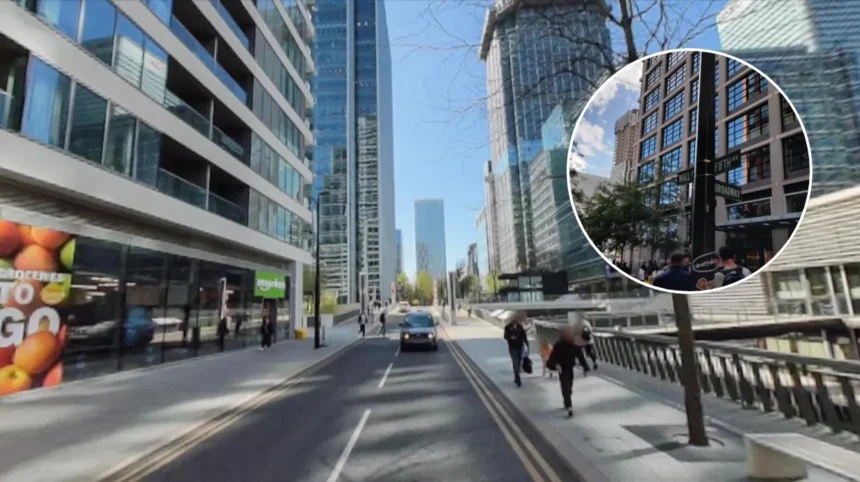
- Union Square is an innovative “meanwhile use” project in the London Borough of Tower Hamlets, developed by Canary Wharf Group with HTA Design.
- It transforms a construction plot into a temporary public oasis at the centre of Canary Wharf’s Wood Wharf masterplan.
- The project provides pedestrian-friendly public space amid ongoing development, featuring landscaped areas and green realm.
- It forms part of the broader Wood Wharf neighbourhood, including nearby residential buildings like 3 & 15 West Lane, completed by HTA Design for Canary Wharf Group.
- Union Square echoes the area’s industrial heritage with design elements inspired by historic warehouse architecture.
- The initiative supports car-free streets, pocket parks, and community activation during the construction phase.
(East London Times), April 18, 2026 – Union Square has emerged as a key “meanwhile use” project in the heart of Canary Wharf’s expanding Wood Wharf masterplan, where Canary Wharf Group, in collaboration with HTA Design, has converted a construction plot into a temporary public green space. This initiative activates an otherwise dormant site, offering residents and visitors a landscaped oasis amid the borough’s transformation. As detailed on The Developer platform, the project exemplifies innovative temporary planning to enhance community access during large-scale development.
- Key Points
- What is Union Square’s Role in Wood Wharf?
- How Does “Meanwhile Use” Define This Project?
- What Features Make Union Square a Public Oasis?
- Who Are the Key Players Behind Union Square?
- What Broader Developments Surround Union Square?
- Background of the Development
- Prediction: Impact on Tower Hamlets Residents and East London Communities
What is Union Square’s Role in Wood Wharf?
The project centres on creating immediate public benefit from land awaiting permanent structures. According to the project profile on The Developer, Union Square transforms underutilised space into a pedestrian-oriented realm, aligning with Canary Wharf Group’s vision for a vibrant, mixed-use neighbourhood.
HTA Design’s involvement extends beyond this temporary space, as the firm recently completed adjacent buildings 3 & 15 West Lane, which house 297 aparthotel units and further public amenities. As reported by Pro Landscape Magazine, these structures surround Union Square, contributing to “The Lanes” – a car-free zone with independent shops, pocket parks, and eateries. Colin Ainger, partner at HTA Design, stated in Architecture Today:
“Canary Wharf is undergoing a major transformation and 3 & 15 West Lane – the latest development in HTA’s ongoing collaboration with CWG – delivers two new residential buildings that contribute to the growing buzz and evolving character of the Wood Wharf neighbourhood.”
This integration ensures Union Square serves as a focal point, blending temporary activation with longer-term infrastructure.
How Does “Meanwhile Use” Define This Project?
“Meanwhile use” refers to temporary occupation of sites during construction or vacancy, a practice increasingly common in London to build community resilience. The Developer’s entry describes Union Square precisely as an
“innovative ‘meanwhile use’ project transforming a construction plot into a public oasis.”
This approach prevents land from lying idle, instead fostering public enjoyment through landscaping and events.
In the wider context, such uses support planning strategies outlined by the Greater London Authority, which highlight their role in addressing urban challenges like empty plots. HTA Design’s HTA.co.uk project page notes that Union Square’s surrounding public realm at 3 & 15 West Lane includes extensive shared amenities, reinforcing the temporary space’s utility. The design draws from Canary Wharf’s industrial past, with brick facades and concrete elements evoking 19th-century docks, as covered by Archello.
No specific timeline for the meanwhile phase is detailed across sources, but it operates within the phased Wood Wharf masterplan.
What Features Make Union Square a Public Oasis?
The space prioritises accessibility and greenery. The Developer profile emphasises its role as a
“public oasis in the centre of Canary Wharf’s Wood Wharf masterplan,”
with landscaped elements enhancing pedestrian flow. Adjacent developments amplify this: Pro Landscape Magazine reports that the green public realm around 3 & 15 West Lane includes pocket parks and active ground-floor uses.
Architecture Today details how the aparthotels at West Lane
“act as a fitting focal point for the newly landscaped Union Square,”
with facades featuring pre-cast concrete string courses, cills, lintels, and capitals to nod to warehouse heritage. Colin Ainger added:
“In the style of the estate’s historic warehouse architecture these buildings act as a fitting focal point for the newly landscaped Union Square while contributing an exciting new living offer to the Wharf’s growing community.”
These elements create a cohesive environment, promoting foot traffic and local interaction without vehicles.
Who Are the Key Players Behind Union Square?
Canary Wharf Group leads as developer, with HTA Design as architects. The Developer attributes the project directly to “London Borough of Tower Hamlets for Canary Wharf Group with HTA Design.” Vertus Edit operates the aparthotels at nearby West Lane, per HTA’s site.
Colin Ainger’s comments in multiple outlets underscore HTA’s role. Pro Landscape Magazine quotes him describing the project as a “major transformation,” with buildings contributing to Wood Wharf’s “evolving character.”
The London Borough of Tower Hamlets provides the planning context, as the site falls within its jurisdiction.
This collaboration builds on Canary Wharf’s history of regeneration, originally master-planned from 1988, as noted in Wikipedia’s overview.
What Broader Developments Surround Union Square?
Union Square sits within the 23-acre Wood Wharf masterplan on the Isle of Dogs. HTA.co.uk explains it as “a major mixed-use development” delivering up to 3,600 homes, offices, a GP surgery, a school, retail, and over 9 acres of public spaces. Archello confirms the site’s centrality, with 3 & 15 West Lane comprising the aparthotel and public realm.
Pro Landscape Magazine highlights Wood Wharf’s completion goals, including
“more than 9 acres of public spaces, squares and parks.”
Architecture Today positions it as part of “The Lanes,” a pedestrian network. This positions Union Square as a bridge between temporary and permanent phases.
Background of the Development
Wood Wharf’s origins trace to Canary Wharf’s regeneration in the late 1980s, when Olympia & York began construction amid Docklands’ decline. Wikipedia records that One Canada Square opened in 1991 as the UK’s tallest building, symbolising revival despite early bankruptcy in 1992. Canary Wharf Group has since expanded residential offerings.
The meanwhile use concept gained traction post-2010s, with the Greater London Authority promoting it for resilience. Meanwhile Space’s projects, like town centre activations, parallel this approach.
HTA Design’s work at West Lane, completed around July 2025 per Architecture Today (July 16, 2025) and Pro Landscape Magazine (July 8, 2025), marks a milestone. Union Square activates the site pre-full build-out, reflecting adaptive urban planning in Tower Hamlets.
Prediction: Impact on Tower Hamlets Residents and East London Communities
This development can enhance public access to green space for Tower Hamlets residents during construction, providing immediate recreational value in a dense urban area. Short-term activation through Union Square may foster community events and footfall in The Lanes, supporting local shops and reducing isolation in Wood Wharf’s transitional phase.
For Canary Wharf’s growing residential population, including aparthotel users, it offers a heritage-inspired gathering point, potentially increasing dwell time and neighbourhood cohesion without car dependency. Longer-term, as Wood Wharf nears completion with thousands of homes and amenities, the model could normalise temporary uses across East London, aiding borough planners in managing development impacts. Local football fans and families in nearby Newham or Hackney may benefit from expanded parks, though traffic from visitors remains a consideration. Overall, it supports sustainable growth by prioritising public realm early.