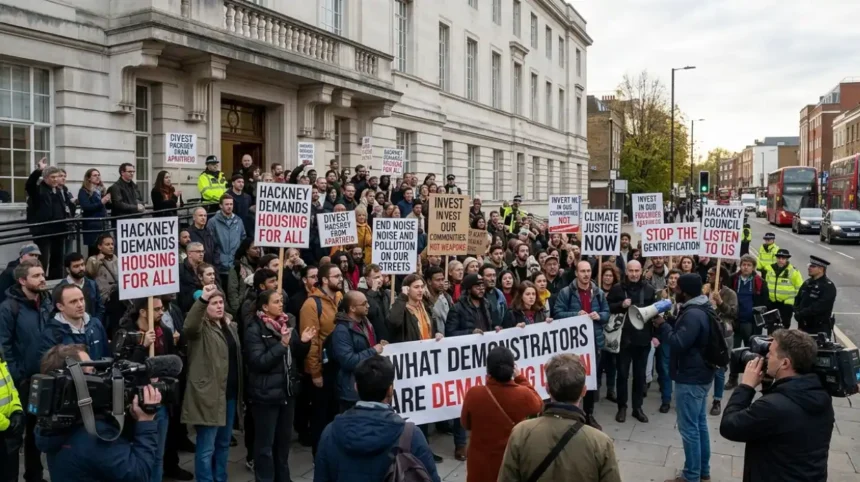
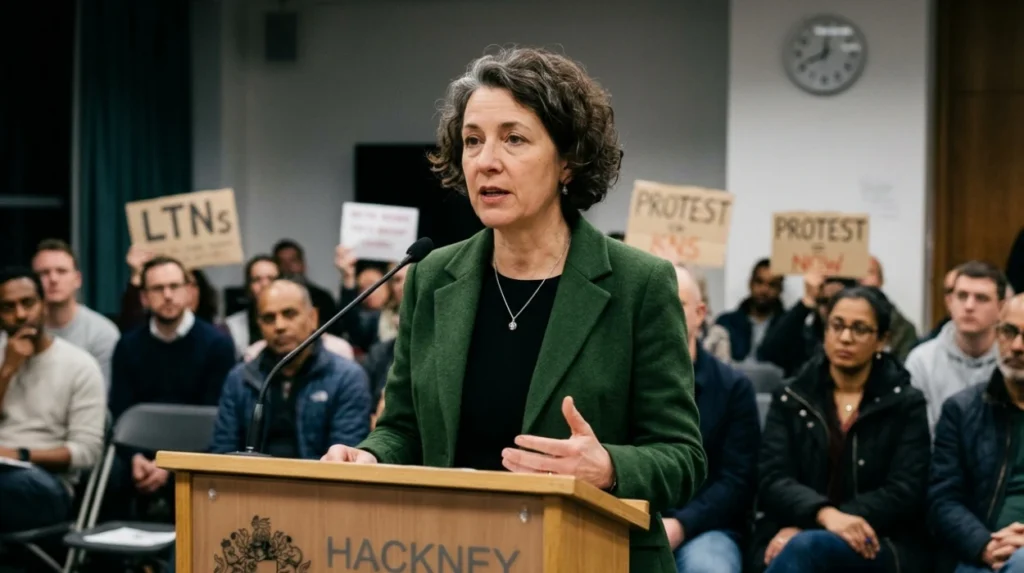
Hackney Town Hall has become a focal point for residents and campaigners pressing Hackney Council over local transport, housing, and moral‑investment policies. In recent protests, demonstrators have converged on Mare Street to demand specific, concrete changes to council decisions shaping how people live, work, and move through the borough. This article explains what protesters at Hackney Town Hall are demanding, why those demands matter, and how they fit into Hackney’s wider political and social landscape.
- What was the main Hackney Town Hall protest in early 2026 about?
- What exactly are protesters demanding in the “open our roads” protest?
- How do LTNs work and why are they controversial in Hackney?
- What are the specific policy changes demonstrators want from Hackney Council?
- Have there been other major protests at Hackney Town Hall in recent years?
- How does the Hackney Town Hall protest fit into wider East London politics?
- What evidence do residents use to support their demands?
- How has Hackney Council responded to the Town Hall protest demands?
- What are the long‑term implications of these protest demands?
What was the main Hackney Town Hall protest in early 2026 about?
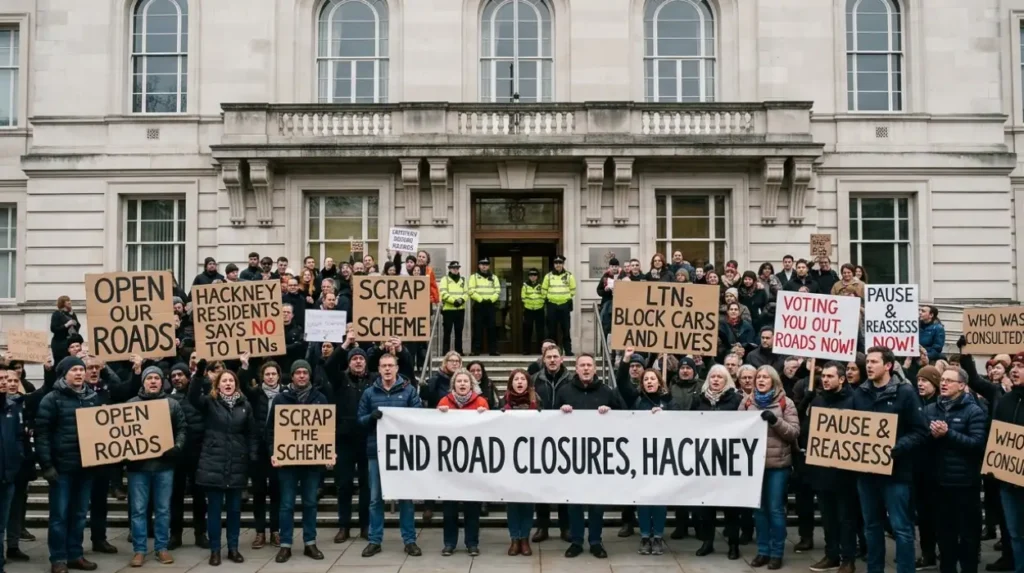
Protesters outside Hackney Town Hall in January 2026 primarily demanded that the council halt or roll back the borough’s Low Traffic Neighbourhood (LTN) scheme and “open our roads” to motor vehicles. The demonstration took place on Monday, 26 January 2026, during a cabinet debate on the LTN policy and followed a petition calling for a pause and reassessment of the scheme. Several hundred residents gathered outside the building, chanting “open our roads” and blocking the pavement to force the council to listen to their concerns. The core message was that the council had imposed road‑closure measures without sufficient consultation and that those changes were harming mobility, health access, and local businesses.
Hackney introduced LTNs from 2020 as part of a wider climate‑adaptation strategy, aiming to reduce car use, improve air quality, and encourage walking and cycling. As of 2026, the borough has 19 LTNs covering about 70 per cent of eligible roads and roughly half of its total area, more than any other London borough. Supporters argue that these schemes cut traffic on side streets and push more journeys onto walking, cycling, and public transport. However, critics say the LTNs have shifted congestion onto main roads, lengthened journeys for emergency services, traders, and disabled residents, and excluded vulnerable groups who cannot easily switch to active travel.
What exactly are protesters demanding in the “open our roads” protest?
In the 26 January 2026 protest, demonstrators issued three main demands: that Hackney Council scrap or suspend the current LTN rollout, reroute traffic more fairly, and involve residents in any new transport plans. The most visible slogan was “open our roads,” which translates into calls to remove or modify bus gates, modal filters, and LTNs that block cars from residential streets. Campaigners such as ShaToya Rose and resident organisers argued that the council’s data showing majority support for LTNs did not reflect the daily experience of people living in affected areas, where journey times to hospitals, schools, and workplaces had increased significantly. They also highlighted that blue‑badge holders and others who must drive were being disproportionately penalised.
Second, protesters demanded a full impact assessment of how LTNs were affecting air pollution, noise, congestion, and business footfall. The petition supporting the demonstration collected over 1,800 signatures and more than 500 detailed impact statements, which residents said the council had not adequately quantified or acted upon. Third, demonstrators called for a transparent, locally‑led review process, including ward‑level consultations and independent transport‑modelling work, before any further LTNs were implemented. They warned that unilateral decisions risked both public health and political legitimacy, especially where the council claimed to be pursuing climate justice while many residents felt they were being pushed to the margins.
How do LTNs work and why are they controversial in Hackney?
Low Traffic Neighbourhoods are designated areas where motor vehicles are prevented from driving through residential streets except for access, deliveries, and exempted users such as blue‑badge holders and emergency services. In Hackney, LTNs are typically implemented using a combination of bus gates (which allow buses and exempt vehicles), planters, bollards, and camera‑enforced 24‑hour bus‑gate restrictions on key junctions. These measures are intended to reduce rat‑running traffic, lower emissions, and make streets safer for pedestrians and cyclists. Proponents argue that LTNs support the borough’s commitment to a climate emergency declaration, which includes aims to cut emissions and transition to net zero by 2040.
However, the controversy in Hackney stems from how these principles play out in practice. Residents on streets such as Chatsworth Road, Dublin Avenue, and Whiston Road have reported higher congestion, longer journeys, and more idling traffic on main roads and around bus gates. Some traders say footfall has dropped by up to 50 per cent in certain areas, which they directly attribute to diverted car traffic and longer access times. Critics also point out that the borough’s population is socially and economically diverse, with around 57 per cent of households in Kings Park ward lacking access to a car and higher proportions in other wards. This means that changes that primarily restrict car travel can hit working‑class and disabled residents hardest, even as wealthier, car‑owning households may feel fewer immediate consequences.
What are the specific policy changes demonstrators want from Hackney Council?
Demonstrators outside Hackney Town Hall have outlined several concrete policy changes they want the council to implement. First, they demand an immediate moratorium on any new LTN schemes and the removal or significant modification of existing bus gates and modal filters that severely restrict access to residential streets. Second, protesters want the council to publish a full, ward‑by‑ward analysis of journey times, ambulance and fire‑service response‑time data, and business‑turnover impacts before making further decisions. They argue that the council currently relies on aggregate traffic counts and survey data, which mask the lived experience of individual households and small‑business owners.
Third, campaigners have called for more flexible, time‑limited LTNs instead of permanent 24‑hour closures. For example, some residents have requested that bus gates around key junctions operate only during peak‑hour periods, allowing unrestricted access at other times. Fourth, demonstrators demand stronger exemptions and clearer routes for blue‑badge holders, disabled drivers, and households caring for vulnerable relatives, including formal appeals processes when standard exemptions are insufficient. Finally, they are pressing for greater democratic accountability, such as dedicated committees or panels made up of residents, business owners, and transport experts to review LTN performance and propose adjustments, rather than leaving decisions solely to council officers and senior cabinet members.
Have there been other major protests at Hackney Town Hall in recent years?
Before the 2026 “open our roads” demonstration, Hackney Town Hall had seen several other large‑scale protests addressing different issues. In 2024, pro‑Palestine campaigners set up an encampment outside the town hall demanding that Hackney divest its pension fund from companies they said were involved in Israel’s military actions and end the borough’s twinning relationship with Haifa. That protest tied into broader national campaigns for public‑sector divestment and drew hundreds of people to Mare Street at different points. The council later agreed to commission an independent review of the pension‑fund investments, although campaigners argued the review did not go far enough.
In 2024, residents from the Frampton Park Estate also marched on Hackney Town Hall to protest poor housing conditions, including frequent leaks, broken lifts, and inaccessible communal areas. They carried banners reading “Fix our block” and “Hackney Council, shame on you,” and demanded a concrete repair plan, a dedicated maintenance budget, and direct accountability from the mayor’s office. In 2023, campaigners from the disability‑rights and housing‑justice sectors held vigils outside the town hall after a pregnant mother and child were placed in what they described as “appalling” temporary accommodation, calling for a moratorium on certain types of emergency housing and a review of the council’s safeguarding protocols. These earlier protests show that Hackney Town Hall functions as a symbolic and logistical hub for multiple strands of local activism around housing, climate policy, and social justice.
How does the Hackney Town Hall protest fit into wider East London politics?
The 2026 Hackney LTN protest fits into a broader East London political pattern of residents challenging top‑down transport and development decisions perceived as favouring affluent or car‑less voters. Hackney is Labour‑run, but internal dissent exists between councillors who champion aggressive climate‑action measures and those who worry about equity and service‑delivery trade‑offs. In neighbouring boroughs such as Tower Hamlets and Newham, similar debates have emerged over bus‑gate schemes, cycle‑superhighways, and low‑emission‑zone enforcement, often leading to ward‑level campaigns and petitions. The “open our roads” slogan has also been echoed by some transport‑focused groups in Lewisham and Islington, suggesting that Hackney’s experience is being watched as a test case for how local authorities manage the tension between climate goals and everyday mobility.
Another layer is the borough’s position within London’s wider transport‑governance structure. Hackney Council sets local LTNs and bus‑gate rules, but Transport for London (TfL) controls bus routes, cycle‑superhighways, and major road corridors such as the A10 and A12. Residents argue that when LTNs reroute traffic onto already‑congested main roads, the cumulative effect is to slow down buses and emergency vehicles, which in turn affects the wider TfL network. Protesters at Hackney Town Hall have therefore called not only for council‑level changes but also for greater coordination with TfL and boroughs such as Islington, Tower Hamlets, and Waltham Forest to ensure that traffic‑diversion policies do not simply export congestion from one East London neighbourhood to another.
What evidence do residents use to support their demands?
Residents backing the “open our roads” demands have used several types of evidence to justify their position. First, they cite personal testimonies collected in the petition, including accounts of missed hospital appointments, delayed dialysis and chemotherapy journeys, and working‑class households spending extra hours stuck in traffic. One resident described that a previously 5‑minute drive to Dublin Avenue from Mare Street now takes nearly half an hour at peak times, enough to deter family visits and limit access to healthcare. Such stories are framed as public‑health issues, not just inconveniences, because delayed medical care can exacerbate existing health conditions.
Second, campaigners point to local business data and anecdotal evidence of reduced footfall and turnover. Some comments on local news sites claim that traders in areas affected by LTNs have seen takings cut by around 30 to 50 per cent, although these figures are self‑reported and not yet audited by the council. Third, residents argue that the council’s own statements undermine the claim that LTNs “do not stop people from driving” but may only make journeys longer. They stress that longer journeys generate more total vehicle‑kilometres, which in turn increases congestion and emissions on main roads and can undermine the climate‑benefit claims. Finally, opponents of the LTN rollout reference the 2021 Census data showing high car‑less rates in wards like Kings Park and Lea Bridge, arguing that policies that simply restrict car travel without compensating improvements in public transport may deepen inequality between wards.
How has Hackney Council responded to the Town Hall protest demands?
Hackney Council has responded to the 26 January 2026 protest by acknowledging residents’ concerns but reaffirming its commitment to the LTN strategy while pledging to review specific issues. Cabinet Member for Climate Change, Environment and Transport, Cllr Sarah Young, stated that the council recognised some residents were experiencing longer journeys, reduced access, and displacement of traffic, and that those stories were being taken seriously. Young also highlighted that around 90 per cent of journeys beginning in Hackney are already made by walking, cycling, wheeling, or public transport, and that borough‑wide traffic levels had fallen, air quality had improved, and more people were walking and cycling. The council’s position is that LTNs are one of several tools to meet its climate‑emergency targets and that they are not designed to eliminate car use entirely but to discourage unnecessary driving.
However, the council has also signalled some flexibility. Young said officials were “working out how we can make our streets work for everyone,” including looking at exemptions for blue‑badge holders, school buses, and other essential users, and reviewing the operation of specific bus gates and LTNs where concerns were strongest. The cabinet meeting on 26 January was cut short by the protest, which demonstrators used to argue that the council needed to create more open, participatory forums for residents to voice their experiences. Since then, the council has said it will continue to gather feedback through ward‑level meetings and online surveys, but campaigners maintain that these mechanisms are not structured to override centralised transport‑policy decisions and that only a formal pause or rollback of the LTN programme would vindicate the protest’s demands.
What are the long‑term implications of these protest demands?
If the protesters’ demands are at least partially met, the long‑term implications for Hackney could include a slower, more consultative pace of transport change and a recalibration of LTN design. A formal pause or selective removal of bus gates might allow the council and residents to gather robust data on safety, emissions, and access before deciding whether to retain or redesign specific schemes. This could strengthen the council’s legitimacy in future climate‑related decisions, because it would demonstrate that it can respond to strong local opposition without discarding the overall climate‑agenda. Conversely, if the council continues on its current trajectory, the protests may escalate into more sustained campaigns, including legal challenges, coordinated actions with other boroughs, and efforts to influence local elections by targeting councillors who support expansive LTNs.
Beyond transport, the 2026 Hackney Town Hall protest also signals a broader trend in East London politics: residents are increasingly organising around specific policy levers, such as bus gates, LTNs, and pension‑fund investments, and using protests outside the town hall as a way to force those issues onto the council’s agenda. For housing, climate, and social‑justice campaigners, the town hall square has become a staging ground for both single‑issue actions and coalition‑building across causes. This pattern is likely to persist as London faces ongoing pressures from climate change, housing‑costs, and inequality, making local government venues like Hackney Town Hall politically symbolic as well as physically central. For East London residents, the question is not just what the demonstrators are demanding today, but how those demands shape the future of who gets to move through and inhabit the borough.
What was the main Hackney Town Hall protest in early 2026 about?
Protesters outside Hackney Town Hall in January 2026 primarily demanded that the council halt or roll back the borough’s Low Traffic Neighbourhood (LTN) scheme and “open our roads” to motor vehicles.
The demonstration took place on Monday, 26 January 2026, during a cabinet debate on the LTN policy. Several hundred residents gathered outside the building, chanting “open our roads” and blocking pavements to force engagement. Protesters argued that road-closure measures were introduced without sufficient consultation and were harming mobility, emergency access, and local businesses.
Hackney introduced LTNs from 2020 as part of a climate strategy aimed at reducing car use and improving air quality. As of 2026, the borough has 19 LTNs covering around 70% of eligible roads—more than any other London borough. While supporters cite reduced traffic on side streets and improved air quality, critics say congestion has shifted onto main roads and disproportionately affects drivers who cannot switch to alternative transport.