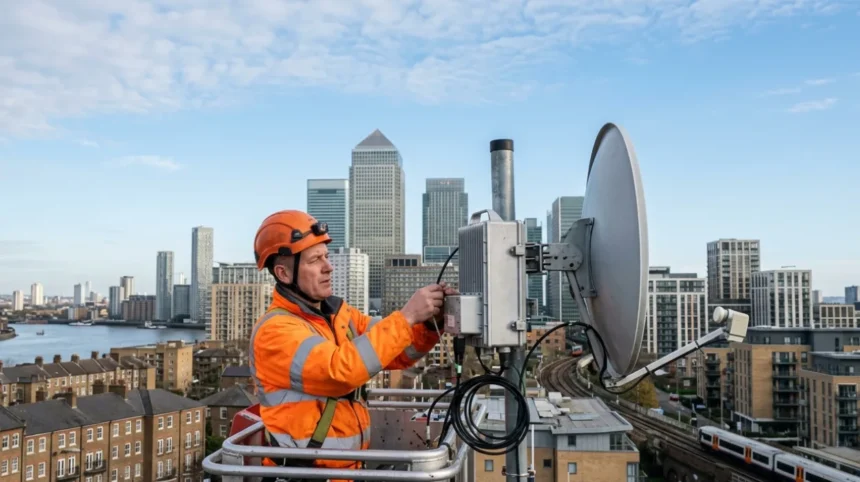
Solar flares are sudden bursts of energy from the Sun that release intense radiation into space. For East London readers, the main relevance is their effect on radio signals, GPS, satellites, and power systems rather than direct danger to people on the ground.
- What Is a Solar Flare?
- How Do Solar Flares Form?
- What Are the Main Types of Solar Flare?
- What Happens When a Solar Flare Reaches Earth?
- Why Does East London Matter in Solar Flare Planning?
- What Are the Historical Examples of Solar Flares?
- How Are Solar Flares Measured and Monitored?
- How Do Solar Flares Affect Daily Life?
- Are Solar Flares Dangerous to People?
- What Is the Difference Between a Solar Flare and a Coronal Mass Ejection?
- How Can People and Services Prepare?
- Why Does Solar Flare Knowledge Still Matter?
What Is a Solar Flare?
A solar flare is a rapid explosion of energy on the Sun caused by magnetic activity in active regions around sunspots. It releases radiation across the electromagnetic spectrum, including X-rays and ultraviolet light, and it often lasts from minutes to hours.
Solar flares happen in the Sun’s outer atmosphere, mainly in the corona. They are driven by the sudden release of magnetic energy stored in twisted field lines. This energy turns into heat, light, and fast-moving particles. The strongest flares can be powerful enough to disturb Earth’s upper atmosphere within minutes.
The Sun follows an approximately 11-year activity cycle. During the peak years, solar flares become more frequent. Scientists track them because they affect technology in space and on Earth. The most intense flares are classified as X-class events.
For East London, the topic matters because modern daily life depends on systems that use radio communication, satellite navigation, and electricity. Even though residents do not feel the flare directly, the effects can appear in transport, communications, and digital services.
How Do Solar Flares Form?
Solar flares form when magnetic energy builds up in the Sun’s atmosphere and is suddenly released through magnetic reconnection. That process heats plasma, accelerates particles, and produces a burst of radiation.
The Sun is made of hot plasma, not solid material. Its magnetic fields shift and twist constantly because of solar rotation and internal motion. When those magnetic fields become too stressed, they snap into a new arrangement. That release is called magnetic reconnection.
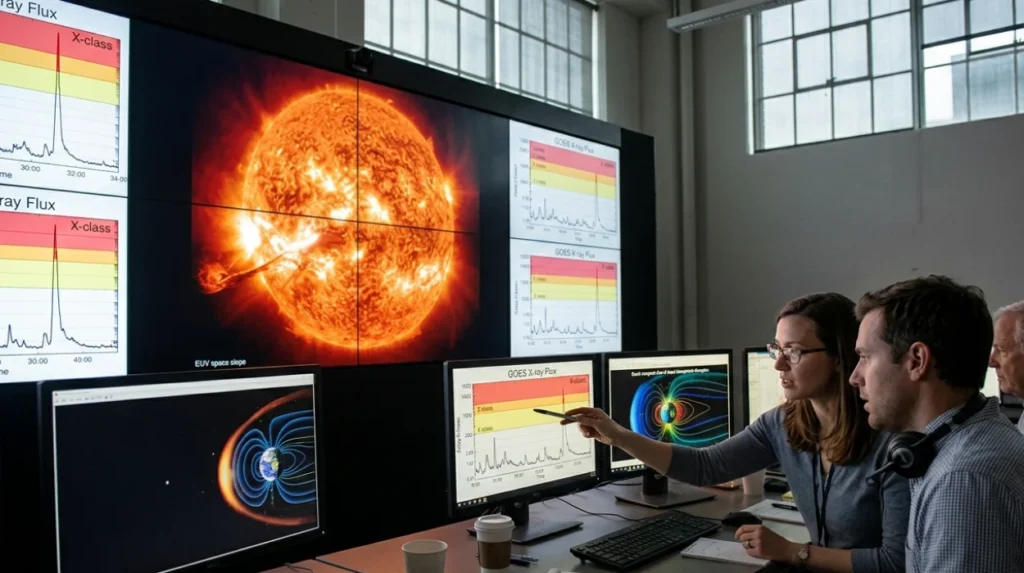
Reconnection creates a chain reaction. It accelerates electrons and ions, heats nearby gas to very high temperatures, and sends radiation outward. The flare often begins with a sharp rise in X-rays, then slowly declines as the hot material cools.
Sunspots are important because they mark areas with strong magnetic fields. Flares usually begin near these active regions. Scientists use solar telescopes and space observatories to watch these areas because they help predict flare activity.
What Are the Main Types of Solar Flare?
Solar flares are grouped by strength into C-class, M-class, and X-class events. C-class flares are weak, M-class flares are moderate, and X-class flares are the strongest and most disruptive.
The classification system uses X-ray intensity measured near Earth. Each step upward means a tenfold increase in strength. That means an X-class flare is far more intense than an M-class flare, and an M-class flare is much stronger than a C-class flare.
C-class flares usually cause little impact beyond minor radio changes. M-class flares can interrupt radio communication and affect high-frequency systems. X-class flares can disrupt satellites, aviation communications, and navigation systems.
Scientists also use sublevels such as M1, M5, or X2 to show the exact strength. This helps compare one flare to another and estimate likely effects. The stronger the flare, the greater the chance of visible space weather impacts on Earth.
What Happens When a Solar Flare Reaches Earth?
When a solar flare reaches Earth, its radiation affects the ionosphere, which can disrupt radio signals, GPS accuracy, aviation communications, and satellite operations. The flare itself does not burn the ground, but it changes conditions above the atmosphere.
The first effect is often a radio blackout on the sunlit side of Earth. High-frequency radio signals can weaken or fail because the ionosphere becomes more ionized. This matters for aviation, maritime communication, emergency services, and some long-distance broadcasting.
GPS systems can also become less accurate. Solar activity changes the density of the upper atmosphere, which affects the signals sent between satellites and receivers. That can create positioning errors and timing problems.
Satellites face additional risk because the upper atmosphere expands during intense solar events. This creates more drag on low-orbit satellites, which can alter their paths. Spacecraft electronics can also suffer from radiation exposure during strong storms linked to flares.
Why Does East London Matter in Solar Flare Planning?
East London matters because the area depends on digital navigation, mobile networks, transport systems, and power infrastructure that can all feel the effects of space weather. The direct danger is low, but the service disruption risk is real.
Local life in East London depends on systems that need accurate timing and communication. Train networks, traffic management, mobile data, and broadcast systems all rely on technologies that are sensitive to space weather. A strong solar flare can create temporary issues in these services, especially if a coronal mass ejection follows.
Air travel is another area of relevance. Flights using polar routes experience the greatest radio and navigation disruption during strong solar activity. Even though East London itself is not near the poles, airport operations, flight planning, and international communication systems still depend on stable space-weather conditions.
Businesses in East London also use satellite-based services for logistics, mapping, and delivery planning. That means flare activity has a wider economic impact than many people expect. The event is solar, but the consequences are terrestrial.
What Are the Historical Examples of Solar Flares?
Historical solar flare events include the 1859 Carrington Event, the 1989 Quebec power outage, and the 2003 Halloween storms. These events show how solar activity can disrupt technology on a large scale.
The Carrington Event of 1859 remains the most famous solar storm in recorded history. It caused bright auroras at unusually low latitudes and disrupted telegraph systems. Some operators reported sparks and failures in telegraph equipment.
In 1989, a major solar event led to a power outage in Quebec, Canada. The storm affected transformers and damaged the electric grid. This event showed that space weather can interfere with large power systems, not just communication devices.
In 2003, a series of strong solar flares and associated storms caused satellite issues, radio problems, and technical disruptions around the world. These examples matter because they demonstrate that solar activity has practical consequences for modern infrastructure.
How Are Solar Flares Measured and Monitored?
Solar flares are measured using X-ray observations, solar telescopes, and satellite monitoring systems. Scientists track flare size, timing, location, and associated radiation to assess the risk to Earth.
Space agencies use satellites to observe the Sun continuously. These instruments detect X-rays, ultraviolet radiation, and particle emissions that cannot be seen from the ground. This monitoring helps scientists classify flare strength and estimate its likely effect.
Ground-based solar observatories also play a role. They study sunspots, magnetic fields, and active regions on the Sun’s surface. This information helps predict whether an active region is building toward a flare.
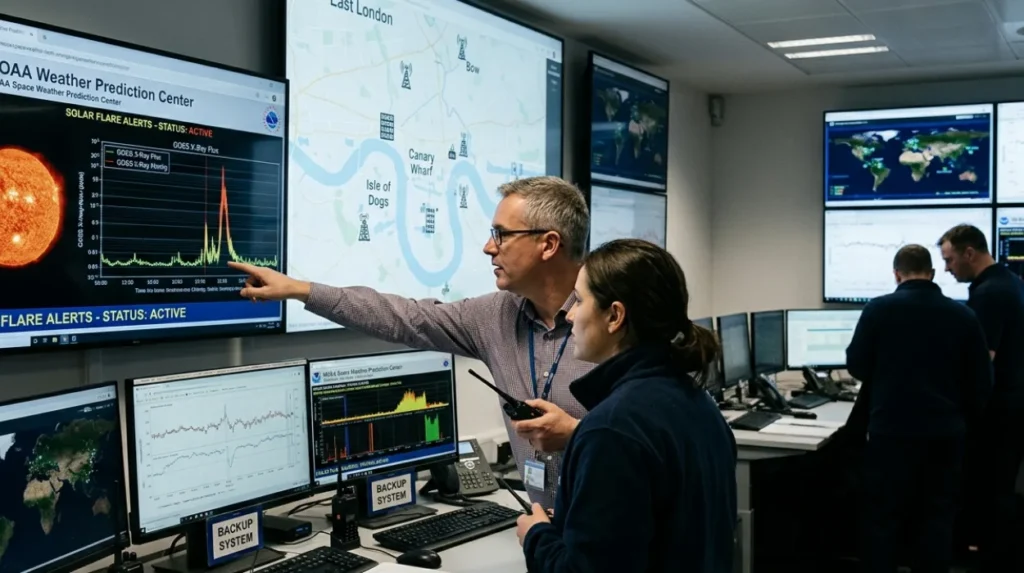
Monitoring matters because solar flares can arrive with little warning once they begin. Early detection helps power companies, aviation planners, satellite operators, and emergency communication teams prepare for possible disruption.
How Do Solar Flares Affect Daily Life?
Solar flares affect daily life mainly through temporary technology disruption. The main impacts are weaker radio communication, GPS errors, satellite issues, and occasional power-grid stress during the strongest events.
For most people, the effect is invisible. A phone may continue working normally, and there is no direct physical harm. The problem appears in systems that depend on satellites or radio waves.
Navigation can become less reliable. This matters for road transport, aviation, shipping, logistics, and emergency response. Timing systems can also shift slightly, which affects networks that rely on precise synchronization.
Power grids face the biggest risk when a strong flare comes with a coronal mass ejection. The flare itself is radiation, but the associated particle cloud can drive geomagnetic storms. Those storms can induce currents in long transmission lines and damage transformers.
Are Solar Flares Dangerous to People?
Solar flares are not dangerous to people on the ground because Earth’s atmosphere blocks the harmful radiation. The main risks are to astronauts, pilots on high-altitude routes, and technology systems.
Earth’s atmosphere and magnetic field provide strong protection. That means people in East London do not need personal shielding or emergency shelter for a solar flare. The event does not cause heat waves, fire, or physical impact at ground level.
Astronauts have much higher exposure because they travel outside most of Earth’s natural protection. High-altitude flights also face increased radiation exposure during strong events, especially on polar routes. That is why aviation systems monitor solar activity closely.
The key public concern is not bodily harm but infrastructure reliability. Communication failures and power problems can affect safety services, transport, and business continuity. That makes solar flare awareness useful even for people who never see the Sun’s activity directly.
What Is the Difference Between a Solar Flare and a Coronal Mass Ejection?
A solar flare is a burst of radiation, while a coronal mass ejection is a large cloud of charged solar material thrown into space. They often happen together, but they are different phenomena.
A solar flare acts fast. It sends electromagnetic radiation across space, and its effects on Earth can begin in minutes. A coronal mass ejection, by contrast, is a physical release of plasma that can take one to three days to reach Earth.
This difference matters because flares and CMEs affect Earth in different ways. The flare mostly causes radio blackouts and ionospheric disruption. The CME can create geomagnetic storms that damage power systems and intensify auroras.
Not every flare comes with a CME. Not every CME comes with a major flare. Scientists study both because the combined event creates the strongest space-weather risk.
How Can People and Services Prepare?
Preparation focuses on monitoring, communication planning, and system resilience. The best response is early warning, backup systems, and awareness of possible radio, navigation, and power disruptions.
Governments and infrastructure operators use space-weather alerts to prepare for strong solar activity. These alerts help grid managers, aviation teams, and satellite operators switch to safer procedures. Backup communication channels reduce the risk of service failure.
For everyday users in East London, the practical step is simple awareness. If a major solar event is reported, temporary navigation errors or communication issues can happen. Businesses that depend on delivery tracking, remote coordination, or cloud-linked timing systems should have fallback plans.
The wider lesson is that solar flares belong in resilience planning. As societies rely more on digital systems, the importance of space-weather forecasting grows. That makes solar flare monitoring part of modern infrastructure protection.
Why Does Solar Flare Knowledge Still Matter?
Solar flare knowledge matters because solar activity affects the systems that support transport, communication, finance, and public safety. The Sun remains a real operational factor in a connected world.
The risk is not constant, but it is recurring. Solar cycles continue, and strong flares remain part of natural solar behavior. As technology becomes more satellite-dependent, the consequences of space weather become more visible.
For East London audiences, the issue connects directly to daily life through phones, GPS, public transport, and digital services. That is why solar flares are not only a science topic. They are also a modern infrastructure topic.
What is a solar flare?
A solar flare is a sudden burst of energy from the Sun that releases radiation such as X-rays and ultraviolet light into space.