
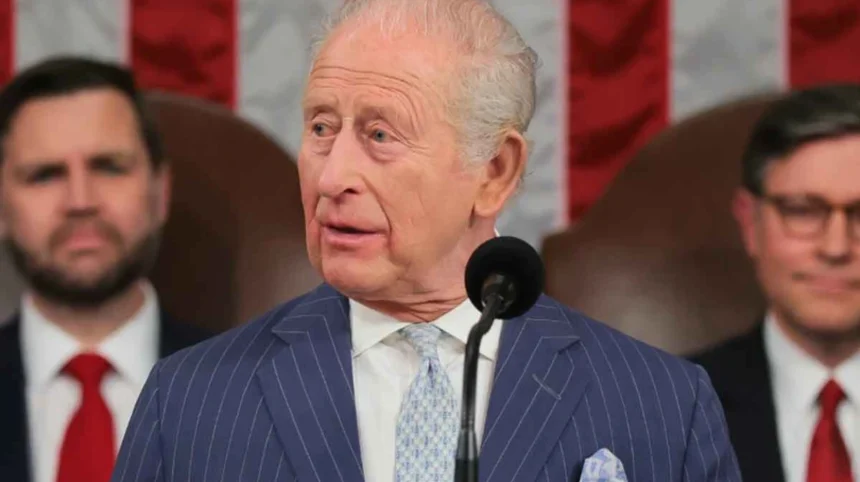
Tuesday 29th day of April 2026 will be a day long remembered in the history of the United States of America and for its Congress. It was that day last week on which King Charles III became the first English king to address the Congress since America’s War for Independence against King George III. It was a remarkable speech in so many ways, not least, because the United States today is in a reverse position in terms of its president assuming extraordinary powers facilitated by a unique theory of immunity declared by the United States Supreme Court. Many Americans reflecting on that famous Declaration of Independence, which inaugurated America’s great experiment in democracy, will find comfort from the King’s speech, but antipathy with their president’s apparent disregard for its objectives.
So far as the King’s visit is concerned it was probably the most successful visit by any reigning monarch or statesman to America since that famous declaration. That is because the King was able to give an authoritative account of Anglo-American relations not just since 1776, but even before that. He reminded the Congress and the Supreme Court that they had inherited British values and principles that had outlasted their revolution and the War of 1812, and would probably outlast many future changes of government. From Magna Carta 1215 to the Bill of Rights 1689 the fundamental principles of government had been inscribed in the American constitution and applied. Not only that, but the concept of a separation of powers was also adopted by Americans to ensure the status of the three organs of government: Judiciary, Legislature and Executive. The King made particular reference to those functions in terms of its checks and balances. Indeed, it is only when such checks and balances are respected and observed that democracy is perhaps at its most effective. Such references reinforced the King’s mention of Magna Carta and the Bill of Rights which in 1215 inhibited the excesses of King John and gave the Barons certain feudal rights, and in 1689 acknowledged Parliament’s sovereignty, limited the powers of the monarchy and recognised fundamental civil rights. The American revolutionaries, led by many lawyers it must be said, drafted their own Bill of Rights to which the King also referred.
Despite President Trump’s antagonism towards NATO and his animosity towards Ukraine in its own war for independence, the King paid tribute to NATO and Ukraine. NATO had preserved the peace in Europe against the Soviets during the Cold War and remained an effective deterrent. It is, he said, essential to European security. Not only that but support for Ukraine is essential if Europe is to remain free as the European Powers are now recognising with their commitments to Ukraine and their concerns over American policy. The King did not explicitly say that ,but his message was clear without support for NATO, the Atlantic alliance which protected US and European interests for 77 years any lack of support would be against the national interests of all its members. In the King’s words it was a means of defending
“our values in Europe and across the world.”
What I found so remarkable about the King’s speech to the Joint Session of the Congress was its effect on the audience of Congressmen and Senators alike, Republican and Democrat. There were at least 12 standing ovations for his comments even those which were contrary to some of President Trump’s pronouncements regarding NATO and Ukraine. No one watching the event could be in any doubt as to the positive effect the speech had on its audience and on Americans as well as people around the world who may have watched or listened to it. Although such effect cannot be precisely measured, it was undoubtedly inspiring. It reminded its audience of why America was founded, why Thomas Jefferson and his colleagues drafted the Declaration in 1776, why they had checks and balances in their constitution, and why above all Anglo-American relations have existed, despite differences, because of common values, a belief in democracy and the rule of law.
Many people had concerns about the King’s visit to the United States at this time, but the King certainly disabused those concerns by a triumph of diplomacy and statesmanship. Not often has there been an occasion such as this where the monarch has been placed in such a difficult position with a president who has a reputation for impulsiveness and questionable behaviour.
As someone who had some American cousins in the northern and southern states, and has visited and lectured there, I imagine that such cousins would have been very interested in the King’s visit and pleasantly surprised by his message which gave meaning to the word “America.”