
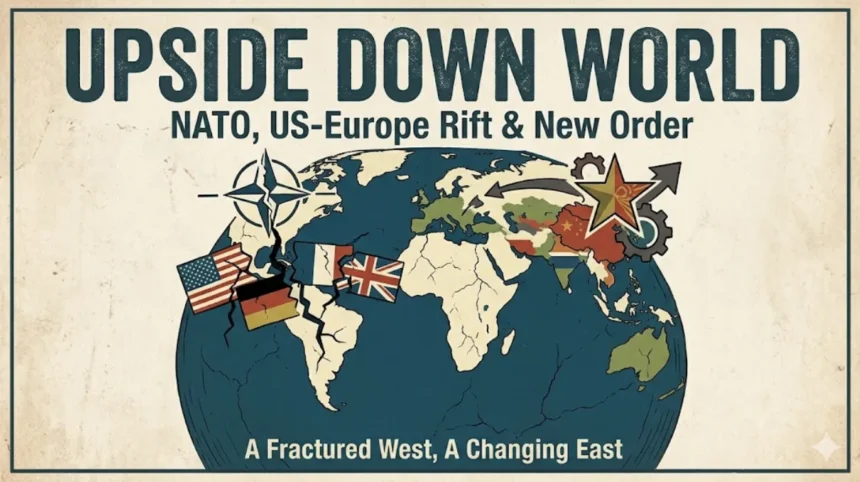
When Lord Cornwallis surrendered the British garrison at Yorktown in 1781 the regimental band allegedly played The World Turned Upside Down. It signified the end of British rule over the Thirteen Colonies. In his speech to the United States Congress on 28 April King Charles spoke of the cultural and historical ties that still unite what was the United KingdomUK News of Great Britain and North America, in particular democracy, our common values, language and the rule of law. He also spoke of our differences. Those differences are acute today as they have sometimes been in the past e.g., differences between Briatin and America during the American Civil War,and those between Roosevelt and Churchill during World War II. But today the different approach taken by the Trump administration towards NATO and its allies is starker so much so that European NATO members, members of the EU and other like-minded countries have recently voiced their concerns at the G7 meeting in Davos and at the more recent meeting of the European Political Community of 48 states in Armenia.
The unpredictable and unexpected action by the Trump administration substituting hostility for diplomacy, threatening the sovereignty of Greenland, Denmark, the Falkland Islands and even Canada, as well as threatening to withdraw troops from NATO, whilst venturing on an illegal and unconstitutional war in the Middle East without Congressional approval, not to mention a personal attack on His Holiness Pope Leo XIV who is an American born in Chicago all of which is without precedent. Historians may argue that Trump is similar to Nixon who had a war in the Middle East and an oil crisis, but Nixon as devious as he was had an excellent foreign policy adviser from Harvard, Professor Henry Kissinger who sorted out his problems. Trump has no one of Kissinger’s standing. Hence Europe’s problem is now the American Problem. Ironic because in the 1930s the Americans talked of the “European Problem.” Also, it was Thomas Jefferson, one of the Founding Fathers and one of the authors of the Declaration of Independence, who guaranteed America’s democracy by avoiding military adventures with Britain. Today it might be argued that Britain avoided something similar by not joining Trump’s war in the Middle East. Indeed, in many respects the policy being pursued by President Trump is contrary to the aspirations of those who founded America. It is not just a reversal of the tenets of Jeffersonian foreign policy and international liberalism, but a fundamental departure from the world order that Roosevelt designed as result of his experiences in office. That design has kept the peace broadly since 1945 and given confidence to members of the United Nations that world peace could be achieved through diplomacy and dialogue. Whilst President Roosevelt had reservations about European hegemony, President Kennedy encouraged European unification as a counterweight to Soviet domination in Europe. However, JFK’s rhetoric has to be interpreted in the in the context of the opinion of one of Henry Kissinger’s Harvard colleagues which was that essentially the United States saw Europe as a rival economically tolerable, but politically potentially anti American and a major threat to American interests. However, subsequently in the early 1990s, American policy accommodated a “Fortress Europe” policy when President George Bush in 1992 advocated an accommodation between the United States and the European Union which was reached through NATO. NATO gave and gives the United States an interest in Europe and influence as well as protection for their interests and Europe’s and America’s security. Just as the Gulf Crisis in 1990-91 demonstrated Europe’s reluctance to support and participate in that crisis, and similarly its reluctance to be involved in Bosnia in 1990-93 and now again in 2026 in Trump’s war with Iran a much deeper impasse has been reached which threatens the unity of NATO.
It is hard to understand the current United States administration’s policy which far from a policy of divide et impera Trump’s belligerent policy in the Middle East and elsewhere has driven the European States and others including Canada into the prospect of a more effective European defence identity. Not only that but the warnings from other states such as Serbia given to Alastair Campbell and Rory Stewart recently in their interview with its President indicate that there are other non-EU states that should join the EU as possibly the current United States government might like to entice them as they attempted in Hungary before its recent election.
In these circumstances it appears that President Trump has left Europe no choice in this matter as Prime Minister Carney has so eloquently advocated at Davos and in Armenia. For Europeans and Canadians, the position is alarming and that is why Prime Minister Carney of Canada, whose country has been on the receiving end of threats of invasion, imposition of high tariffs and bombastic insults, has been motivated to promote Canada in numerous new trade agreements with China and Europe. It has also provided $270 million support to Ukraine when the United States ceased direct military support on Trump taking office.
If ever there was time for leadership in the western democracies it is now. Prime Minister Carney has stepped up valiantly to that role in Davos at the G7 conference and last week in Armenia at the European Political Community meeting. As in Davos Carney warned of the threat to democracy, the world order, NATO and from those who prefer transactional policies rather than upholding international law norms and values. He referred to a ruptured world order that now prevails and that “strategic autonomy” is required. This means a unity of interests and values tied together in a mutual progressive alliance. The reality is now, as Prime Minister Carney said:
“The rules no longer protect you, you must protect yourself.”
President Alexander Stubb, the brave leader of Finland, spoke of “value-based realism” protecting the independence and sovereignty of states, the rule of law, the UN Charter, and importantly human rights.
As Prime Minister Carney said you need the “middle countries” to unite in the face of the three dominant powers of China, the United States and Russia since they have the capacity to control the world economy. To counter that prospect such “middle countries” need to combine their resources and strengths to preserve their independence. After all one might suggest that those countries do that in the same vein as that famous American lawyer-statesman Thomas Jefferson suggested all those years ago to the English colonists fighting for their freedom, independence, democracy and the rule of law.