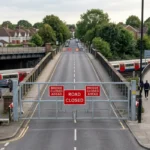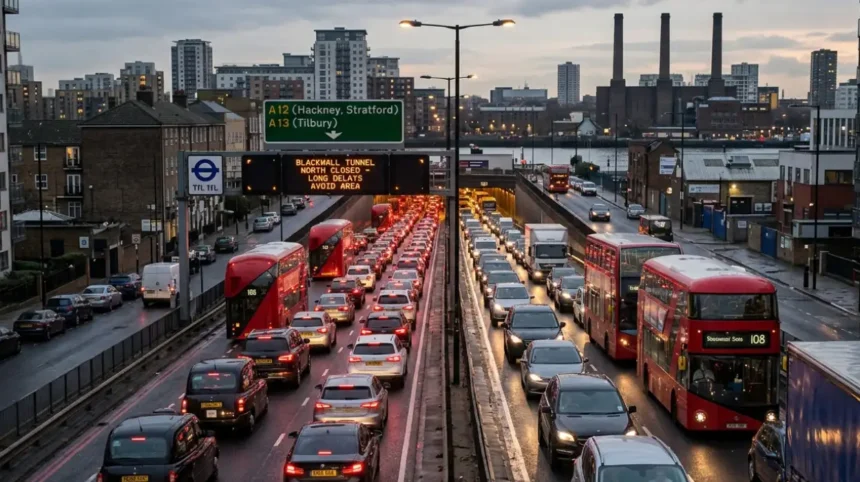
East London traffic congestion is shaped by river crossings, radial trunk roads, and dense local travel demand across boroughs such as Tower Hamlets, Newham, Greenwich, Hackney, and Barking and Dagenham. The worst delays cluster around the Blackwall Tunnel, the A12, the A13, the North Circular, and the South Circular, while live updates come from Transport for London road status pages, tunnel notices, and traffic camera feeds.
- What causes traffic congestion in East London?
- Which East London roads are the worst?
- How does the Blackwall Tunnel affect traffic?
- Where do live updates come from?
- What does “live traffic” mean for drivers?
- How bad is London congestion overall?
- Which roads need the most attention?
- How do tunnel charges change traffic?
- What data shows the worst delays?
- What should drivers check before traveling?
- Why does East London need evergreen traffic coverage?
- What is the clearest way to read East London traffic?
What causes traffic congestion in East London?
East London congestion comes from limited river crossings, heavy commuter flows, roadworks, freight traffic, and network bottlenecks on major corridors such as the A12, A13, A406, and A102. The area has strong demand for cross-river travel and few fast alternatives, so small disruptions create long queues quickly.
East London sits on a road network that carries both local trips and strategic traffic. The Blackwall Tunnel links the A102 on the Greenwich Peninsula to the A12 at Poplar, which makes it one of the most important east London crossings for drivers. The Silvertown Tunnel also connects the same wider corridor and has been added to relieve pressure on the Blackwall route.
Congestion also builds where major roads meet older urban streets. East London contains dense residential, commercial, and port-related areas, so vehicles merge, slow, stop, and rejoin often. This pattern produces recurring delay, especially at peak commuting times and during incidents or roadworks.
Which East London roads are the worst?
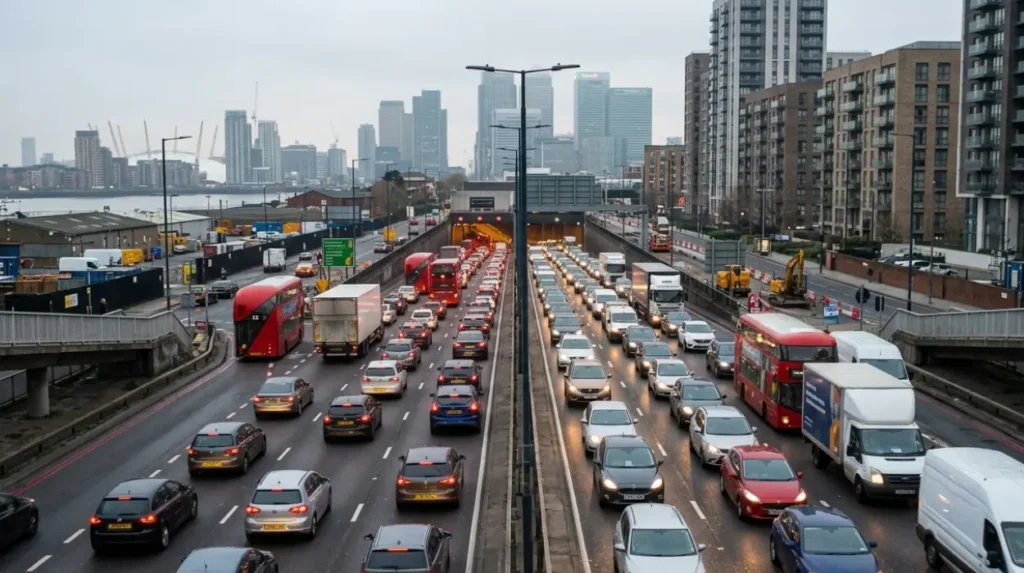
The worst East London roads are the Blackwall Tunnel approach roads, the A12, the A13, the North Circular, and the South Circular, because they carry the heaviest traffic and are the first to suffer from incidents or excess demand. TfL’s road corridor pages track these strategic links as key routes with exceptional delay risk.
The Blackwall Tunnel is the most notable pinch point. It connects south-east and east London traffic across the Thames, and TfL treats it as a major corridor with charging rules and live status updates. The tunnel and its approaches often dominate local congestion reporting because they connect multiple boroughs and funnel traffic through one constrained crossing.
The A12 and A13 also rank as key East London congestion routes. These roads carry long-distance and local traffic through Newham, Tower Hamlets, and the wider east side of the city. The A406 North Circular and A205 South Circular add another layer of pressure because they distribute traffic between boroughs and link radial routes to river crossings.
How does the Blackwall Tunnel affect traffic?
The Blackwall Tunnel is East London’s most important traffic bottleneck because it concentrates river-crossing demand into a narrow corridor and turns minor disruptions into major queues. TfL says the tunnel connects the A102 in Greenwich to the A12 at Poplar, and it operates alongside the newer Silvertown Tunnel under a charging regime.
The tunnel matters because it serves daily commuting, freight movement, and cross-river travel at the same time. When traffic rises or incidents occur, the queue can extend back onto the A102, the A12, and nearby local roads. That creates secondary congestion in surrounding streets, not just at the tunnel mouth itself.
The current tunnel system also includes variable charging periods. TfL says Blackwall and Silvertown tunnel charges apply every day except Christmas Day, with peak times on weekday mornings and evenings. This pricing structure is designed to manage demand, but the route remains a critical live-traffic focus for East London drivers.
Where do live updates come from?
Live East London traffic updates come from Transport for London road status pages, tunnel information pages, and live traffic camera networks such as TfL JamCam feeds. These sources give the most direct view of current delays, closures, and queue conditions on major corridors.
TfL’s road status widgets list corridor-by-corridor updates for major routes including the A12, A13, A20, A21, A205, A406, and the Blackwall Tunnel. The pages show whether there are no exceptional delays or active problems on the network.
Traffic cameras add visual confirmation. TfL JamCam feeds cover London’s major roads and junctions, with live views across all boroughs and more than 900 camera locations. That makes them useful for checking whether a queue is local, tunnel-related, or caused by a wider incident.
What does “live traffic” mean for drivers?
Live traffic means current road conditions reported in real time or near real time, including delays, closures, incidents, and congestion levels on specific roads. For East London drivers, that usually means checking the route before departure, then monitoring the network again if the trip crosses the river or uses a trunk road.
A live update is useful because East London conditions change fast. A road that moves normally in the morning can become heavily delayed within minutes after a breakdown, collision, lane closure, or signal fault. This is especially true near Blackwall Tunnel, the A12 corridor, and the A406.
For practical use, live traffic should be read as a decision tool. If the corridor status shows no exceptional delays, the route is normally open and moving. If cameras show standing traffic or TfL indicates incident management, drivers should allow more time or use an alternative route.
How bad is London congestion overall?
London remains one of the most congested cities in Europe, and that citywide pressure reaches East London through the same trunk roads and river crossings. BBC reporting on Inrix data said London motorists spent 101 hours stuck in traffic in 2024, which marked the fourth consecutive year the capital held that position in Europe.
That wider congestion matters to East London because regional pressure does not stay in the centre. Traffic spills outward along the A12, A13, and Circular routes, and river crossings absorb a large share of the load. As a result, East London often feels the effects of citywide congestion even when the local road surface is unchanged.
The Department for Transport road traffic dataset also shows the scale of movement across the city. It reported 19.4 billion vehicle miles travelled across London’s 9.2 thousand miles of roads in 2024, which shows the intensity of demand on the network.
Which roads need the most attention?
The roads that need the most attention are the East London corridors with the highest volume and the fewest fallback options, especially the Blackwall Tunnel approaches, A12, A13, A406, and A205. These are the roads where one delay creates a wider network effect across multiple boroughs.
The Blackwall Tunnel approaches need attention because they are single-purpose gateways for river crossing. The A12 and A13 need attention because they carry long flows through dense development zones and connect to key junctions. The A406 and A205 need attention because they redistribute pressure across the whole of East and South London.
These corridors also matter for non-car traffic. Buses, deliveries, taxis, emergency vehicles, and freight all depend on the same space. When one corridor slows, the effect reaches local high streets and feeder roads, which then lose reliability for everyday trips.
How do tunnel charges change traffic?
Tunnel charges change traffic by discouraging unnecessary trips, spreading demand across time, and reducing repeated use of the same constrained crossing. TfL says both Blackwall and Silvertown tunnels are charged in both directions during charging hours.
The current system uses peak and off-peak periods. TfL states that weekday peak hours run from 06:00 to 10:00 northbound and 16:00 to 19:00 southbound, with off-peak rates outside those windows and free travel overnight between 22:00 and 06:00. That structure directly shapes when drivers choose to cross.
Congestion Charge rules also affect broader travel patterns. TfL says the Congestion Charge operates in central London between 07:00 and 18:00 on weekdays and 12:00 to 18:00 on weekends and bank holidays, with a daily fee of £15 if paid in advance or on the same day, and £17.50 if paid by midnight on the third day after travel.
What data shows the worst delays?
Historical live-traffic studies show that East London’s worst delays are concentrated around the river crossings and their feeder routes, especially the Blackwall Tunnel corridor. Earlier London congestion research found the tunnel among the capital’s slowest routes, with waits extending beyond an hour during severe conditions.
That pattern remains important because the road geometry has not changed. The tunnel still channels large volumes into a limited space, and the surrounding network still relies on a small number of high-capacity roads. That means the same structural bottlenecks continue to create recurring delay.
London-wide traffic studies also confirm that congestion is not a short-term problem. BBC reporting on 2024 figures showed the capital remained Europe’s most congested city, which gives context to why East London corridors stay under pressure even outside obvious peak periods.
What should drivers check before traveling?
Drivers should check road status, live cameras, tunnel charges, and incident notices before traveling through East London, especially when the route includes the A12, A13, A406, A205, or Blackwall Tunnel. TfL provides corridor updates and route-specific information that helps identify disruption before departure.
The most useful checks are simple. First, review corridor status on TfL. Second, confirm whether Blackwall or Silvertown Tunnel charges apply. Third, inspect a live camera view for queue length or stationary traffic. Fourth, allow extra time if the route passes through a known bottleneck.
For publishers covering East London traffic, this structure also supports evergreen SEO. Readers search for worst roads, live updates, and congestion explanations together, so an article should cover all three in one place with clear entity-based language and route names.
Why does East London need evergreen traffic coverage?
East London needs evergreen traffic coverage because congestion is structural, recurring, and tied to fixed corridors that stay important year after year. The core factors are river crossings, corridor capacity, and high travel demand, not a single temporary incident.
Evergreen coverage also matches user intent. People search for “worst roads,” “live updates,” and “traffic today” at the same time because they want both background and immediate routing guidance. A strong article answers the background question, names the routes, and points readers to the live information channels that update continuously.
That approach gives the content lasting value. It remains useful during school runs, commuting periods, roadworks, tunnel changes, weather disruption, and incident-heavy days, while also serving as a stable reference for the East London road network.
What is the clearest way to read East London traffic?
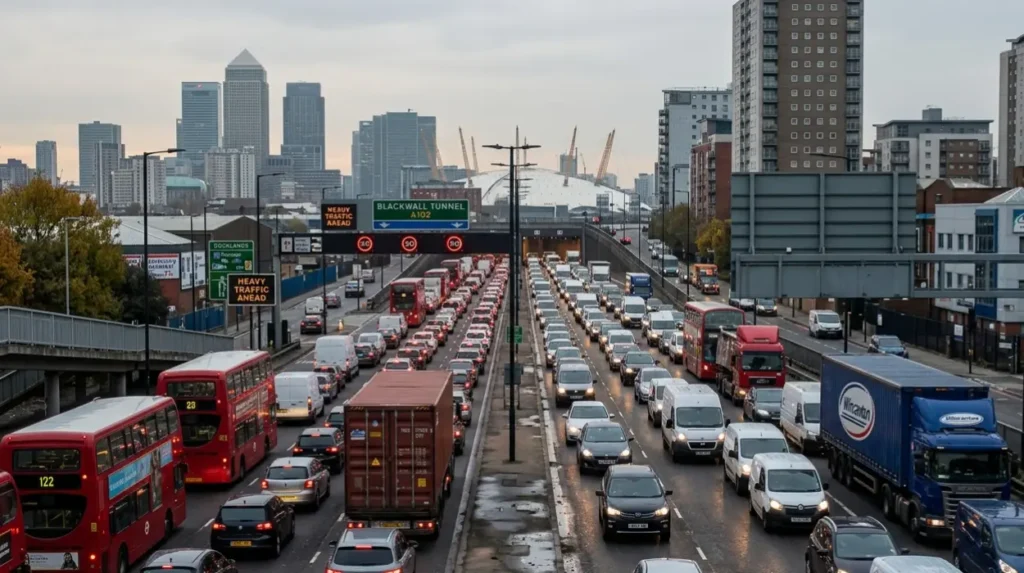
The clearest way to read East London traffic is to treat it as a network problem centered on a few critical corridors rather than as scattered local delays. The important routes are the ones that move traffic across the river and across borough boundaries, because those roads shape the whole system.
That network view explains why the same names appear repeatedly in congestion reports. The Blackwall Tunnel, A12, A13, A406, and A205 are not just roads; they are load-bearing parts of East London mobility. When they slow, the effect spreads into local streets, bus routes, and journey times across the wider area.
For that reason, the best live-update strategy is not guessing from one road only. It is checking the corridor status, looking at a camera if needed, and reading the route as part of the wider London traffic system. That method gives a more accurate picture of what is happening now and what it means for the next trip.
Why is East London traffic always so bad?
East London traffic is bad because too many vehicles rely on a small number of major roads and river crossings. Routes like the Blackwall Tunnel, A12, A13, A406 North Circular, and A205 South Circular carry commuter traffic, freight vehicles, buses, and delivery vans at the same time. Even a small breakdown or lane closure can create queues across multiple boroughs.