Key Points
- Major Redevelopment Proposed: Plans have been officially submitted to transform the Crowlands Heath Golf Course site on Wood Lane, Dagenham, into a massive, housing-led mixed-use neighbourhood.
- 1,298 New Homes: The project outlines the demolition of all existing golf course buildings and structures, followed by extensive site reprofiling to deliver 1,298 residential flats.
- Affordable Housing Breakdown: A 102-page planning statement confirms that the entire allocation will be affordable tenures, featuring 763 social rent units and 535 key worker living rent units.
- Cross-Borough Boundary: The 22.5-hectare site straddles two local authorities, with 998 homes structurally situated within the London Borough of Havering and 300 homes located inside the London Borough of Barking and Dagenham.
- Community Infrastructure: Alongside housing, the master plan details a community and commercial retail unit, an artificial multi-use games area, padel courts, a residential management suite, and comprehensive ecological restoration.
- Infrastructure Alterations: The application proposes a brand-new highway junction connecting to Crow Lane and major modifications to the existing junction at Wood Lane.
- Loss of Golfing Facilities: The development will see the permanent closure of the 9-hole USGA standard links-style course and its distinctive 30-bay floodlit “aqua” driving range.
- Secondary Application: Concurrently validated within the borough’s weekly planning updates is a separate application for a certificate of lawful development for a single-storey rear extension at 38 Jasmine Road, Rush Green.
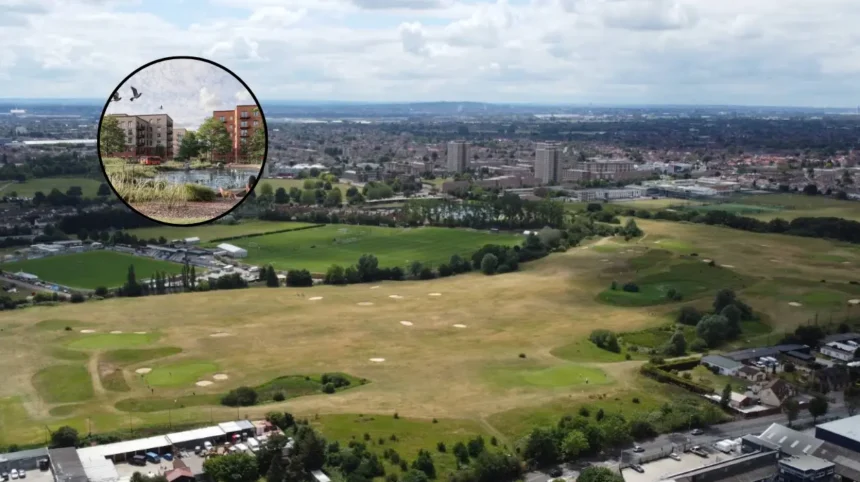
Dagenham (East London Times) July 3, 2026 — A major planning application has been formally lodged to completely reshape the well-known Crowlands Heath Golf Course site in Dagenham, replacing its existing sports structures with a major housing-led development. The comprehensive proposal intends to demolish all current infrastructure, reprofile the undulating landscape, and pave the way for 1,298 new residential dwellings alongside dedicated space earmarked for community and retail uses.
- Key Points
- Who is Behind the Crowlands Heath Transformation, and What Types of Housing Will Be Built?
- How is the 1,298-Home Project Split Across Local Borough Boundaries?
- Why is the Long-Standing Golf Course Being Closed Down?
- What Additional Community and Infrastructure Features Are Included in the Master Plan?
- What Environmental Challenges Must the Site Overcome Before Construction?
- What Separate Planning Applications Were Validated in the Area This Week?
- Background of the Crowlands Heath Redevelopment
- Prediction: How This Development Can Affect Local Residents and Key Workers
Processing on behalf of Barking and Dagenham Council is being managed by Be First, the local authority’s wholly owned regeneration and planning company, under the planning reference 26/00755/FULL. An identical reference covering cross-boundary observations, registered under Ref. No: 26/00830/OBS, has been cross-referenced within the weekly municipal listings.
Who is Behind the Crowlands Heath Transformation, and What Types of Housing Will Be Built?
As reported by reporter Luke Acton of the Romford Recorder, the official planning application was submitted by applicant Marc Pennick, who operates as the director of Homes4Life.
The corporate entity listed as the primary developer for the extensive regeneration project is LB Crowlands Heath Limited, which is owned directly by Homes4Life. The financial and structural framework of the proposal indicates that the development will pivot entirely toward affordable housing options designed to alleviate regional municipal waitlists.
A 102-page planning statement accompanying the submission confirms that the entire 1,298-home allocation will consist of affordable tenures, explicitly divided between social rent and key worker provisions.
According to the documented details, 763 units will be designated as social rent properties, which align strictly with the definitions set out in the London Plan to ensure rents are capped in accordance with national guidelines for registered providers.
The remaining 535 units are classified as “key worker living rent” properties, serving as an intermediate rental tenure tailored for essential public sector personnel whose household incomes exceed traditional social housing thresholds but remain insufficient to comfortably access local market-rate housing.
How is the 1,298-Home Project Split Across Local Borough Boundaries?
The spatial distribution of the development represents a highly complex cross-boundary administrative challenge.
As noted by the planning team at Be First, the total site footprint encompasses roughly 22.5 hectares of land that directly straddles the geographical border dividing the London Borough of Barking and Dagenham from the neighbouring London Borough of Havering.
Journalistic analysis of the validated planning statement reveals that the overwhelming majority of the physical housing stock will sit outside Barking and Dagenham’s technical border.
Specifically, 998 of the proposed flats are scheduled to be built within the boundary of Havering, while the remaining 300 homes will fall inside the jurisdiction of Barking and Dagenham.
Because of this cross-boundary reality, duplicate planning submissions have been processed, requiring coordinated assessments from both municipal chambers, alongside a formal evaluation and Stage 1 review by the Mayor of London’s planning unit.
Why is the Long-Standing Golf Course Being Closed Down?
The decision to close the recreational facility stems primarily from long-term financial insolvency and declining participation metrics. Writing for the Romford Recorder, local journalists highlighted that the submitted planning documentation openly states that Crowlands Heath Golf Course
“has been losing money for a number of years and is no longer financially viable to operate.”
Statistical breakdowns included in the developer’s formal submission paint a stark portrait of a dwindling sports club. At the exact time the planning permission papers were validated, the facility possessed just 72 active golfing members, 12 dedicated driving range members, and 27 registered social members.
To mitigate local policy objections regarding the loss of open sports provisions, the planning statement explicitly argues that regional demand is sufficiently met elsewhere.
The developers note that there are six alternative 18-hole golf courses operating within the London Borough of Havering alone, two of which are located in extremely close proximity to the site—specifically within 400 metres and 600 metres respectively.
What Additional Community and Infrastructure Features Are Included in the Master Plan?
Beyond the construction of residential blocks, the master plan drafted by architectural firm RCKa aims to establish a highly integrated, sustainable neighbourhood fabric.
Public notice documentation confirms the inclusion of a 1,084.1-square-metre flexible community and commercial retail unit positioned near the primary Wood Lane entrance.
This space is intentionally designed to serve flexibly as a local café, a convenience storefront, or a community assembly room, engineered to spill outward into the landscaped surroundings.
The environmental and recreational blueprint also introduces an artificial multi-use games area (MUGA), modern padel courts, and a central residential management suite to oversee daily estate operations.
A prominent feature of the landscape design involves extensive enhancement works to the existing Wantz Boating Lake. Director Marc Pennick publicly confirmed that he intends to bring the under-utilised boating lake back into active community use.
Pennick stated to local media that he has partnered with the London Kayak School and has “personally underwritten the costs for the next five years for the local school” to ensure community access to water sports.
To accommodate the influx of vehicular traffic, the application details substantial transport modifications. These include the layout of an entirely new highway junction connecting directly onto Crow Lane, alongside extensive alterations to the existing structural junction that feeds into Wood Lane.
What Environmental Challenges Must the Site Overcome Before Construction?
Because the 22.5-hectare site sits on land historically designated as part of the Metropolitan Green Belt, the application faces rigorous regulatory scrutiny.
The planning statement seeks to reclassify the plot from traditional green belt to “grey belt,” arguing that its contribution to the wider green belt network fell away long ago due to heavy industrial degradation.
Historical records show that the location was intensely utilised as an active landfill site from 1954 until 1972. Consequently, a comprehensive Environmental Impact Assessment (EIA) and an accompanying Environmental Statement have been submitted alongside the primary blueprints.
Environmental engineers have completed preliminary assessments, determining that while underlying soil contamination and landfill gas emissions are present, the overall risks to human health, controlled waters, and the wider ecosystem can be thoroughly managed.
The developer’s documentation asserts that these environmental issues will be
“effectively mitigated through appropriate remediation, gas protection measures, and clean cover systems”
prior to the laying of any residential foundations.
What Separate Planning Applications Were Validated in the Area This Week?
In addition to the landmark golf course transformation, Barking and Dagenham Council’s latest weekly planning ledger validated smaller-scale suburban residential modifications.
Among these minor filings is an application for a lawful development certificate at 38 Jasmine Road, Rush Green, Romford (RM7 0WZ).
Registered under the reference number 26/00780/CLUP, the homeowner is seeking formal legal confirmation for a proposed single-storey rear extension. Unlike major developments, this application requires no public environmental statements and will be determined strictly against permitted development criteria by municipal officers.
Background of the Crowlands Heath Redevelopment
The sudden transition of Crowlands Heath from a sports hub into a high-density residential zone follows nearly a year of behind-the-scenes municipal coordination and shifting architectural research. The facility originally opened in 1991, establishing a unique niche within the Essex and East London golfing communities.
It became well-known for its links-style 9-hole course built to USGA championship standards, which featured four separate tees per hole to effectively simulate the variety of a full 18-hole round. Additionally, the venue gained local fame for its 30-bay floodlit “aqua” driving range, a distinct setup where players hit balls directly into a large lake toward floating target greens and yardage buoys.
However, the underlying structural transition of the land began accelerating in late 2025. In October of last year, a formal letter addressed to residents living immediately adjacent to the Wood Lane site was distributed, disclosing that the specialized housing provider Homes4Life had entered into a binding legal agreement to purchase the golf course from its private owners.
The architectural firm RCKa had previously published extensive research advocating for the selective release of under-used, failing London golf courses to satisfy the capital’s acute social infrastructure and housing shortages. Following the publication of this research, the private owners of Crowlands Heath actively approached RCKa to design a high-level master plan capable of unlocking a high proportion of affordable housing on the financially unviable site.
The political mechanism enabling the sale was finalized a few months later. In March of this year, a formal cabinet meeting held by Barking and Dagenham Council officially reconfirmed the strategic municipal decision to support the sale and comprehensive redevelopment of the land, setting the stage for the major environmental and structural applications validated this month.
Prediction: How This Development Can Affect Local Residents and Key Workers
If approved by both Havering and Barking and Dagenham councils, this major development will profoundly alter the socioeconomic landscape for two distinct local audiences: families on municipal housing registers and regional key workers.
For local families currently stuck on long-term municipal housing waitlists, the introduction of 763 dedicated social rent homes represents one of the largest single-site injections of genuinely affordable housing in East London in recent years.
This influx will directly increase the statistical probability of local families securing stable, permanent tenure within their home boroughs, particularly addressing the acute shortage of three- and four-bedroom houses highlighted by the developers.
Concurrently, the allocation of 535 key worker living rent units will create a protected housing bubble for essential public sector staff—such as local NHS nurses, emergency service personnel, and school teachers.
By offering rents insulated from the volatile open market, the development is highly likely to improve retention rates for essential workers within the local outer-London boroughs, as these employees will no longer be priced out of the communities they actively serve.
Conversely, neighboring residents living along Wood Lane and Crow Lane will face long-term adjustments. The surrounding community will experience localized disruption from a multi-year environmental remediation and construction phase, necessary to neutralize the historical landfill infrastructure.