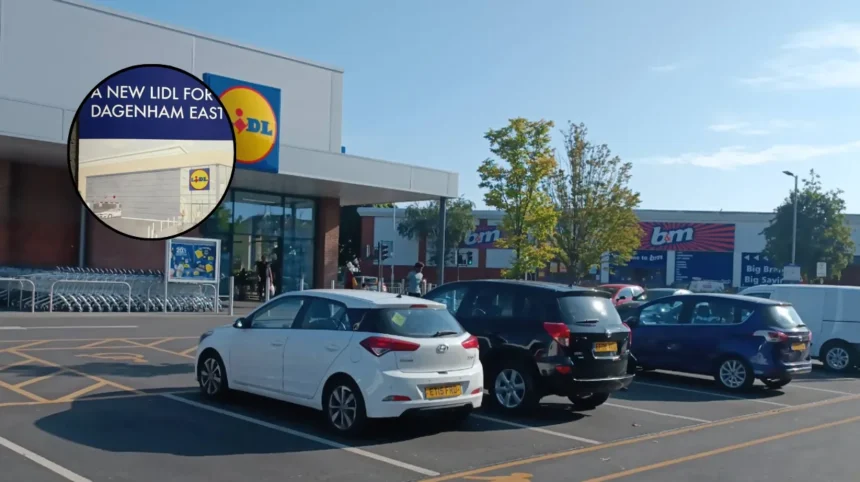
Key Points
- Formal Plans Pending: Budget supermarket chain Lidl has confirmed that formal planning documentation to construct a new store in Dagenham is in its final preparation stages.
- Location Confirmed: The proposed development will occupy the vacant site of the former Jewson builders’ merchant yard located on Shafter Road, near Dagenham East.
- Procedural Progress: Barking and Dagenham Council planning officers have officially ruled that the project does not require an Environmental Impact Assessment (EIA), removing a potential regulatory hurdle for the development.
- Store Specifications: Early proposals detail a 2,263 square metre gross internal area, featuring an in-store bakery, customer toilets, and an elevated store layout constructed above parking provisions.
- Community Divide: While the store promises discounted options amidst cost-of-living challenges, local independent traders and residents have expressed strong opposition regarding imminent traffic congestion and potential small business closures.
Dagenham (East London Times) July 11, 2026 –As reported by Nick Clark, a Local Democracy Reporter for the Barking and Dagenham Star, newly publicised planning documents have revealed that the international discount supermarket giant Lidl intends to submit a formal planning application to build a new retail food outlet on the site of the former Jewson builders’ merchant yard in Dagenham. The industrial site, located on Shafter Road, has stood vacant since the building merchant closed down in 2025.
- Key Points
- What Do the Initial Blueprints Disclose About the Supermarket’s Layout and Scale?
- Why Has the Environmental Impact Assessment Decision Sparked Local Dialogue?
- How Are Local Independent Business Owners Responding to the Supermarket Expansion?
- Background of This Particular Development
- Prediction: How This Development Can Affect the Local Community and Independent Retailers
According to official correspondence released by the local authority, Lidl Great Britain Limited has been advancing its property frameworks following an initial period of intense local consultation earlier this year.
A spokesperson for Lidl stated explicitly to reporters that the enterprise is progressing plans for the new Shafter Road store with the clear intention of bringing high-quality, affordable products to the local community.
The corporate real estate branch is currently finalising the granular details of the application, which is expected to land on the desks of the local planning authority in the coming weeks.
What Do the Initial Blueprints Disclose About the Supermarket’s Layout and Scale?
As revealed by the Romford Recorder through published consultation materials and screening requests submitted by Sean Moulton of Rapleys LLP on behalf of the supermarket chain, the prospective development is substantial in its physical scope. The proposed site plan indicates that the store would encompass a gross internal area (GIA) of 2,263 square metres.
Out of this total footprint, the net sales area would occupy 1,209 square metres, whilst the remaining space is to be split cleanly between a 512 square metre warehouse sector and a 541 square metre ancillary block, which is slated to feature customer toilets and a freshly baked goods station.
Architectural designs indicate that the food store will be constructed uniquely above its parking level. According to the screening documents, the building will present a modern, functional appearance utilizing an attractive glazed frontage meant to blend seamlessly with the emerging architectural styles of the surrounding neighbourhood.
Operational parameters have also been outlined at this early stage. The documentation suggests the supermarket will seek operating hours from 8:00 am to 10:00 pm from Mondays to Saturdays, including bank holidays, while its Sunday trading hours would run from 10:00 am to 4:00 pm.
Furthermore, to limit disruption to nearby housing estates, the site plans specify that the store will typically receive a maximum of two deliveries per day.
All operational waste generated by the retail facility is to be stored internally within the warehouse boundary and retrieved directly by the returning delivery vehicles, thereby reducing heavy goods vehicle (HGV) movements on surrounding residential streets.
Why Has the Environmental Impact Assessment Decision Sparked Local Dialogue?
As reported by journalists at the Romford Recorder, the project recently passed a critical regulatory checkpoint when Barking and Dagenham Council’s planning officers issued a formal screening opinion under national environmental infrastructure laws.
The local authority ruled definitively that a comprehensive Environmental Impact Assessment (EIA) would not be legally required before full planning permissions can be assessed.
The technical response from the municipal planning officers defined the commercial scheme as an “urban development project,” but clarified that it remains far too small to cross the statutory thresholds that necessitate an exhaustive environmental impact study.
Furthermore, council officials formally noted that the former merchant yard is not situated within a legally classified “sensitive area”.
This ruling effectively greenlights Lidl’s legal team to file their finalized full planning application without navigating months of complex environmental litigation, accelerating the timeline towards physical construction.
How Are Local Independent Business Owners Responding to the Supermarket Expansion?
Despite the corporate momentum, the proposal has encountered stiff resistance from established independent merchants operating in the Dagenham East sector. The primary point of contention revolves around commercial survival and local highway infrastructure safety.
As documented by local reporter Gianni Cirillo, independent business owners organized an emergency site gathering in late February to confront Lidl representatives directly.
Manj Mattu, the longstanding owner of the nearby independent convenience store Dagenham East Wines, expressed grave concerns regarding the survival of small-scale retail ecosystems. Mattu stated to local media:
“It would cause chaos. We’ve got a Tesco, Dagenham East station, independent shops, and three sets of traffic lights – why congest everything into this area? If Lidl was to open here, I think half of these shops would be closed within a year – we can’t survive otherwise. It’s the little things that keeps us going.”
Mattu argued that local authorities should push the development toward alternative sites, pointing specifically to the vacant plot of the former The Bull public house further down Rainham Road South as a viable space that features far easier logistical access without endangering passing pedestrians.
In terms of physical access, current layouts dictate that customer vehicles will enter and exit the underground car park directly from Shafter Road, while foot passengers will have a secondary pedestrian-only gate connecting to Rainham Road South.
Local residents have voiced worries that the short corridor of Rainham Road South where Western Avenue, Shafter Road, and Dewey Road intersect is already a notorious bottleneck that will become completely impassable during peak weekend trading hours.
In response to these escalating safety and logistical anxieties, Lidl representative Joe Loydon reassured the public during community engagement forums that the corporate entity is acutely aware of the local highway concerns.
Loydon announced that the firm’s traffic engineers are collaborating intimately with the regional highway authority to verify that the store’s entrance designs do not compromise urban safety, adding that the highway authority would never permit a retail scheme that is inherently hazardous to the public.
Explore More Dagenham News
Crowlands Heath Golf Course 1,300 Homes Plan Lodged: Dagenham 2026
CCTV Catches Fly-Tipper Facing £2,000 Court Fine in Dagenham 2026
Background of This Particular Development
The push by Lidl to anchor a major discount retail store in Dagenham East comes against a backdrop of aggressive nationwide expansion by German discount chains looking to capitalise on shifts in British consumer habits.
Over the last decade, high inflation and squeezed household disposable incomes across Greater London have driven shoppers away from traditional “Big Four” supermarket networks towards cheaper alternatives.
The specific site choice on Shafter Road reflects a wider urban planning trend within the London Borough of Barking and Dagenham, which involves reallocating defunct brownfield industrial sites for commercial and high-density residential use.
Jewson, a major national builders’ merchant, consolidated its distribution networks and closed this retail yard in 2025, leaving a highly accessible urban plot vacant. Given its immediate proximity to Dagenham East underground station and a densely populated residential zone, the site quickly became a prime target for major grocery firms.
Initial moves began quietly in February when Lidl distributed thousands of local informational leaflets across the RM10 postal area, launching a public feedback portal that officially closed on March 4.
The progression from a community consultation to an EIA screening request, and now toward an imminent full planning submission, shows a calculated corporate strategy to rapidly replace industrial infrastructure with low-cost retail assets.
Prediction: How This Development Can Affect the Local Community and Independent Retailers
If Barking and Dagenham Council’s planning committee grants full approval for the Shafter Road development, the material impact will be felt directly by two distinct local audiences: everyday consumers and independent high-street shopkeepers.
For the general residential demographic of Dagenham East, the presence of an affordable supermarket within walking distance will likely yield positive financial relief. The inclusion of a 1,209 square metre net sales floor with an in-store bakery will drive intense price competition against the adjacent Tesco Express branch, driving down the everyday cost of essential groceries for suburban families.
Furthermore, the introduction of 47 to 52 parking spaces and 22 secure bicycle bays will provide a modern infrastructure asset for shoppers who currently travel further out to the Dagenham Heathway or Chadwell Heath commercial centres for large-scale weekly food shops.
Conversely, for independent retail owners and convenience store operators along Rainham Road South, the opening of this store could prove economically devastating. Small family-run grocers, off-licenses, and boutique bakeries rely heavily on incidental foot traffic generated by commuters walking to and from Dagenham East station.
Because independent shops cannot match the purchasing power and rock-bottom margins of an international discount corporation like Lidl, a significant portion of local revenue is predicted to shift away from the high street.
If local predictions by traders hold true, the area could see storefront vacancies rise within 12 to 24 months of the store opening, permanently changing the socio-economic makeup of the neighbourhood from a hub of independent traders into a corporate-dominated retail pocket.