
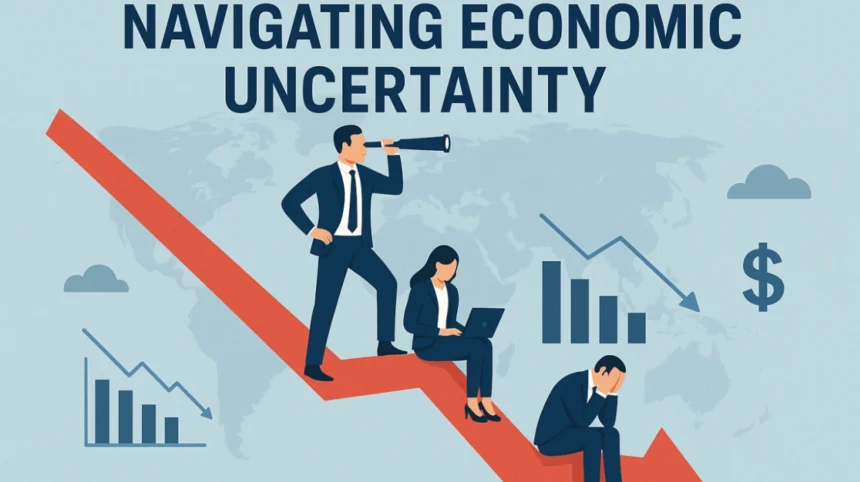
For decades, businesses learned how to manage familiar economic risks. Inflation, interest rates, labour costs, and market cycles could be measured, analysed, and often anticipated. Companies built strategies around forecasts, governments designed policies around economic models, and investors made decisions based on expectations of relative stability.
Today, however, the nature of economic risk has changed.
The greatest challenge facing businesses is no longer only the cost of borrowing or the pressure of rising prices. It is uncertainty itself.
Throughout my years covering economic and international affairs, I have noticed a significant shift in the conversations taking place among policymakers, investors, and business leaders. The focus is no longer only on growth figures or interest rate decisions; it is increasingly about how to make decisions in a world where certainty has become more difficult to achieve.
From changing trade policies and geopolitical tensions to supply chain disruptions and rapid technological transformation, companies are operating in an environment where long-term planning has become increasingly challenging. The question facing business leaders is no longer simply where to invest, but whether they can confidently predict the conditions that will shape tomorrow’s economy.
The International Monetary Fund has highlighted uncertainty as one of the key factors affecting global growth prospects. Although the global economy has demonstrated resilience, growth remains below historical averages, while risks related to trade tensions, geopolitical developments, and policy uncertainty continue to influence investment decisions.
This new reality is changing the way companies think about the future.
When Waiting Becomes a Business Strategy
Investment depends on confidence.
A company expanding a factory, entering a new market, or hiring more employees is making a decision based on expectations about future conditions. When those expectations become unclear, businesses often delay action.
Waiting becomes a strategy.
This does not necessarily mean companies lack ambition or financial strength. In many cases, caution is a rational response to an unpredictable environment.
The Organisation for Economic Co-operation and Development (OECD) has warned that elevated uncertainty can weaken business investment. When companies cannot accurately assess future demand, costs, regulations, or market conditions, they often postpone major decisions.
The economic impact of this hesitation can be significant: fewer investments, slower innovation, and missed opportunities for growth.
From Efficiency to Resilience
For many years, global businesses focused on efficiency. International supply chains were designed primarily to reduce costs and maximise productivity.
However, recent global disruptions changed that approach.
The pandemic revealed the vulnerabilities of highly concentrated supply networks. Companies discovered that efficiency alone was not enough; they also needed resilience.
Today, many businesses are investing in:
• diversified supply chains,
• alternative production locations,
• digital transformation,
• and stronger risk management systems.
This shift may increase costs in the short term, but many executives now view resilience as a strategic investment rather than an unnecessary expense.
The lesson is clear: the cheapest option is not always the most secure option.
The Limits of Traditional Economic Tools
Central banks remain among the most powerful institutions in the global economy. Interest rates continue to play a critical role in managing inflation and influencing demand.
However, today’s challenges cannot always be solved through monetary policy alone.
Higher interest rates cannot rebuild disrupted supply chains. They cannot remove geopolitical tensions. They cannot determine the future direction of technology or global trade.
This means economic stability requires a broader approach.
Governments, businesses, and financial institutions must work together to create conditions that encourage investment. This includes predictable regulations, long-term policy frameworks, and greater confidence in the economic environment.
For companies, certainty does not mean knowing exactly what will happen. It means having enough stability to make decisions despite uncertainty.
Technology: Opportunity and Disruption
Artificial intelligence represents another major factor reshaping the global economy.
For many businesses, AI offers one of the greatest opportunities for productivity growth in decades. It has the potential to improve efficiency, reduce costs, and create entirely new industries.
At the same time, it raises important questions about investment, skills, employment, and competitiveness.
The challenge for businesses is not simply adopting new technology. It is understanding how to use it effectively while managing the risks created by rapid transformation.
Companies that successfully combine technology with human expertise may gain a significant advantage in the years ahead.
A New Mindset for a Changing World
The global economy has always experienced periods of uncertainty. What makes today different is the speed and scale of simultaneous changes.
Businesses are facing economic pressures, technological disruption, changing consumer behaviour, and geopolitical challenges at the same time.
The most successful companies of the future may not necessarily be the largest ones. They will be those capable of adapting quickly, managing risks effectively, and maintaining a clear long-term vision.
The future of global business will not be built on certainty. It will be built on the ability to operate successfully despite uncertainty.
As a journalist, I have learned that behind every economic statistic there are human decisions, businesses, and communities affected by the choices made today. Understanding uncertainty is therefore not only an economic challenge; it is also a human one.
The question facing the global economy is no longer whether uncertainty can be avoided.
It is whether businesses, governments, and societies can learn how to succeed within it