Key Points
- Nancy Karoki, an intensive care (ITU) nurse at Barking, Havering and Redbridge University Hospitals NHS Trust (BHRUT), has been honoured with a You Made a Difference award for her care of a patient named Chloe.
- Chloe was admitted to ITU after complications from a laparotomy, became unable to breathe independently, and clinicians considered a tracheotomy or end-of-life comfort care.
- Nancy sat with the family to explain the tracheotomy process, supported them through decision-making, and later successfully removed Chloe’s tracheotomy tube after four months of gradual weaning.
- Chloe’s mother, Jayne Stump, nominated Nancy for the award, describing her as an “earth angel” and saying Nancy “saved us from what would have been the worst decision of our lives”.
- Nancy received the award from BHRUT’s interim chief executive, Fiona Wheeler, and said she was “beyond honoured” to have made an impact on Chloe and her family.
East London (East London Times) August 4, 2026 — An intensive care nurse at a major East London hospital has been formally recognised for sustained, compassionate care that helped a vulnerable patient avoid a life-altering procedure and return home with her family. Nancy Karoki, an ITU nurse with BHRUT, received a You Made a Difference award after supporting Chloe, a patient with severe global development delay, and her family through a critical post-surgical period involving complex breathing difficulties and high-stakes treatment choices.
- Key Points
- Who is Nancy Karoki and what award did she receive?
- What medical situation did Chloe face after her laparotomy?
- How did Nancy Karoki support Chloe’s family in making a treatment decision?
- What did Chloe’s family say about the care they received?
- What did Nancy Karoki say after receiving the award?
- Background: What is a laparotomy and why can it lead to intensive care?
- Prediction: How might this development affect patients, families, and ICU staff in East London?
Who is Nancy Karoki and what award did she receive?
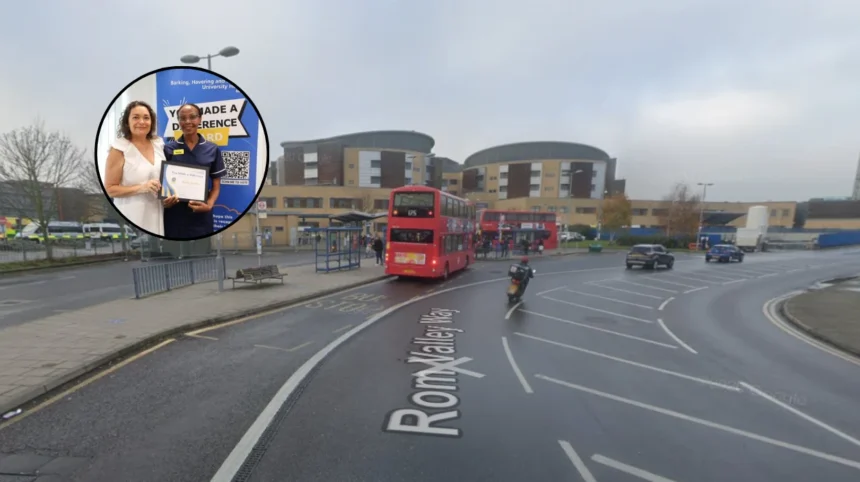
Nancy Karoki works in the intensive therapy unit (ITU) at BHRUT, which runs Queen’s Hospital in Romford and King George Hospital in Ilford. She was presented with the You Made a Difference award by Fiona Wheeler, the trust’s interim chief executive, following a nomination from Chloe’s mother, Jayne Stump.
As reported by Lucy Herbert of BHRUT’s official news service, Jayne Stump said:
“I owe everything to Nancy. She saved us from what would have been the worst decision of our lives.”
She added:
“I’ve never known such a caring individual and from day one she treated Chloe like a normal human being and saw through Chloe’s disabilities.”
Jayne Stump also stated:
“She went above and beyond for Chloe, who after four months is now home with her family and not needing extra care. She is an earth angel and so worthy of recognition.”
What medical situation did Chloe face after her laparotomy?
Chloe was admitted to ITU the day after undergoing a laparotomy, a surgical procedure in which an incision is made into the abdomen. Following the operation, she required a tube to be placed in her airway to assist her breathing. According to the trust’s account, Chloe has severe global development delay and was unable to breathe independently when clinicians attempted to remove the tube.
At that point, medical staff advised that the next option would be to attempt a tracheotomy — a surgical procedure that creates an opening in the neck to provide direct access to the trachea. The trust’s report notes there was a risk that a tracheotomy could mean Chloe would require long-term care. The alternative presented to the family was to focus on making Chloe comfortable for end of life.
How did Nancy Karoki support Chloe’s family in making a treatment decision?
Nancy Karoki cared for Chloe from her first day in ITU. As reported by Lucy Herbert of BHRUT’s official news service, Nancy sat down with the family to explain the process of a tracheotomy and provided support to both Chloe and her relatives so they could make their decision with a clear understanding of the implications.
Following those discussions, Chloe’s family decided to proceed with the tracheotomy. Over the subsequent four months, Nancy was involved in a gradual weaning process. Eventually, she successfully removed the tracheotomy tube, enabling Chloe to leave hospital and return home without the need for extra care.
What did Chloe’s family say about the care they received?
Jayne Stump, Chloe’s mother, credited Nancy with preventing what she described as a potentially devastating decision. In her nomination for the award, she said:
“I owe everything to Nancy. She saved us from what would have been the worst decision of our lives.”
She also highlighted Nancy’s approach to Chloe’s dignity and personhood, stating:
“I’ve never known such a caring individual and from day one she treated Chloe like a normal human being and saw through Chloe’s disabilities.”
According to the trust’s account, Jayne Stump added:
“She went above and beyond for Chloe, who after four months is now home with her family and not needing extra care. She is an earth angel and so worthy of recognition.”
What did Nancy Karoki say after receiving the award?
After receiving the You Made a Difference award from interim chief executive Fiona Wheeler, Nancy Karoki said she was “beyond honoured to know I made an impact on Chloe and her family.”
As reported by Lucy Herbert of BHRUT’s official news service, Nancy also said:
“The care we give in ITU is vital and it’s important for families that we empower them so they can make the right decision for their loved ones.”
Background: What is a laparotomy and why can it lead to intensive care?
A laparotomy is a surgical procedure involving an incision into the abdominal cavity, typically performed for diagnostic or therapeutic reasons in emergency or urgent settings. Patients who undergo emergency laparotomy are at higher risk of postoperative complications, including respiratory failure, infection, and organ dysfunction, and many require admission to intensive care units for close monitoring and support.
Clinical guidelines indicate that patients with high predicted mortality risk, significant comorbidities, or ongoing physiological instability after laparotomy should be considered for ICU admission. Complications such as inability to breathe independently, sepsis, or the need for advanced airway management can arise, sometimes necessitating interventions like tracheostomy to maintain a secure airway during recovery.
In this context, the care pathway for Chloe — from laparotomy to ITU admission, respiratory support, consideration of tracheotomy, and eventual weaning — aligns with recognised patterns in emergency abdominal surgery, where multidisciplinary critical care and clear communication with families are central to decision-making.
Prediction: How might this development affect patients, families, and ICU staff in East London?
This case is likely to reinforce the importance of sustained, empathetic communication between ICU nurses and families facing complex, high-risk decisions after major surgery. For patients and families in East London, particularly those caring for people with severe disabilities, the public recognition of Nancy Karoki’s role may encourage greater trust in critical care teams and a stronger expectation that staff will take time to explain options such as tracheotomy versus end-of-life care in accessible terms.
For ICU staff at BHRUT and similar trusts, the award highlights how detailed, patient-centred support over months — not just during acute crises — can materially change outcomes and family experiences. It may prompt units to prioritise continuity of nursing care, family education, and structured weaning protocols for long-term ventilation or tracheostomy patients, potentially reducing unnecessary long-term dependency on invasive airway support where clinically feasible.
For commissioners and trust leaders, the story underscores the value of recognition schemes like You Made a Difference in surfacing exemplary practice that might otherwise remain invisible. If replicated, such recognition could improve staff morale, retention, and recruitment in intensive care, while setting a benchmark for how vulnerable patients with complex needs are supported through critical illness and recovery in East London hospitals.