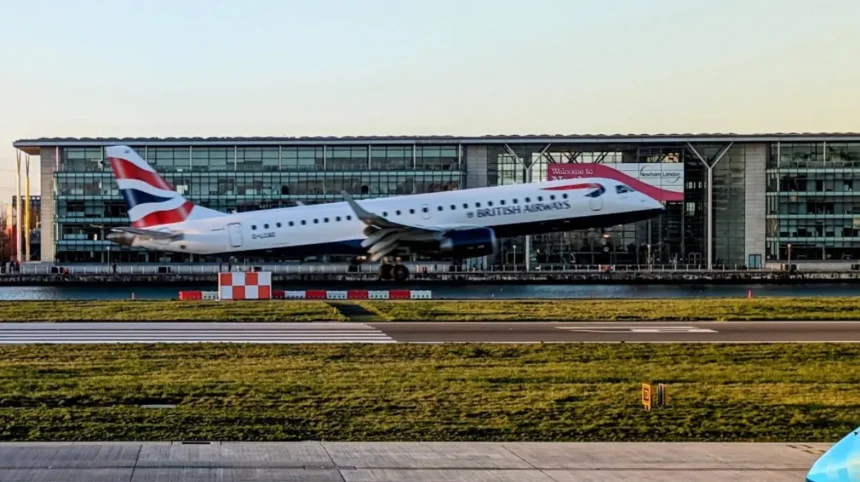
Key Points:
- Ministers approved plans in 2024 to increase London City Airport’s passenger capacity from 6.5 million to 9 million per annum by 2031.
- The airport operates around four million passengers annually, predominantly via short-haul flights to European destinations.
- Travel executives are currently evaluating growth methods, including an application to the Civil Aviation Authority (CAA) for a lower approach to allow Airbus A320neo operations, with a decision expected next month.
- Corporate Affairs Director Michael Kissman emphasised that adopting modern aircraft such as the A320neo will allow passenger growth with relatively fewer flights, lower noise levels, and improved fuel efficiency.
- Environmental critics and City Hall representatives, including former London Assembly Environment Committee Chair Leonie Cooper, have raised significant concerns regarding noise, vibrations, and local population density.
- Former Assembly Committee Chair Leonie Cooper called for independent, real-world assessments of the environmental and community impacts.
- Conservative Assembly Member Thomas Turrell refused to sign an assembly letter demanding additional assessments, describing aviation capacity as vital for unlocking East London’s economic potential and criticizing Mayor Sadiq Khan’s stance.
- A spokesperson for Mayor Sadiq Khan reiterated that airport growth must proceed only after environmental impacts are properly assessed and addressed, whilst a Department for Transport spokesperson supported responsible expansion aligned with decarbonization goals.
Newham (East London Times) August 20, 2026 –London City Airport has launched a dedicated public relations campaign to support its ongoing expansion strategy, framing its planned growth as an essential element of East London’s broader economic trajectory. Following the government’s approval in 2024 allowing the Newham-based aviation hub to increase its annual passenger capacity cap from 6.5 million to 9 million by 2031, transport planners are now actively determining the operational mechanisms needed to deliver these figures.
- Key Points:
- What Is the Operational Strategy Behind London City Airport’s Expansion Plans?
- Why Are City Hall and Environmental Campaigners Raising Objections?
- How Are Political Representatives Responding to the Expansion Debate?
- Background of London City Airport Expansion Development
- Prediction: How This Development Will Affect East London Residents and Travelers
Located on the capital’s most central runway, the airport currently handles roughly four million passengers annually, focusing mainly on short-haul European business and leisure routes.
Central to the current operational review is an official application submitted to the Civil Aviation Authority (CAA) seeking approval for a lower flight approach angle, a change that would accommodate larger next-generation aircraft such as the Airbus A320neo. A formal ruling from the aviation regulator is anticipated next month. Airport management maintains that utilizing larger, cleaner aircraft will deliver the necessary capacity increases without multiplying overall flight volumes.
What Is the Operational Strategy Behind London City Airport’s Expansion Plans?
According to statements made to the Local Democracy Reporting Service (LDRS) by Michael Kissman, Director of Corporate Affairs at London City Airport, the facility’s growth strategy remains anchored in localized development and operational transparency. As reported by Local Democracy Reporter Kumail Jaffer of the LDRS, Michael Kissman stated that
“we want to hold on to the element that we’ve always had of this being rooted in East London and being part of the East London growth story.”
Reflecting on the historical context of the site, Michael Kissman noted that since opening in 1987, the airport has functioned as a continuous catalyst for regional investment alongside other key infrastructure projects across East London.
Detailing the technical transition currently under review, as reported by Kumail Jaffer of the LDRS, Michael Kissman explained that
“one of the ways is to change the mix of aircraft that currently use the airport. At the moment, we use predominantly smaller regional jets, but by introducing aircraft such as the A320, it will mean we’re able to grow the airport towards that new passenger cap of nine million but with relatively fewer flights, with more modern aircraft that are more efficient, have a better fuel economy better on noise.”
Addressing critics concerned about the local impacts, Michael Kissman acknowledged that while an understandable debate exists, the central focus should remain on responsible growth frameworks and transparency rather than halting necessary infrastructure improvements.
Why Are City Hall and Environmental Campaigners Raising Objections?
Despite assurances from airport executives, the expansion model continues to generate considerable scrutiny within City Hall, where the Mayor of London, Sir Sadiq Khan, alongside various London Assembly members, has expressed reservations regarding cumulative noise and environmental disruption. As reported by Kumail Jaffer of the LDRS, Leonie Cooper, former Chair of the London Assembly’s Environment Committee, stated that
“we are talking about expanding the airport right in the middle of what is becoming a more and more dense area for population without doing a proper, robust, independent analysis of the impacts of particularly noise.”
Highlighting specific community health considerations, as reported by Kumail Jaffer of the LDRS, Leonie Cooper added that
“we do know now that noise impacts, particularly when people are trying to sleep, are very, very bad. It’s not just the noise, it’s also the vibrations that you get as well, that sort of rumble.”
Questioning the wider policy logic of simultaneous regional infrastructure expansions across the South East, Leonie Cooper noted that justification remains thin for expanding multiple sites—including Gatwick, Stansted, Luton, Heathrow, and London City—without independent verification of the localized environmental trade-offs.
Earlier this summer, the assembly’s environment committee sent formal correspondence to the CEO of London City Airport requesting robust, real-world data collection regarding local noise and vibration metrics.
How Are Political Representatives Responding to the Expansion Debate?
Political consensus over the expansion remains divided along party lines within City Hall. Conservative Assembly Member Thomas Turrell, who sat on the environment committee during the initial review, explicitly refused to sign the committee’s letter demanding extra studies. As reported by Kumail Jaffer of the LDRS, Thomas Turrell stated that Britain is “desperate for extra aviation capacity” and argued that London City Airport’s expansion will
“unleash so much economic potential for East London.”
Criticizing the Mayor’s opposition to the ministerial decision, Thomas Turrell asserted that Sir Sadiq Khan was failing to prioritize regional economic development.
In response, City Hall maintained that environmental protections must remain paramount before operational adjustments proceed. As reported by Kumail Jaffer of the LDRS, a spokesperson for Mayor Sadiq Khan stated that
“the Mayor is clear that changes such as those proposed at London City Airport should only be approved once the environmental impacts have been properly assessed and addressed.”
The spokesperson added that whilst the Mayor acknowledges the economic growth and employment created by the aviation sector, airport operators must take full responsibility for mitigating their localized environmental footprint.
Aligning with the national infrastructure policy, a spokesperson for the Department for Transport told the LDRS that airport growth is crucial for unlocking employment, strengthening international connectivity, and driving investment, provided that development supports national decarbonization targets and minimizes neighborhood disruption.
Explore More Newham News
BTP Issue Upskirting CCTV Appeal at West Ham Underground Station 2026
Newham Council Launches Free Bulky Waste Collections in Newham 2026
Background of London City Airport Expansion Development
The debate over London City Airport’s capacity stems from its unique location within the Royal Docks in the London Borough of Newham. Constructed in the late 1980s on former docklands infrastructure, the airport was specifically designed to provide short-haul commercial links to key European financial districts, serving business travelers seeking rapid transport to Canary Wharf and the City of London.
Due to its short runway length and steep glide path angle (historically 5.5 degrees compared to the standard 3 degrees at most airports), aircraft operating at London City have traditionally been restricted to smaller regional jets and turboprop models with specialized steep-approach certification.
Over the past decade, urban regeneration efforts have dramatically increased the residential density of Newham and the surrounding East London boroughs. As high-density housing developments arose adjacent to flight paths, local opposition groups and municipal leaders began scrutinizing airport operations more intensely, particularly regarding noise pollution, air quality, and night-time noise limits.
In response to increasing regional passenger demand, the airport submitted formal applications to adjust its passenger throughput ceiling. Government ministers granted outline planning approval in 2024 to lift the passenger ceiling from 6.5 million to 9 million per year by 2031.
To facilitate this higher throughput without exceeding total flight movement allowances, airport operators turned to fleet modernization, seeking regulatory approval from the Civil Aviation Authority (CAA) to permit larger, next-generation short-haul aircraft like the Airbus A320neo.
Prediction: How This Development Will Affect East London Residents and Travelers
The upcoming Civil Aviation Authority (CAA) decision regarding approach angles and aircraft types will directly affect local residents across Newham and East London, as well as the broader business and leisure travel community.
For local residents living beneath or adjacent to the airport’s flight corridors, the introduction of larger aircraft models such as the Airbus A320neo presents a mixed scenario.
If the CAA approves the lower approach path and modern fleet mix, residents may experience fewer total flight movements relative to the higher volume of smaller regional jets that would otherwise be required to transport 9 million passengers.
Modern aircraft feature re-engineered turbofan engines designed to reduce acoustic output and fuel consumption, potentially mitigating ground-level noise per passenger carried.
However, because the A320neo is a physically larger aircraft than traditional regional jets, local communities may still notice differences in low-frequency engine vibrations and visual impact during arrival and departure phases.
Furthermore, as passenger throughput increases toward the 9 million mark by 2031, local ground transport infrastructure, including the Docklands Light Railway (DLR) and surrounding road networks, will experience higher daily footfall, impacting everyday local commutes.
For travelers and regional businesses, the implementation of the expansion plans will likely expand flight capacity, increase destination variety, and enhance connectivity to European commercial centers directly from central London.
The capability to host larger short-haul aircraft could enable airlines to lower seat-mile costs, potentially leading to more competitive fare structures and direct long-term investment in East London’s commercial ecosystem.