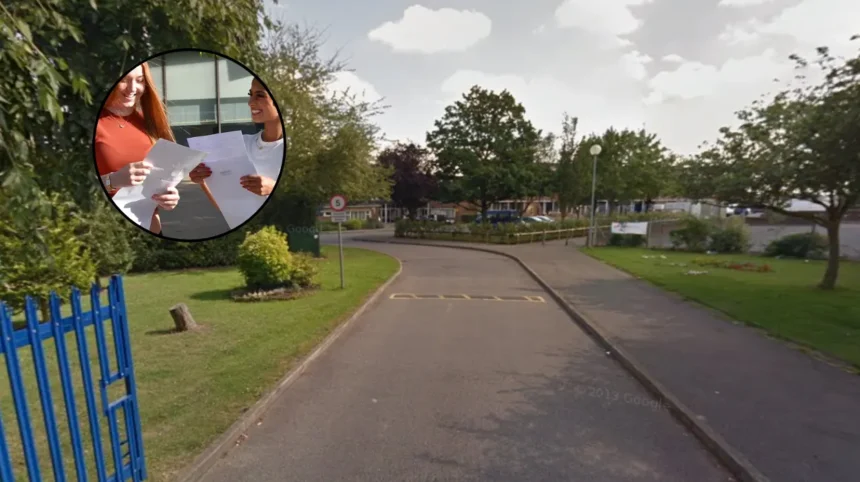
Key Points
- Over 3,000 pupils across Havering received their GCSE results following five years of secondary school education.
- Emerson Park Academy recorded its tenth consecutive year of strong performance, matching or exceeding national averages.
- Drapers’ Academy achieved several record-breaking milestones, including its highest-ever marks in Maths Grade 7 and Pupil Premium Attainment.
- Frances Bardsley Academy for Girls reported that 79 per cent of all exam entries achieved grades 9–4, showing significant year-on-year improvement.
- Individual successes range from top-tier academic grade 9 sweepers to vocational apprenticeship placements in central London.
- Local authority representatives and school leaders highlighted the resilience of the Class of 2026 amidst changing educational demands.
Havering (East London Times) August 21, 2026 – More than 3,000 pupils across the London Borough of Havering have received their long-awaited GCSE examination results, with schools throughout the region reporting significant academic successes, record-breaking attainment levels, and notable individual triumphs. Thousands of teenagers gathered at secondary schools from Hornchurch to Harold Hill to collect their results, marking the culmination of five years of secondary education. The outcome opens avenues to sixth-form studies, further education colleges, vocational training, and direct apprenticeships. Behind the institutional statistics, headteachers across the borough emphasized stories of personal perseverance, community support, and academic determination amidst an evolving educational landscape.
- Key Points
- How Did Emerson Park Academy Perform on Results Day?
- What Records Were Broken at Drapers’ Academy?
- How Did Frances Bardsley Academy for Girls Fare?
- What Support Is Available for Students Navigating Next Steps?
- Background of GCSE Grading and Post-16 Pathways
- Prediction: How This Development Will Affect Havering’s Regional Economy and Educational Sector
How Did Emerson Park Academy Perform on Results Day?
At Emerson Park Academy in Hornchurch, over 200 pupils sat their GCSE examinations this academic year, gathering early in the morning to collect their results packages and formulate post-16 plans. The school confirmed that for the tenth consecutive year, its overall academic performance has compared favorably with national benchmark averages, maintaining a sustained decade of high attainment.
Councillor Kevin Gill, Cabinet Member for Children and Young People, personally visited Emerson Park Academy to meet with the departing cohort and assess the outcomes. Commenting on the atmosphere and student performance, Councillor Gill stated:
“Once again there have been some remarkable achievements by students, who should be very proud of their efforts. This is a pivotal time in many of their lives as they decide which road to take and they have so many options from sixth form to college to apprenticeships. Whatever path they choose I wish them success on this next step of their journey.”
Among the individual achievers highlighted by the institution was Ethan, who secured an exceptional tier of results comprising two grade 9s, five grade 8s, and two grade 7s. Ethan confirmed his intention to apply to The Coopers’ Company and Coborn School in Upminster, where he intends to study A-levels in Mathematics, Economics, and Business.
Similarly, fellow Emerson Park pupil Bonnie achieved 11 GCSE passes, which included two grade 9s. Bonnie also aims to transition to Coopers’ Company and Coborn School to undertake A-level studies in Mathematics, Biology, and Chemistry.
Demonstrating the diversity of pathways taken by this year’s cohort, student TJ secured a vocational apprenticeship with a London jewellery firm alongside his academic studies. TJ simultaneously plans to continue his athletic pursuits in competitive boxing, a discipline he has maintained since the age of 11.
Scott McGuinness, Headteacher of Emerson Park Academy—which recently received positive feedback following an inspection by Ofsted—emphasized the broader narrative behind the numerical outcomes:
“Every set of results represents an individual story, and there have been many achievements this year of which our whole school community can be proud. For some of our pupils, the past five years have brought considerable challenges, making their success particularly significant. Their resilience, perseverance and willingness to keep moving forward have been truly commendable. Success such as this is never achieved in isolation. Our pupils have been supported by dedicated staff, parents, carers, families and friends, all of whom have played an important part in helping them reach this point.”
McGuinness also noted that the school was celebrating the success of its former students, who received top-tier A-level results the previous week and are now preparing to enter leading universities across the United Kingdom.
What Records Were Broken at Drapers’ Academy?
Further north in Harold Hill, Drapers’ Academy reported a historic set of examination results for the Class of 2026, breaking several institutional records and sustaining a three-year trajectory of academic elevation.
The academy confirmed measurable improvements across key national accountability metrics, including Attainment 8, overall Mathematics outcomes, and the proportion of students achieving Grade 4 or above in English. Furthermore, the school secured its highest-ever historical performance in:
- Mathematics Grade 7 and above
- Pupil Premium Attainment
- Female students achieving Grade 4 or above in both English and Mathematics
- Overall female Attainment scores
Gillian Dineen, Principal of Drapers’ Academy, praised the combined efforts of the staff and student body:
“I am delighted that the hard work from our pupils and staff show our success at both sustaining the significant improvements in GCSE results we achieved over the last two academic years, as well as achieving a number of record-breaking results for the Academy.”
High academic achievements were recorded across the student cohort. Delia Scutaru earned a remarkable profile consisting of six grade 9s—in Biology, Chemistry, Physics, English Literature, Geography, and History—alongside grade 8s in English Language, Mathematics, and German.
Scutaru, who relocated to the United Kingdom from Moldova five years ago, spoke of the personal obstacles overcome during her secondary education:
“I am really happy and I really want to thank my parents and my teachers because they helped me achieve this. It has been quite a journey with lots of challenges, but it is really nice to see all the hard work I have put in pay off.”
Scutaru intends to study A-levels in English Literature, History, and Economics, with long-term ambitions of entering the fields of Law or International Relations.
Other notable performers at Drapers’ Academy included:
- Vishali Chagger: Attained four grade 9s and five grade 8s. Chagger confirmed she will remain at Drapers’ Sixth Form to study Mathematics, Chemistry, and Business. She noted, “I got four 9s and five 8s and I am really proud. My mum and sister are here with me today and they are so happy for me.”
- Kristupas Kulsinskas: Secured grade 9s in Mathematics, Biology, Chemistry, and Physics, alongside a Distinction in Music. Kulsinskas plans to pursue A-levels in Physics, Chemistry, and Mathematics prior to reading Engineering at university.
- Olly Rowland: Achieved a grade 9 in Mathematics, grade 8s in German and Physics, and grade 7s in Biology, Chemistry, English Language, English Literature, and Geography.
- Ryan Fethers: Collected grade 8s in Biology, German, and Mathematics, complemented by grade 7s in Business Studies, Chemistry, Geography, and Physics.
How Did Frances Bardsley Academy for Girls Fare?
At Frances Bardsley Academy for Girls in Romford, the Class of 2026 recorded what school leadership described as an excellent set of examination outcomes, marking a substantial increase on previous year figures.
The school announced that 79 per cent of all exam entries were awarded grades 9–4 (equivalent to the former A*–C boundary). Core subjects demonstrated marked strength: 55.7 per cent of all students achieved a Grade 5 or higher (“strong pass”) in both English and Mathematics, while 73 per cent secured a Grade 4 or higher (“standard pass”) across both subjects.
In a joint statement issued by the school leadership team, Headteacher Emilie Darabasz and Executive Headteacher David Turrell commented on the collective achievement:
“Behind every grade is a story of hard work, perseverance and determination. We would like to thank our exceptional staff and our students’ families for the encouragement and support they have given along the way. We are very excited to welcome back students to our Sixth Form but equally proud of those heading to other schools, colleges, apprenticeships and other new opportunities, and we wish every one of them enormous success for the future. Congratulations, Class of 2026!”
What Support Is Available for Students Navigating Next Steps?
Acknowledging that national assessment days inevitably bring varied outcomes, local authority leaders emphasized that comprehensive advisory networks are active across Havering for pupils whose results differed from their initial projections.
Addressing the broader student population across the borough, Councillor Gill highlighted the availability of professional guidance services:
“While we recognise that many pupils will have had great success there are some students who may not have done as well as they’d hope. However, it’s important that they know help and support is available to help them decide what to do next.”
Local education authorities, working in conjunction with national careers services, have deployed advice hubs to assist young people with course clearance, alternative vocational entries, and apprenticeship placements.
Background of GCSE Grading and Post-16 Pathways
The General Certificate of Secondary Education (GCSE) framework serves as the primary academic qualification taken by pupils aged 15 to 16 in England, Wales, and Northern Ireland. Introduced to replace the old O-Level and CSE qualifications in 1988, the assessment system underwent radical reform between 2017 and 2020.
The traditional $A^*$ to $G$ grading scale was systematically phased out in favor of a numerical system ranging from 9 (highest) down to 1 (lowest). Under this structure:
- Grade 9: Awarded to a select percentage of top performers nationally, positioned above the former $A^*$ benchmark.
- Grade 7: Directly equivalent to a traditional Grade $A$.
- Grade 5: Classified by the Department for Education as a “strong pass.”
- Grade 4: Defined as a “standard pass,” representing the baseline required for direct progression into most academic post-16 institutions without compulsory retakes in core subjects.
Following statutory changes introduced under the Education and Skills Act 2008, young people in England are required to remain in education or accredited training until their 18th birthday. However, this requirement does not dictate staying in traditional school settings. Students completing their GCSEs select from three primary pathways:
- Academic Post-16 Education: Studying Level 3 qualifications such as A-levels or International Baccalaureates at school sixth forms or dedicated Sixth Form Colleges.
- Vocational & Technical Education: Undertaking T-Levels, BTECs, or National Diplomas at Further Education (FE) colleges focused on industry-specific disciplines.
- Work-Based Training: Securing paid apprenticeships or traineeships that combine formal study with workplace employment.
Prediction: How This Development Will Affect Havering’s Regional Economy and Educational Sector
The strong 2026 GCSE performance across Havering’s secondary institutions will have several direct and indirect impacts on the regional economy, local educational infrastructure, and labor market dynamics across East London and Essex.
Impact on Post-16 Institutional Capacity
With schools like Frances Bardsley achieving 79 per cent pass rates (Grades 9–4) and Drapers’ Academy securing record high-tier attainment, local sixth-form providers face increased demand for Level 3 academic seats. Popular educational destinations—such as The Coopers’ Company and Coborn School—will likely experience heightened competition for A-level slots in STEM (Science, Technology, Engineering, and Mathematics) disciplines, Economics, and Humanities. Concurrently, local Further Education colleges may see expanded enrolment in technical streams as pupils leverage baseline qualifications to secure specialized diplomas.
Strengthening the Local and Regional Skilled Workforce
The rise in high-tier passes in core subjects—specifically Mathematics and Sciences—directly aligns with the UK government’s emphasis on addressing regional skill shortages. Students moving into A-level Physics, Chemistry, and Engineering routes (such as Drapers’ pupil Kristupas Kulsinskas) form the foundational talent pipeline for London’s expanding technology, infrastructure, and engineering corridors. Furthermore, early entry into trade and commercial apprenticeships—exemplified by student placements in central London’s luxury and retail industries—indicates a healthy diversification of young talent bypassing traditional university debts for immediate workplace integration.
Socioeconomic Mobility and School Evaluations
The sustained performance across historically disadvantaged pupil demographics, noted specifically in Drapers’ Academy’s record “Pupil Premium Attainment” metrics, suggests a narrowing of the regional socio-economic attainment gap within Havering. Continued academic improvement in non-selective state academies is likely to boost regional property demand in catchment areas like Harold Hill, Hornchurch, and Upminster. Moreover, strong results, combined with positive Ofsted evaluations at institutions like Emerson Park Academy, reinforce parental confidence in the local state education sector, retaining top academic talent within the borough rather than losing pupils to private or out-of-borough selective institutions.