Key Points
- Czech businessman Daniel Kretinsky will take a 46 per cent stake in West Ham United, making him the club’s largest shareholder.
- Existing directors triggered a pre-emption rights agreement, blocking an investment bid by former Newcastle United director Amanda Staveley.
- Former chairman David Sullivan’s shareholding will increase from 38.8 per cent to 40 per cent following his resignation from the board in June.
- Co-chair Vanessa Gold and the Gold family are selling their entire 25.1 per cent stake, which existing shareholders bought through first-refusal rights.
- Tripp Smith will raise his ownership to 11 per cent, leaving minority shareholders with the remaining 3 per cent.
- The Independent Football Regulator is continuing its enquiries into David Sullivan’s suitability, but officials do not expect this deal to trigger a separate review.
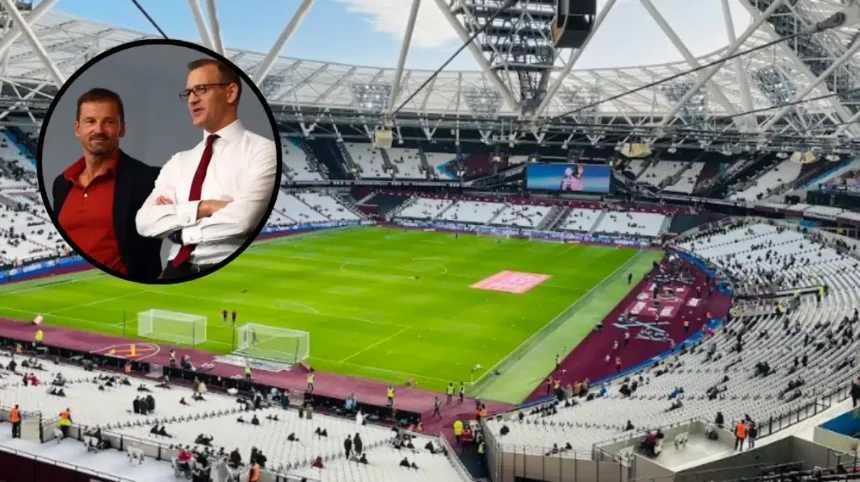
West Ham United (East London Times) September 4, 2026— Royal Mail owner Daniel Kretinsky is to take a 46 per cent stake in West Ham United as part of a major share redistribution deal that will establish him as the club’s largest single shareholder. The Czech businessman has struck a comprehensive arrangement with the Hammers’ remaining shareholders—including former chairman David Sullivan—to acquire the 25.1 per cent holding previously controlled by the Gold family. As reported by Jacob Steinberg of The Guardian, the late-stage maneuver deals a decisive blow to former Newcastle United director Amanda Staveley, effectively ending her immediate hopes of acquiring a stake in the Championship club.
- Key Points
- How was Amanda Staveley’s takeover bid thwarted by existing directors?
- What is David Sullivan’s future role and legal status at the London Stadium?
- How is the remaining equity divided among West Ham’s stakeholders?
- Background of the particular development
- Prediction: How this development affects West Ham United supporters and the club’s future
How was Amanda Staveley’s takeover bid thwarted by existing directors?
How did the existing West Ham board maneuver to prevent an outside takeover? As detailed by Matt Lawton of The Times, co-chair Vanessa Gold had initially reached a preliminary agreement earlier this summer to sell her family’s entire 25.1 per cent shareholding to Amanda Staveley’s investment consortium. However, the formalisation of that sale triggered a complex pre-emption clause enshrined within West Ham United’s corporate articles of association. This agreement legally mandated that existing directors and major investors held first refusal over any proposed sale of significant equity blocks.
Existing board members exercised these pre-emption rights prior to the strict 5:30 pm deadline. The internal redistribution resulted in Kretinsky—who originally purchased a 27 per cent stake in November 2021—buying a substantial slice of equity from Sullivan alongside the Gold shares to raise his absolute stake to 46 per cent. Consequently, Staveley’s group was left with no legal avenue to complete their acquisition, despite her presence at the London Stadium to watch West Ham’s recent 4-2 victory over Wolverhampton Wanderers.
What is David Sullivan’s future role and legal status at the London Stadium?
What does this transaction mean for David Sullivan’s governance and stake in the East London club? As revealed in a joint media report by BBC Panorama and The Times, seven women have brought severe allegations against the 77-year-old businessman, alleging historic sexual exploitation and abuse of power dating back to the 1980s and 1990s during his time running adult publications and news outlets. Sullivan categorically denies all charges of wrongdoing. Although he resigned from his executive role as co-chairman and board member in June 2026 to prevent becoming a operational distraction, his personal holding in West Ham United will paradoxically rise from 38.8 per cent to 40 per cent through this pre-emption sequence.
Addressing the ongoing scrutiny surrounding Sullivan’s continued equity participation, an official spokesperson for the Independent Football Regulator (IFR) stated:
“The IFR’s enquiries into the suitability of David Sullivan under our ODSE [owners, directors and senior executives] regime are active and ongoing, and we are in touch with relevant authorities as part of this process.”
It is understood by regulatory observers that while his character suitability remains under review, this specific equity transfer will not trigger an independent investigation, as Sullivan no longer maintains a voting seat on the operational board.
How is the remaining equity divided among West Ham’s stakeholders?
Who owns the rest of West Ham United following this restructuring? Under the terms of the agreed redistribution:
- Daniel Kretinsky: Expands his position from 27 per cent to become the lead shareholder at 46 per cent.
- David Sullivan: Increases his individual equity position to 40 per cent.
- Tripp Smith: The American financier increases his stake from 8 per cent to 11 per cent.
- Minority Investors: Holdings among small shareholders, including Terry Brown and Daniel Harris, collectively rise from 1.1 per cent to 3 per cent.
- Vanessa Gold & The Gold Family Trust: Fully exit their 25.1 per cent position in the football club.
As confirmed by Chief Football News Reporter Simon Stone of BBC Sport, neither Kretinsky, Sullivan, Gold, nor official representatives from West Ham United have offered direct public comment regarding the finalized transaction.
Explore More West Ham United News
West Ham Sign Adama Boiro on Loan East London News 2026
Josh Landers to Seal West Ham United Exit London News 2026
Background of the particular development
The dramatic overhaul of West Ham United’s ownership architecture follows one of the most turbulent periods in the club’s modern history. In May 2025, the Hammers suffered a catastrophic sporting setback by being relegated from the Premier League to the EFL Championship. The footballing downfall triggered severe financial strains and prompted widespread supporter protests directed at executive management regarding perceived underinvestment, transfer recruitment missteps, and stadium atmosphere concerns at the London Stadium.
The off-pitch situation deteriorated further in June 2026 when long-serving vice-chairman Karren Brady departed her post, closely followed by David Sullivan’s resignation from executive duties amidst the broadcast of the explosive BBC Panorama documentary. Seeking an exit strategy, co-chair Vanessa Gold opened discussions with external buyers, inviting Amanda Staveley’s PCP Capital Partners network into negotiations. Staveley, who previously orchestrated Saudi Arabia’s Public Investment Fund (PIF) takeover of Newcastle United, sought to acquire full operational leverage in East London. However, Daniel Kretinsky—the billionaire founder of 1890 Holdings who also owns Czech giants Sparta Prague—consistently signaled his desire to assert dominant financial control. By orchestrating this pre-emption buyout alongside Sullivan, Kretinsky successfully contained outside corporate interference, consolidating power internally.
Prediction: How this development affects West Ham United supporters and the club’s future
The consolidation of a 46 per cent controlling stake under Daniel Kretinsky marks a pivotal transition for West Ham United’s fanbase, playing staff, and commercial operations.
For the supporters, Kretinsky’s emergence as the primary power broker provides a long-awaited shift away from the polarizing “GSB” (Gold, Sullivan, Brady) era. Known colloquially in financial circles as the “Czech Sphinx,” Kretinsky brings substantial capital backing through his global infrastructure and postal empire. Fans can expect a more corporate, analytical, and less personalized style of executive management. However, because Kretinsky’s 46 per cent does not constitute an absolute 50.1 per cent majority, his operational vision will still require alignment with David Sullivan’s 40 per cent block. This split dynamic could create friction regarding major capital investments or managerial appointments if strategic visions diverge.
For the playing squad and football operations, Kretinsky’s dominant position is likely to inject immediate financial stability into the club’s transfer budget as they navigate the rigorous Championship campaign. Drawing on his operational model at Sparta Prague, the club is expected to restructure its recruitment team around modern data analytics and long-term academy development, rather than relying on short-term veteran signings.
Finally, for Amanda Staveley and prospective outside investors, East London remains closed for the foreseeable future. The blocking of Staveley’s consortium signals that West Ham’s internal share block prefers incremental recapitalisation via existing billionaires over radical, sovereign-adjacent operational overhauls.