Key Points
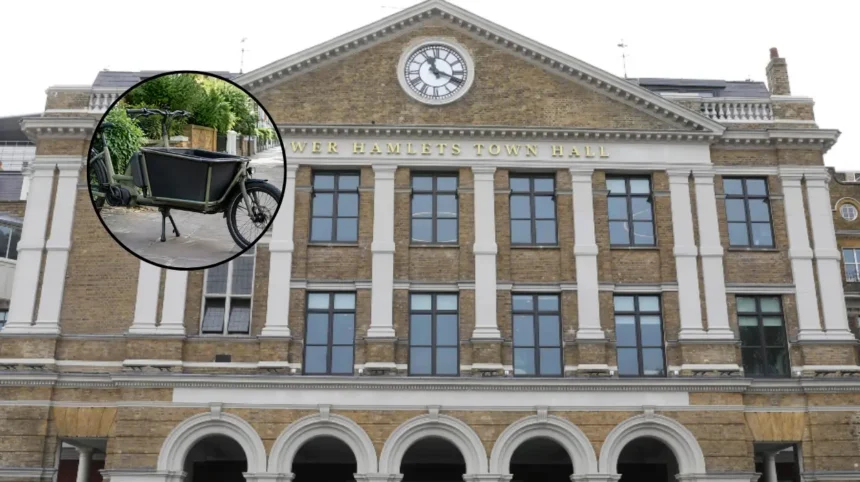
- A shared electric cargo-bike hire point has been officially opened in St Paul Old Ford in Bow by Tower Hamlets Council.
- With this opening, the total number of shared e-cargo bike hire points in the borough becomes three, with two other such points already in operation in Bethnal Green and Poplar.
- It has been clearly stated by the authorities of the local council that it is a local offer for hire and not a transport network project for the whole borough.
- Certain operational aspects, including the size of the fleet at each location, the charges and the hours of operations, were not included in the council’s announcement.
- This is part of the process of deploying low-emission transport networks in selected areas of East London.
Tower Hamlets (East London Times) September 17, 2026 – Tower Hamlets Council has formally expanded its shared electric cargo-bike network, introducing a third strategic hire location at St Paul Old Ford in Bow to complement existing facilities in Bethnal Green and Poplar.
- Key Points
- What is the scope of the new electric cargo-bike launch in Bow?
- Why has Tower Hamlets Council framed the scheme as a local hire offer?
- What practical information remains unconfirmed for prospective users?
- What are the immediate next steps outlined by the local authority?
- What is the background of electric cargo-bike initiatives in Tower Hamlets?
- How could this transport development affect local residents and small businesses?
What is the scope of the new electric cargo-bike launch in Bow?
Tower Hamlets Council confirmed that shared electric cargo bikes are now accessible at three distinct borough locations following the addition of the St Paul Old Ford site in Bow. The new point joins established hubs in Bethnal Green and Poplar, marking an incremental geographically targeted expansion of the local authority’s micro-mobility provision.
In its official communication, the local authority presented the St Paul Old Ford facility as a direct continuation of its localized sustainable transport initiative. However, specific operational parameters were not disclosed in the initial announcement. Details regarding the exact volume of electric cargo bikes stationed at each of the three locations, the physical storage infrastructure, charging mechanisms, and operational availability hours were omitted from the statement. The council focused its announcement strictly on geographical site availability rather than broader transport network integration.
Why has Tower Hamlets Council framed the scheme as a local hire offer?
Tower Hamlets Council explicitly characterized the service as a targeted “local hire offer,” emphasizing that the initiative does not represent a borough-wide transport overhaul. This distinction establishes the operational boundary of the project, framing it as a micro-mobility service confined to specific municipal hubs rather than a fundamental altering of broader borough transport policy or road infrastructure.
The council’s specific framing indicates that the project is designed primarily as a localized access scheme for shared electric cargo bikes within designated neighborhoods. Broader long-term strategic ambitions, potential future site expansions to additional wards, or formal integration into larger London-wide transport networks were not outlined in the provided information. By explicitly limiting the defined scope, the authority clarified that the current public offering remains restricted to the three identified local hire hubs.
What practical information remains unconfirmed for prospective users?
The public announcement released by the local authority focused primarily on location availability and the limited scale of the scheme, omitting broader operational guidelines. Consequently, essential administrative details—including user eligibility criteria, booking platform mechanisms, hire fees, security deposits, storage management, and maintenance protocols—have not yet been detailed in the public record.
Prospective users and local residents are advised to view the scheme through the council’s designated framing as a localized hire service. The current administrative guidance provided by the local authority centers strictly on the intended limited scale and immediate community-level purpose of the three active sites.
What are the immediate next steps outlined by the local authority?
The statement from Tower Hamlets Council concluded by confirming the operational integration of the St Paul Old Ford site alongside the Bethnal Green and Poplar locations, reiterating the limited local-hire nature of the service. Beyond confirming the addition of the Bow facility, the authority provided no additional timeline, funding details, or operational commitments.
No statutory consultations, future installation dates, or strategic shifts toward a broader municipal transport program were detailed in the release. The official record regarding the borough’s shared electric cargo-bike scheme currently rests entirely on the operational status of the three named locations and the council’s baseline definition of the initiative as a localized hire offer.
What is the background of electric cargo-bike initiatives in Tower Hamlets?
The introduction of shared electric cargo bikes in Tower Hamlets reflects broader municipal efforts across Greater London to reduce commercial and personal reliance on motor vehicles for short-distance trips and localized freight transport. Often referred to as “last-mile” logistics solutions, electric cargo bikes have been increasingly deployed by London local authorities to address urban congestion, curb localized carbon emissions, and improve overall air quality in densely populated residential areas.
Prior to the addition of the St Paul Old Ford site in Bow, Tower Hamlets Council established initial trial locations in Bethnal Green and Poplar. These early hubs served as proof-of-concept points to test public demand, local business adoption, and the viability of shared micro-mobility options in East London. Municipal interest in e-cargo bikes has grown following wider Low Emission Zone requirements and regional climate action plans aimed at encouraging active travel and sustainable transport alternatives for local errands, light commercial deliveries, and domestic transport needs.
How could this transport development affect local residents and small businesses?
The expansion of electric cargo-bike access to a third location in Bow primarily impacts local residents, independent retailers, and tradespeople operating within the immediate vicinities of Bow, Bethnal Green, and Poplar. For small business owners and sole traders, access to shared e-cargo bikes offers a potential low-cost alternative to diesel or petrol vans for short-distance deliveries, potentially lowering operational overheads while navigating local traffic constraints and parking restrictions.
For local residents and families, the availability of localized cargo-bike hire provides a practical alternative for transporting heavy goods, groceries, or young children without relying on private motor vehicles. However, because the council has explicitly defined the scheme as a localized hire offer rather than a comprehensive borough-wide transport overhaul, the immediate impact will remain concentrated around the three specific hub locations. Residents living outside the immediate catchment areas of Bow, Bethnal Green, and Poplar are unlikely to experience direct changes to their daily transport options unless the local authority decides to expand the network’s geographic footprint in future phases.