Key Points
- The newly built Green Street Library is scheduled to officially open its doors to the public on 28 September.
- The opening marks the conclusion of a six-year, £6.5 million regeneration scheme focused on Queen’s Market and the surrounding neighborhood.
- Funding for the multi-million-pound development was sourced from Newham Council, the Greater London Authority’s Good Growth Fund, and the Central Government’s Levelling Up Fund.
- Designed by Office S&M Architects, the two-storey facility is double the size of the previous library and features flexible community spaces, a children’s library, homework zones, and bookable commercial workspaces.
- Extensive community co-design involved over 1,600 local residents across workshops, online surveys, working groups, and youth Minecraft modeling sessions.
- The capital project directly counters the national trend of public library closures, which has seen roughly 190 council-run libraries shut across England since 2016.
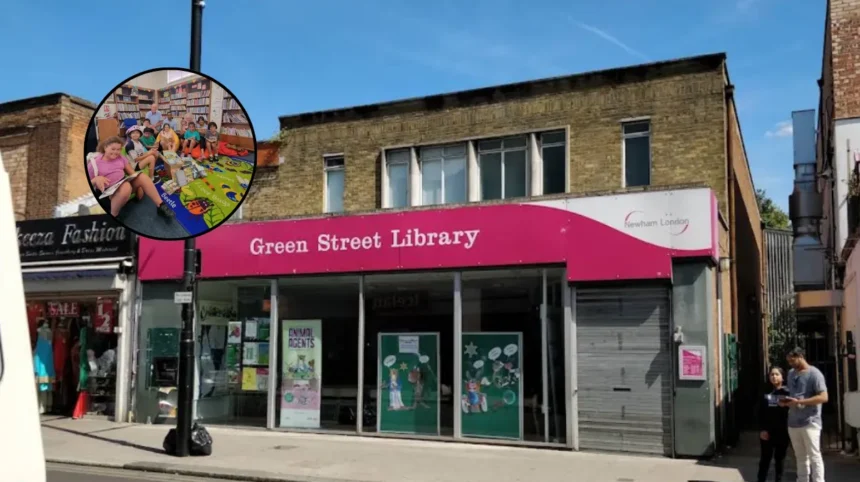
Newham (East London Times) September 22, 2026 – The long-awaited Green Street Library is set to open its doors to the public on Monday, 28 September, marking the official completion of a six-year, £6.5 million urban regeneration initiative centered around Queen’s Market. Coordinated by the Newham Council’s Place Making team, the capital project aims to revitalize the local high street by replacing the previous municipal library with a brand-new, two-storey community hub that is double the size of its predecessor.
- Key Points
- How does Newham Council view this launch amid national library closures?
- What architectural features and community spaces does the facility offer?
- How were local residents involved in the design and procurement process?
- What wider improvements were delivered through the Queen’s Market Good Growth Programme?
- Queen’s Market Infrastructure
- Market Administration and Public Amenities
- Canopies, Wayfinding, and Signage
- Queen’s Square Public Realm
- How does regional leadership evaluate the impact of this regional investment?
- Background of the Green Street and Queen’s Market Development
- Prediction: How This Development Will Impact Local Stakeholders
Financed through a multi-agency funding package combining resources from Newham Council, the Greater London Authority’s (GLA) Good Growth Fund, and the UK Government’s Levelling Up Fund, the development incorporates expanded public services, digital infrastructure, and commercial workspaces designed to subsidize ongoing operational costs.
How does Newham Council view this launch amid national library closures?
As reported by official council communications detailing municipal infrastructure strategy, Mayor Forhad Hussain highlighted that the launch comes at a critical juncture for local public services across the country. Mayor Forhad Hussain stated that
“at a time when libraries across England are closing at a rate of nearly twenty a year, the London Borough of Newham is bucking the trend.”
Elaborating on the national context of public funding cuts, Mayor Forhad Hussain noted that
“since 2016, an estimated 190 council-run libraries have shut their doors across the country. Green Street represents a direct challenge to that trend. Rather than scaling back, Newham has invested in maximising the library’s full potential, making it an essential piece of social infrastructure that serves the range of needs that bring local people through its doors, from health and wellbeing to business support.”
Addressing the specific consultation process with local demographics, Mayor Forhad Hussain further explained that
“in developing and delivering the whole project, we have listened to the voices of our residents including those who live in Hamara Ghar – the over 55’s accommodation which sits above the new library – who wanted a visible and accessible space, and Newham’s young people, who asked for comfortable, safe places to spend time, meet, study and access online services. This will be far from the hushed environment most often associated with libraries it will be a new vibrant hub of community activity and engagement.”
What architectural features and community spaces does the facility offer?
The two-storey building, designed by urban practice Office S&M Architects, incorporates a flexible layout intended to accommodate diverse public uses simultaneously, ranging from health and wellness classes such as yoga and Zumba to social dominoes clubs. At ground level, full-height floor-to-ceiling windows connect the interior main library and dedicated children’s library directly to the public square outside. The ground floor layout utilizes adaptable partitions, enabling spaces to be merged or separated based on operational requirements.
On the upper floor, an area previously configured as windowless storage rooms has been converted into a fully glazed, light-filled perimeter zone running the length of the structure. This space houses a dedicated youth homework area alongside a bookable corporate boardroom and co-working facilities. The inclusion of commercial, income-generating office spaces was deliberately engineered into the operational design to cross-subsidize the public library service, increasing the site’s financial self-sustainability over time.
How were local residents involved in the design and procurement process?
According to statements issued by the project’s lead design firm, community participation formed a primary pillar of the structural planning. As reported by Hugh McEwen, Director at Office S&M Architects, the project team maintained close local ties throughout the execution phase. Hugh McEwen stated that
“our team lives, works, has friends and family in Newham, meaning we are deeply committed to the positive outcome of the largest investment in the area for two decades. Green Street Library shows what’s possible when a community is genuinely involved in shaping their own spaces.”
Detailing how public feedback directly affected the structural outcomes and supply chain, Hugh McEwen added that
“the co-design process changed the way the building looks and operates, based on what local people told us they needed. The same principle runs through how we procure and build, making sure that money circulates locally, meaning the project’s value doesn’t stop at the front door. A library like this should belong to its neighbourhood in every sense.”
In total, over 1,600 local inhabitants participated in the co-design phase through dedicated working groups, neighborhood workshops, public online surveys, and digital spatial mapping sessions using Minecraft to engage local youth. Feedback from these engagements directly influenced the building’s floor layouts, functional priorities, and the thematic wall murals installed across both levels.
What wider improvements were delivered through the Queen’s Market Good Growth Programme?
The opening of the library serves as the final delivery milestone for the broader Queen’s Market Good Growth Programme. According to official municipal development records, the overarching £6.5 million programme delivered several major infrastructure upgrades across the market site and public realm:
Queen’s Market Infrastructure
The market area received upgraded, energy-efficient lighting installations, yielding a 150-per-cent increase in ambient light levels across the concourse. Additional electrical outlets were integrated throughout the floor plan to support daily market traders, public events, and community activities.
Market Administration and Public Amenities
Construction delivered a new centralized market office featuring a customer lobby, improved staff break facilities—including showers and accessible toilets—a dedicated meeting room, and staff co-working facilities. Four public sanitary facilities, including two fully accessible units, were installed for visitors and market personnel.
Canopies, Wayfinding, and Signage
New structural canopies were constructed at the front of the market, accompanied by illuminated signage positioned above the canopy line to increase visibility from Green Street and the approach from Upton Park underground station. Secondary illuminated directional signage was added at the Rochester Avenue entrance.
Queen’s Square Public Realm
The public spaces adjacent to the market were renovated to incorporate expanded urban greenery and permanent street seating, aimed at increasing dwell time and creating spaces for cultural gatherings.
How does regional leadership evaluate the impact of this regional investment?
Evaluating the broader strategic impact on London’s urban infrastructure, regional leaders highlighted the collaborative governance model used to complete the project. As reported by Jules Pipe, Deputy Mayor of London for Planning, Regeneration and the Fire Service, the capital investment serves as a benchmark for municipal development. Jules Pipe stated that
“Green Street Library is a great example of how investment in local communities can deliver lasting benefits for residents. Through the Mayor of London’s Good Growth Fund, we have worked in partnership with Newham Council to transform Queen’s Market and the surrounding area, creating welcoming public spaces, supporting local traders and providing a modern library and community hub where it is needed on the high street.”
Underscoring the social equity aims of the venue, Jules Pipe further remarked that
“designed with local people and for local people, this new larger space will be a place where residents of all ages can learn, connect and access opportunities, helping to build a fairer and more inclusive London for all.”
When doors officially open on Monday, 28 September, local residents will be invited to access the expanded print and digital collections, utilize the public computing suites and high-speed Wi-Fi, and register for scheduled community programming operating across the newly modernized facility.
Background of the Green Street and Queen’s Market Development
The area surrounding Green Street and Queen’s Market in the London Borough of Newham has historically served as one of East London’s most culturally vibrant commercial corridors. Queen’s Market itself, situated adjacent to Upton Park station, holds a long-standing history as a vital retail hub offering affordable food, textiles, and goods tailored to the borough’s diverse multicultural demographic.
However, over the past two decades, the surrounding physical infrastructure faced increasing operational strain due to aging facilities, inadequate public lighting, and limited accessible community space. Previous attempts to redevelop the area met with mixed reactions from local residents and market traders, who sought guarantees that capital investment would preserve the character and affordability of the market while improving security and public amenities.
To address these long-term infrastructure needs, Newham Council’s Place Making team established the Queen’s Market Good Growth Programme six years ago. Rather than pursuing top-down commercial redevelopment, the council secured a tripartite funding structure consisting of local authority capital, the Greater London Authority’s Good Growth Fund, and national resources via the Government’s Levelling Up Fund. This £6.5 million investment strategy was structured to systematically upgrade the market’s physical utilities, enhance public safety through lighting and architectural interventions, and provide modern social infrastructure capable of supporting diverse civic functions. The completion of the Green Street Library represents the final physical phase of this comprehensive, multi-year urban masterplan.
Explore More Newham News
Newham Council Launches 12-Week Parking Consultation in Newham 2026
Newham Mental Health Unit Inquest Finds Neglect Contributed to Unlawful Killing Newham 2026
Prediction: How This Development Will Impact Local Stakeholders
The completion of the Green Street Library and the broader Queen’s Market Good Growth Programme is expected to bring tangible operational and socio-economic changes across several key local groups:
Local Residents and Young People
For residents living in the immediate vicinity—including the senior population residing at the Hamara Ghar housing complex directly above the library—the opening provides an accessible, step-free community space. The availability of dedicated health, wellness, and social activities (such as Zumba, yoga, and dominoes clubs) will likely alleviate social isolation among older demographics. For students and young people, the provision of a fully glazed, secure first-floor study environment equipped with high-speed Wi-Fi and public PCs addresses a critical regional shortage of quiet homework spaces outside the home, potentially driving positive educational outcomes for local students.
Market Traders and High Street Businesses
The structural upgrades to Queen’s Market—specifically the 150-per-cent increase in lighting levels, expanded power infrastructure, new customer toilets, and enhanced canopy visibility from Upton Park station—are projected to increase footfall and extend operational hours into dusk. Increased pedestrian dwell time in the renovated Queen’s Square should translate into higher casual foot traffic for both traditional market stallholders and adjacent brick-and-mortar retailers along Green Street. Furthermore, local entrepreneurs and small businesses stand to benefit from the bookable boardroom and co-working workspace on the library’s upper floor, offering professional meeting space on the high street without the overhead costs of traditional commercial leases.
Municipal Library Services and Local Taxpayers
From a public administration perspective, the integrated revenue-generating model built into the facility—where commercial room bookings and office rentals cross-subsidize core library operations—creates a financially resilient structure for Newham Council. By offsetting operational overheads with commercial yields, the facility reduces its reliance on discretionary municipal budgets, establishing a sustainable operational model that safeguards the service against future public sector budget cuts.