Key Points:
- Transport Controversy: The Hackney council approved a new traffic plan along Queensbridge Road that includes floating bus stops which will have cycle lanes crossing them.
- Safety Woes: The blind and disabled protestors raised concerns about safety with regard to maneuvering along the bypasses to the bus stops as the same was said to be akin to “playing Russian Roulette.”
- Accessibility Issues: The National Federation of the Blind of the UK (NFBUK) stated that disabled, visually impaired, and elderly people will be “designed out” of London’s streetscape.
- Shift in Consultation Plans: The residents and campaign groups mentioned that whereas the first November 2025 consultation covered traffic management and cycle lanes, the floating bus stop proposal was approved in July 2026.
- Accessibility Demands: The campaigners have urged Hackney council to reject the bypass idea and opt for continuous footways instead of cycle lanes.
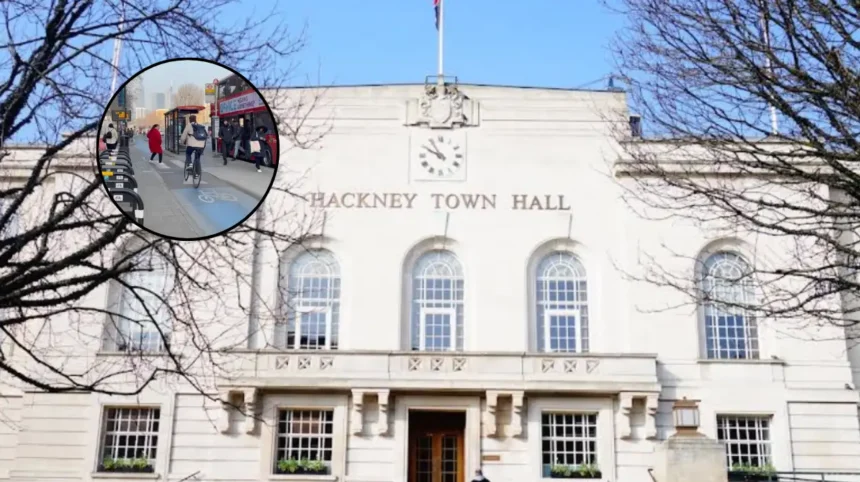
Hackney (East London Times) September 23, 2026 – Hackney Council is facing intense criticism from disability rights campaigners following the approval of controversial “floating bus stops” along Queensbridge Road, a decision warning voices claim places visually impaired and disabled pedestrians in direct danger.
- Key Points:
- Why are Hackney Council’s proposed bus stops sparking severe backlash from disabled campaigners?
- How do transport accessibility advocates view the wider impact on London’s public spaces?
- What is the background of the Queensbridge Road transport development?
- What is the prediction for how this development could affect disabled and vulnerable residents in Hackney?
Why are Hackney Council’s proposed bus stops sparking severe backlash from disabled campaigners?
The controversy centers on an updated traffic management scheme for Queensbridge Road in East London. In November 2025, Hackney Council concluded a public consultation on proposals designed to introduce new cycle lanes, implement traffic-calming measures, and remove 33 car parking spaces along the busy thoroughfare. However, concerns escalated significantly after an updated version of the proposal—incorporating bus stop bypasses, commonly referred to as floating bus stops—was formally signed off in July 2026.
Floating bus stops require public transport passengers to cross an active cycle lane when moving between the bus shelter platform and the main pavement. Disability advocate groups contend that this configuration creates hazardous conflicts between cyclists and pedestrians, particularly those with reduced mobility, hearing impairments, or sight loss.
Campaigners have railed against Hackney Council’s move to bring in these controversial structures, describing the prospect of navigating them as “frightening” and extraordinarily risky. Representatives from advocacy organizations emphasize that expecting blind or visually impaired individuals to judge the speed and distance of approaching bicycles—which often travel silently and at speed—presents an unreasonable safety risk.
How do transport accessibility advocates view the wider impact on London’s public spaces?
The National Federation of the Blind of the UK (NFBUK) has issued stark warnings regarding the systemic implementation of bus stop bypasses across the capital. Spokespersons for the federation warned that disabled people were increasingly being “designed out” of London’s urban landscape, as infrastructure layouts prioritize continuous cycling routes over fundamental pedestrian accessibility and safety.
Accessibility campaigners argue that floating bus stops force vulnerable individuals to play what they describe as “Russian Roulette” every time they attempt to board or alight from public buses. Because cyclists are not legally required to stop at zebra crossings built across cycle tracks in the same manner as motor vehicles on main roads, enforcement and compliance remain major points of contention.
Representatives from local community networks in Hackney noted that while active travel initiatives and safer cycling infrastructure are broadly supported, doing so at the expense of pedestrian safety creates unnecessary divides. They maintain that public transport must remain universally accessible to all members of the community, regardless of physical ability.
What is the background of the Queensbridge Road transport development?
Hackney Council initiated public consultations in late 2025 aimed at improving overall air quality, encouraging active transport methods, and reducing motor traffic congestion throughout the borough. The initial consultation launched for Queensbridge Road in November 2025 detailed plans for dedicated cycle corridors, reduced curb-side parking, and refined street layouts.
During the consultation period, residents and local stakeholders submitted feedback regarding traffic flow, residential parking capacity, and street safety. Following the review process, an updated design scheme was finalized and officially signed off in July 2026. This updated iteration integrated floating bus stops along the corridor to allow cyclists to bypass stationary buses without pulling out into motor traffic lanes.
The implementation of bus stop bypasses has been a focal point of debate across London local authorities in recent years. While cycle safety advocates highlight that bypasses protect cyclists from large vehicles, disability organizations have consistently campaigned against their deployment, citing real-world instances of near-misses, collisions, and a lingering fear that deters vulnerable people from using public buses independently.
Explore More Hackney Council News
Hackney Council Anti-Austerity Summit Debates 2027 No-Cuts Budgets Hackney 2026
Hackney Council Replaces Scaffolding With Cherry Pickers for Gutter Clearance: East London 2026
What is the prediction for how this development could affect disabled and vulnerable residents in Hackney?
If Hackney Council proceeds with the full installation of floating bus stops on Queensbridge Road without substantial structural modifications, the development is predicted to have immediate operational and social impacts on local public transport users.
Impact on Pedestrian Autonomy and Safety
For visually impaired, deaf-blind, and mobility-impaired residents, the primary outcome is likely to be a significant reduction in independence. Fear of colliding with oncoming cycle traffic may prevent vulnerable individuals from accessing bus services along Queensbridge Road, leading to increased isolation or reliance on costlier private transport alternatives.
Legal and Policy Implications for Local Councils
The ongoing pushback may force Hackney Council and Transport for London (TfL) to re-evaluate infrastructure standards for future active travel schemes. Continued opposition from national bodies like the NFBUK could result in formal accessibility audits, potential legal challenges under the Equality Act 2010, or revised design guidelines that mandate controlled signal crossings or alternative bypass layouts across London boroughs.