Key Points
- Stratford station has been selected as a trial location for Live Facial Recognition (LFR) technology to combat public transport crime.
- City Hall’s Police and Crime Committee revealed over 4,500 reports of violence against women and girls on London public transport in 2025—an average of 12 per day.
- Only 3% of reported transport violence incidents led to a charge, while over 50% yielded no identifiable suspect.
- Research by TravelWatch highlights that approximately 70% of people avoid travelling at certain times due to security concerns.
- High transport volume at Stratford makes it a key test bed for network-wide safety rollouts.
- Public concerns regarding civil liberties and data privacy are being countered with commitments to strict safeguards and operational transparency.
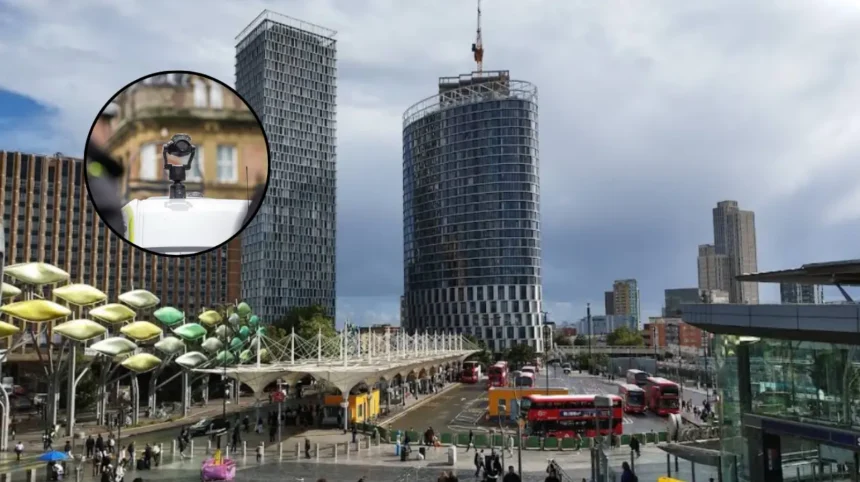
Newham (East London Times) September 26, 2026 — Stratford station, one of London’s busiest transport hubs, has been selected to pilot Live Facial Recognition (LFR) technology following revelations that more than 4,500 incidents of violence against women and girls were reported across the capital’s public transport network in 2025.
- Key Points
- Why is Stratford station implementing Live Facial Recognition technology?
- How does passenger anxiety impact daily travel behaviour in London?
- What operational role will Live Facial Recognition play for law enforcement?
- How are authorities addressing privacy and civil liberty concerns?
- Background of the particular development
- Prediction: How this development can affect commuters and public transport users
Why is Stratford station implementing Live Facial Recognition technology?
As reported by Unmesh Desai, member of the London Assembly Police and Crime Committee at City Hall, writing for the Newham Recorder, data gathered by the committee exposed alarming safety gaps across London’s transport infrastructure. As Desai detailed, the choice of Stratford station reflects both its heavy passenger volume and the urgent need to address systemic violence against female commuters.
According to figures published by Desai, the City Hall committee discovered that over 4,500 incidents of violence against women and girls were logged on public transport during 2025 alone—representing more than 12 official complaints every day. Experts emphasize that these metrics capture only those victims who came forward to authorities.
Outlining the enforcement crisis, Desai wrote that “only 3% of these reported incidents led to an individual being charged,” while “more than half didn’t even identify a single suspect”. The implementation of LFR at major interchanges is intended to give police officers real-time tools to cross-reference crowds against specific watchlists of wanted offenders.
How does passenger anxiety impact daily travel behaviour in London?
The decision to trial biometric scanning comes as passenger trust reaches critical lows, particularly among vulnerable demographics. As noted in the reporting by Desai, expert testimonies delivered to the Police and Crime Committee painted a stark picture of public apprehension.
Referencing data provided by transport advocates, Desai highlighted that “a senior representative from TravelWatch even said that their research discovered around 70% of people avoid travelling at certain times out of fear for their security”.
Transport for London (TfL) has similarly acknowledged the psychological weight of transport-related misconduct. As reported by TfL’s official press office, research published by the transport authority found that 77% of young women aged 13 to 16 surveyed had experienced unwanted sexual behaviour on public transport journeys, whilst 91% had witnessed similar incidents, leading 40% to actively avoid travelling due to safety fears.
What operational role will Live Facial Recognition play for law enforcement?
The technical mechanics of the pilot involve streaming real-time video footage from station concourses through biometric scanning algorithms calibrated to detect individuals on pre-authorised watchlists.
Addressing the practical application of the technology, Desai wrote that “when used properly, it can give officers another tool to help identify suspects for arrest or questioning”. Desai clarified that whilst LFR “can’t replace good policing,” it allows frontline personnel to single out high-harm offenders more efficiently, raising conviction rates for violent and sexual offences.
As outlined in announcements by British Transport Police (BTP) and Transport for London, images of members of the public that do not trigger a watchlist match are purged immediately from the scanning system to protect public privacy.
How are authorities addressing privacy and civil liberty concerns?
The expansion of biometric monitoring on public transit networks has drawn scrutiny from privacy advocates and legal campaigners. Acknowledging the public debate, Desai reported that widespread anxieties surrounding mass surveillance are recognized by City Hall.
Desai stated that “those concerns should not simply be dismissed” and affirmed that “the technology needs to be used carefully, with proper safeguards and transparency to reassure those who are worried”.
As reported by Siwan Hayward, Director of Security, Policing and Enforcement at Transport for London, in statement releases regarding station trials:
“Everyone should be able to travel without fear of harassment, intimidation or violence. Live facial recognition has the potential to be a powerful additional tool in helping police quickly identify those wanted for high-harm offences… in a targeted, proportionate way with strict safeguards in place”.
Background of the particular development
The deployment at Stratford forms part of a broader, phased evaluation of biometric policing across the United Kingdom’s travel infrastructure. British Transport Police initially initiated trials of Live Facial Recognition at major mainline rail hubs, including London Bridge, King’s Cross, and Liverpool Street stations. Following testing in railway environments, authorities extended LFR operations directly onto the London Underground network, targeting high-traffic interchanges like Victoria and Stratford.
The technological push follows independent evaluations conducted by the National Physical Laboratory (NPL), commissioned by law enforcement to analyze algorithmic accuracy across age, gender, and racial demographics. Concurrently, police forces have increasingly turned to digital infrastructure to manage persistent backlogs in identifying perpetrators of sexual misconduct, violence against women and girls (VAWG), and knife crime across metropolitan transit systems.
Prediction: How this development can affect commuters and public transport users
If the trial at Stratford proves successful in increasing charge rates and deterring high-harm offenders, it will likely pave the way for permanent, network-wide biometric surveillance across the entire Transport for London network.
For female commuters and vulnerable passengers, the visible presence of LFR interventions may restore confidence, encouraging greater freedom of movement during off-peak hours and reducing travel avoidance driven by safety fears. Higher identification rates could disrupt repeat offending patterns by swiftly removing wanted individuals from transit corridors.
Conversely, regular commuters will adapt to a new paradigm of routine biometric screening in public places. For the general public, the long-term impact will depend on the balance between verified crime reduction and the ongoing legal scrutiny surrounding personal privacy rights, data governance, and consent in public spaces.