Key Points
- Romford Urban District Council launched an architectural competition in 1935 to design its new municipal offices and assembly hall.
- The competition drew 66 sets of drawings and was assessed by Kenneth M. B. Cross, a Fellow of the Royal Institute of British Architects.
- Bournemouth architects Herbert R. Collins and Antoine Englebert O. Geens secured both first (£250) and second (£100) prizes with two distinct submissions.
- Third place was awarded to Cardiff architect James Wallace (£50).
- The second-placed design was praised by the assessor for its direct planning, but lost to the winning scheme due to cost considerations (£54,502 versus £61,634).
- The winning design allowed phase-based construction, enabling the municipal offices to open in 1937 while the assembly hall was postponed indefinitely.
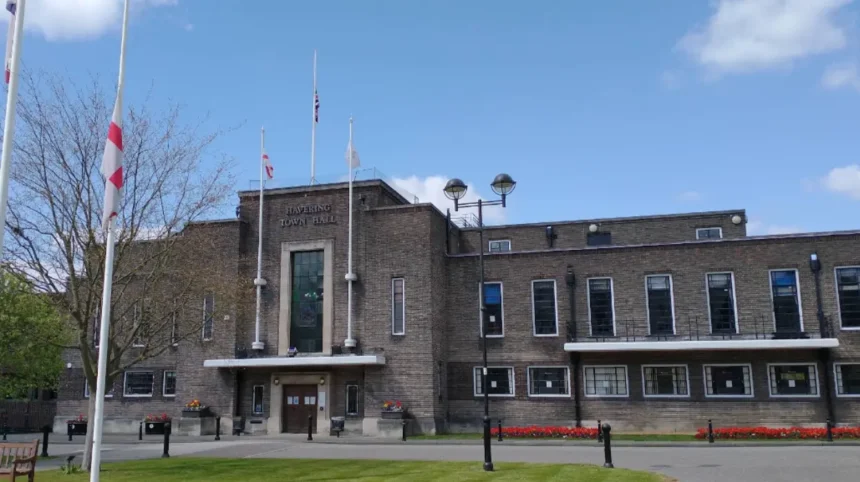
- Historic England classifies the former Romford Town Hall as an International Moderne structure.
Romford (East London Times) October 6, 2026 – A 1935 architectural competition held by the Romford Urban District Council produced one of the most unusual results in British municipal history when a single architectural firm was awarded both first and second place for two separate design proposals. Bournemouth-based architects Herbert R. Collins and Antoine Englebert O. Geens submitted two distinct plans for the creation of Romford’s new municipal offices and assembly hall, beating 64 other entries to take the top two cash prizes.
- Key Points
- Who Were The Key Figures Behind The Romford Architectural Competition?
- Why Did The Winning Design Beat The Alternative Proposal?
- How Did Practicality Shape The Construction Of Romford Town Hall?
- Background To The 1930s Civic Building Boom
- Prediction: How This Historic Precedent Impacts Architectural Historians And Civic Planning Today
Who Were The Key Figures Behind The Romford Architectural Competition?
The competition was commissioned by the Romford Urban District Council during a period of rapid civic expansion in suburban Essex. To ensure professional impartiality and high standards, the council appointed Kenneth M. B. Cross, an established architect and Fellow of the Royal Institute of British Architects (FRIBA), as the official assessor for the submitted schemes.
The council offered financial incentives to attract top talent across the United Kingdom. First prize was set at £250, second prize at £100, and third prize at £50. Upon reviewing the 66 sets of architectural drawings, Cross awarded first place to Herbert R. Collins and Antoine Englebert O. Geens. When the identity of the anonymous second-place entry was revealed, it was discovered that Collins and Geens had also secured second prize with an alternative proposal. Third place was awarded to Cardiff-based architect James Wallace.
Why Did The Winning Design Beat The Alternative Proposal?
The official assessor’s report, published in The Architects’ Journal in August 1935, provided detailed insight into the decision-making process. Cross noted that the second-placed scheme by Collins and Geens possessed several architectural strengths that were, in certain aspects, superior to their winning submission. The runner-up scheme placed the buildings further back from Main Road and featured a remarkably straightforward and direct internal layout.
However, strict financial parameters dictated the final decision. The competition instructions had specified that overall economy was a fundamental requirement for the council. The total estimated cost of the winning scheme came in at £54,502. In contrast, the second-placed scheme was calculated at £61,634—a price difference of over £7,000 that proved decisive for the municipal authority.
How Did Practicality Shape The Construction Of Romford Town Hall?
Beyond immediate financial savings, the winning proposal offered crucial structural flexibility. The design by Collins and Geens allowed the main municipal offices to be constructed first without compromising the visual or functional integrity of the site if the adjacent assembly hall needed to be postponed.
This phased approach proved prophetic. While construction on the municipal offices proceeded, economic pressures led to the indefinite delay of the proposed assembly hall, which was ultimately never built. Throughout the process, Collins and Geens adhered strictly to a functional philosophy, avoiding costly decorative features. The architects stated in their report that the civic character of the building should derive purely from its balance of proportions, high-quality materials, and fitness for purpose. The municipal offices were formally opened in 1937, serving as Romford Town Hall. Today, Historic England recognizes the structure under the International Moderne architectural style, attributing the surviving Main Road building to Collins and Geens.
Background To The 1930s Civic Building Boom
During the interwar period of the 1930s, suburban regions surrounding London experienced massive population growth, driven by expanded public transportation networks and suburban housing developments. Romford transformed rapidly from a historical market town into an expansive urban district requiring modernized administrative infrastructure.
Local authorities across Britain frequently utilized open architectural competitions during this decade to secure modern, efficient designs for civic centers, town halls, and public libraries. The competition system was governed by strict guidelines set out by the Royal Institute of British Architects to guarantee anonymity during judgment. Submissions were marked only by pseudonyms or numbers until the assessor made the final selection. This strict anonymity explains how Collins and Geens successfully captured both top honors without the assessor realizing both entries originated from the same Bournemouth practice. Their dual entry strategy allowed them to present two contrasting interpretations of the site—one emphasizing optimal set-back and spatial flow, and the other prioritizing strict budget control and modular construction phases.
Prediction: How This Historic Precedent Impacts Architectural Historians And Civic Planning Today
The history of the 1937 Romford Town Hall site offers significant lessons for contemporary civic planners, heritage officers, and local residents in Havering.
For local authorities and urban planners, the historic success of the Collins and Geens design highlights the long-term utility of adaptable, phased architecture. As municipal budgets face renewed scrutiny in the modern era, local councils managing historic civic assets will likely draw inspiration from interwar functionalism—prioritizing adaptable construction that can weather economic uncertainties.
For architectural historians and heritage conservationists, the recognition of the building’s International Moderne style by Historic England ensures that any future alterations or retrofitting projects on Main Road will face strict regulatory oversight. Local residents and preservation groups can expect the unadorned, proportion-driven aesthetic of the site to remain a protected feature of Romford’s townscape, serving as a permanent example of how 1930s economic prudence shaped local civic identity.