‘East London is Wonderful’ and ‘We Are The Clapton – Always AntiFascist’ are proudly hung banners at the Old Spotted Dog ground in Forest Gate, the home of Clapton Community Football Club (CCFC). But in 2018, Clapton Community didn’t exist. Clapton FC, a club with a long history of being a successful non-league team, had a section of fans growing increasingly frustrated with the ownership of the club and began to break away. Thus came the birth of Clapton Community, and fast forward to October 2026, Clapton FC no longer plays football matches, having withdrawn from non-league football altogether in 2024. Meanwhile, Clapton Community is the surviving football team in the region and is still going strong.
Clapton FC was established in 1877, originally ‘Downs FC’ as they were based in Hackney Downs in Lower Clapton. Founding members of the Southern League in 1894, then the Isthmian League in 1905, they had a longstanding reputation in non-league football. Having been the first club from Great Britain to play in continental Europe in 1890, Clapton won the FA Amateur Cup five times, the Isthmian League twice, reached the third round of the professional FA Cup in 1926, and became the first amateur side in history to play a floodlit game in 1956 at former West Ham stadium Upton Park. Eventually they were relegated to Division Two of the Isthmian League in 1976 (which later became Division One due to the establishment of the Isthmian League’s Premier Division). After a further relegation to the new Division Two, bouncing back up, then back down, eventually Clapton were placed into the Essex Senior League in 2006 after further restructuring of the divisions.
The original attempt to form a breakaway club happened in 2016, as fans, angered by the discontinuation of Clapton’s youth and reserve teams, formed Downs Football Club, named after the original 1877 team. A boycott of the club took place in 2017, with supporters frustrated with the management of Clapton from chairman Vince McBean, unhappy with the shoddy state of the ground and facilities, and new (and sometimes old) fans couldn’t even access membership.
Speaking to two Clapton Community fans at the ground, Tamara and Charlie, gave great insight into the history of the club. Tamara said:
“People started to realise that – believe it or not – actually quite a lot of money does go through the club, and people realised the money just wasn’t being converted back into the club itself.”
Charlie added: “There was a serious dispute over his attempt to raise price for everything, and that’s when there was a boycott by the fans at the time.”
With the boycott running out of steam by the next year, the Football Supporters’ Association advised fans against using funds for legal fees, and instead that they start their own club entirely.
Tamara and Charlie joined the club in 2018 shortly after its genesis, though they weren’t part of its founding..
“I know that at first it kind of seemed like maybe a wild idea. But Geoff Ocran, who is our manager now, was at the time player-manager as well, and a few of our other players, like James Briggs, were still part of that team…they also agreed that it would be better for Clapton CFC to split and separate.”
The breakaway fans named the new team Clapton Community, finding a new temporary home in Walthamstow, affectionately named the ‘Stray Dog’. Many Clapton players were recruited over to the new team, and money was raised through the sale of brand-new kits based on the colours of the International Brigades and Spanish Republic flag, a nod to the many Claptoners who helped fight fascism in Spain in the 1930s. A women’s team was set up in 2019, and a few months later, the original Clapton team being evicted from the ground, Clapton Community raised funds for the purchase and returned home.
“When the breakaway happened, there had been severe problems with the maintenance of the pitch, [which] was one of the issues”, says Charlie,
“so the courts ended up essentially invalidating the previously existing lease…which is how we ended up at the ground.”
The two clubs actually met in 2023 for an Eastern Counties Football League match, which cathartically, ended in a 2-1 victory for Clapton Community. Even more incredibly, in the same season (2023-24) for the Eastern Counties (now known as “Thurlow Nunn”) Division One South, Clapton Community finished 6th and qualified for the playoffs. Clapton, meanwhile, finished 18th. They were due to both be transferred to the Southern Counties East League, but Clapton withdrew in June, and no longer play fixtures. (I didn’t ask, but I wonder if there is a sense of vindication for CCFC fans here.) Clapton Community, on the other hand, kept on rising. After finishing 7th the following season and winning the Southern Counties East League cup, they were transferred back to the Eastern Counties Football League Southern division for 2025-26. They finished 2nd and won the play-off final, being promoted to the Step Five Essex Senior League, ironically the very same one Clapton FC were placed in in 2006 after the league restructuring.
The men’s and women’s side are paid equally, and both sides play at The Old Spotted Dog, or ‘The Dog’ – Clapton FC were evicted from the ground in 2019. The women’s side has had its own share of success, being back to back Football Supporters’ Association winners in 2023 and 2024. The women’s team also has the highest ever attendance for any Clapton Community team match, having visited Brentford’s Gtech Community Stadium in September 2024, amassing 3585 CCFC fans. The youth sides also conduct their training sessions at The Old Spotted Dog.
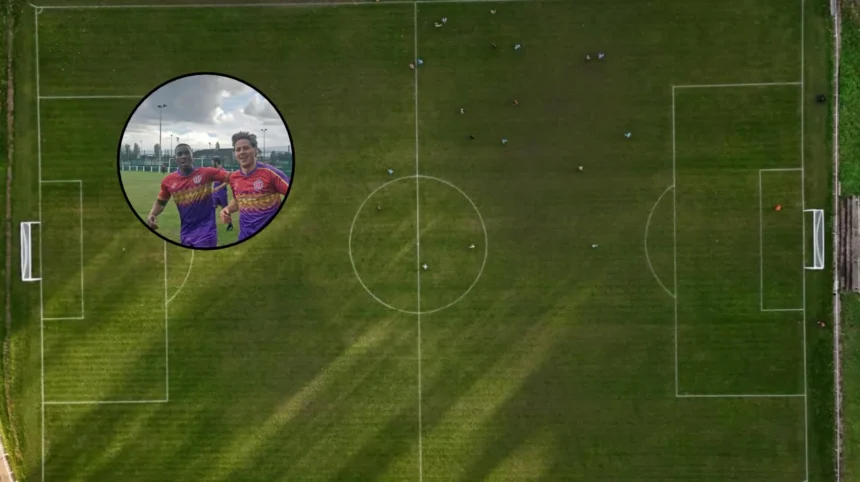
The Dog is a unique ground, which I went along to for their midweek game on the 22nd September where they won 1-0 against Saffron Walden Town. Fairly well-maintained, you can watch the match without buying a ticket given the fairly clear view you get through the fence even if you’re just passing by, or if you happen to live in one of the several flats which have windows overlooking the ground. The fence used to be walled, so during the original boycott, fans would stand on boxes of beers to see over it in order to support the team, but not put money into the club.
I am told by Charlie that it is the oldest senior football ground in London. The ‘ultras’ passionately sing from a scaffold repurposed to house the most passionate of the home support. The unapologetically political nature of the club is there for all to see. Based in Forest Gate, London, Clapton Community FC is 100% fan-owned, and is known for its outspokenness as a football club on political issues, with a strong working class, anti-fascist identity – Tamara and Charlie originally became part of the club through left-wing connections. There are varying rates of membership, but the club operates on a “one member, one vote” basis for motions and AGMs no matter how much a member pays.
Stickers are plastered in the clubhouse and bar advocating standing up for Palestine, workers’ rights, women’s rights, LGBTQ+ inclusivity and in support of various global political causes. A gravestone is present in tribute to Clapton volunteers who died aiding in the fight against fascism in the Spanish Civil War. CCFC have won several awards for their community impact and social impact in football, even sell a trans solidarity goalkeeper kit on the site, which in its opening window raised nearly £8,000 for the Trans Legal Clinic defending transgender rights. The profits now go towards ensuring Clapton Community’s own trans-inclusivity within the club. Opposite the bar, a tea and biscuits table is open at half time, with a mini library of political and football books open to the public, at which point I was convinced I would be a CCFC fan for life. On one side are biographies of Brian Clough, Pele, Megan Rapinoe; on the other, ‘Das Capital’ by Karl Marx. They prefer cash so all profits go to the club, and aside from bar workers, all staff are made up of community volunteers in several committees, such as merch, matchday, programmes and accountability. The ground also hosts clubhouse events for the local community such as self-defence and fitness classes and London Renters Union meetings, and hosts open access sessions for women and non-binary individuals.
On the political nature of the club, Tamara said:
“I think the reason it works is because we’re fully fan-owned. And a very big part of it all, just from the inception of the club…the root is in the community aspect of it being egalitarian, from that it all stems.”
She said that Clapton CFC “looks at what issues are near and dear to us, and the level we’re able to apply it.”
I compared the political nature to that of Dulwich Hamlets, albeit theirs being to a less radical degree.
“I do think even with Dulwich Hamlets, it’s slightly harder [to be political], because it’s not fan-owned and fan-run.”
Charlie mentions football’s reputation for being dominated by negative politics and typical image of exclusion.
“This is the reputation football has, right? And I think it’s important that a club like this exists to plant a flag and say that, you know, football’s a sport for everybody. And whether that means inclusiveness based on sort of a myriad of identity factors that get excluded within a lot of fan groups in Premier League football, or just add to that grassroots feel.
It’s really important to have that in football, and not just have it be the stereotype, which is always a problematic stereotype.”
The football is made better by the fans’ enthusiasm. I had wondered whether a more politically tolerant crowd might be more muted in their intensity, whether they would shout and chant with the vociferousness of an apolitical club, or if they would perhaps be more timid. Not a chance. The crowd scream for fouls, appeal, incensed, to the ref in typically football-ish indignant anger at his decisions, and sing in full voice. They seemed to grow in confidence even as their team looked for a goal. The match itself was limited to few half-chances in the first half but the team fed off the energy of the crowd and pushed with several fast-paced attacks in the second, eventually getting the only goal through Andre Odeku with a delightful chip over the goalkeeper. Despite a couple last-minute scares, Clapton won, and their jubilant celebrations at the end alongside the squad reflected the magic of non-league, grassroots football.
Everywhere we go
Watching CCFC
Putting on a show
Oh-ohhhh-oh…
CCFC has a remarkable origin story and stands as testament to the power of community action and the achievements of fans who care about the game they love enough to start a local team all over again. To this day, it stands up for… . Clapton Community is a symptom of how for many, football is more than just a game. And for those who’d tell people who love the sport and care about political and social issues to just stay in their lane and “stick to football”, it is a real kick in the teeth.