Key Points
- Cross-Council Coalition: The Mayor of Hackney, Zoë Garbett, along with council leaders from Lambeth, Lewisham, Haringey, Southwark, and Waltham Forest, has met with the Equality and Human Rights Commission (EHRC) to challenge its latest guidance on single-sex spaces.
- Meeting with Commission Chair: The coalition raised urgent concerns directly with Dr Mary-Ann Stephenson, Chair of the EHRC, arguing that the updated regulations are both “practically unworkable and morally unacceptable”.
- Impact of Legal Precedent: The EHRC guidance came into force in August, following a Supreme Court ruling from the previous year which defined “sex” under the Equality Act 2010 as sex assigned at birth.
- Core Issues Highlighted: The councils pointed to underestimated implementation costs, an unevidenced claim regarding public preference for trans-exclusionary spaces, spreading misinformation, and heightened safety risks for trans residents as outlined in the Government’s own Impact Assessment.
- Ongoing Advocacy: Following the meeting, the council leaders issued a formal follow-up letter seeking urgent clarity on unanswered questions, declaring they will not rest until trans+ individuals secure full access to public life.
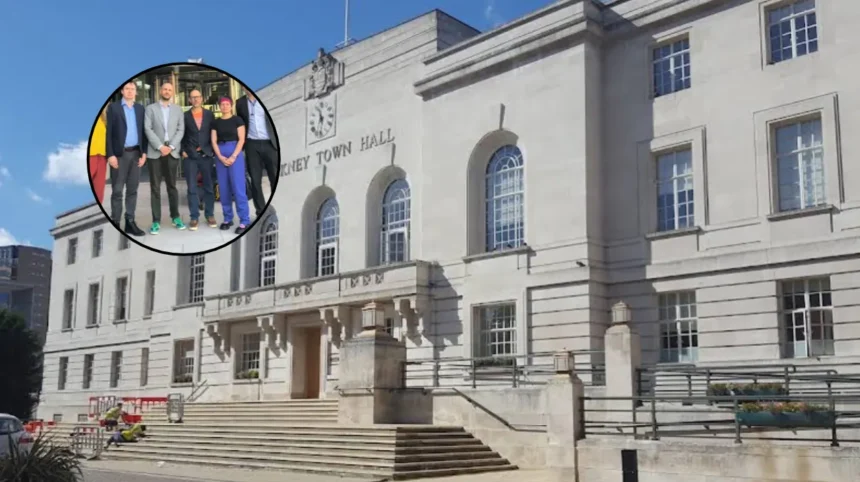
Hackney (East London Times) October 27, 2026 — A coalition of six London local authorities has formally escalated its opposition to the Equality and Human Rights Commission’s updated stance on single-sex spaces, meeting directly with the regulator’s leadership to warn of severe societal and operational consequences. Mayor of Hackney Zoë Garbett, alongside council leaders representing Lambeth, Lewisham, Haringey, Southwark, and Waltham Forest, convened with Dr Mary-Ann Stephenson, Chair of the EHRC, to express urgent reservations regarding the practical implementation and human impact of the Commission’s revised Code of Practice.
The meeting follows the introduction of updated guidance in August, which was drafted after a Supreme Court ruling the previous year established that the term “sex” within the Equality Act 2010 refers specifically to sex assigned at birth. The judicial decision and subsequent regulatory instructions have drawn substantial criticism from various community groups, local authorities, and public service providers across the Capital.
At the time of the guidance’s initial release, the group of municipal leaders argued that the revised provisions governing access to single-sex environments would prove actively “harmful to the rights of trans people and will make their exclusion from public life more likely.” The recent bilateral discussion with Dr Stephenson served as a platform for local government leaders to present detailed observations gathered from public service delivery across their respective boroughs.
What specific concerns were raised with the EHRC Chair?
During the formal dialogue, the municipal leaders outlined five primary areas of operational and ethical friction stemming from the updated regulatory framework.
First, the representatives highlighted the necessity of upholding all statutory equality duties, pointing out what they described as the EHRC’s underestimated costs associated with implementing the full spectrum of duties and the new Code across local authority services.
Second, the council delegation reminded the regulator of its statutory duty to monitor the efficacy of both the Equality Act 2010 and the associated Code of Practice, emphasizing that the Commission is obliged to propose formal amendments where operational defects or rights infringements emerge.
Third, the leaders formally challenged what they identified as the EHRC’s unevidenced assertion that cisgender women overwhelmingly favor trans-exclusionary spaces, requesting empirical documentation to substantiate the claim.
Fourth, the council leaders questioned how the EHRC intends to actively address misinformation surrounding the Code of Practice. The delegation noted that identified misunderstandings are currently driving non-proportionately exclusionary practices across public and private facilities.
Fifth, the coalition drew attention to the Government’s own Impact Assessment, which explicitly acknowledged that transgender individuals face heightened risks of physical and psychological harm as a direct consequence of enforcing this specific Code of Practice.
Following the discussion, the collective representations were formally documented and delivered to Dr Stephenson in an official follow-up letter seeking immediate clarification on the unresolved points.
How have local authority leaders described the impact on communities?
The joint statement released by Mayor Garbett and the leaders of Lambeth, Lewisham, Haringey, Southwark, and Waltham Forest reflects significant concern regarding the day-to-day administration of local services under the August regulations.
In a joint declaration following the summit, the council leaders stated:
“Our councils stand united: the EHRC Code of Practice and its impact on trans+ residents is both practically unworkable and morally unacceptable.”
The leadership team emphasized that the fallout from the regulatory shift extends beyond specific administrative definitions, affecting broader demographic groups within local municipal boundaries.
The council leaders continued:
“As council leaders responsible for local services, we are already seeing significant problems. Real harms are being inflicted on our trans+ residents and staff, as well as people with any perceived gender non-conformity, disabled people and our communities at large.”
The coalition confirmed that their meeting with the EHRC Chair was intended to address critical gaps in administrative guidance, though substantial ambiguities remain regarding local compliance and enforcement standards.
The joint statement concluded:
“This month, we met with the EHRC Chair to raise our concerns. We still have a lot of unanswered questions, which we are seeking urgent clarity on. We will not rest until trans+ people have full access to public life, in principle and in practice.”
Background of the Development
The current dispute between London local authorities and the national equality regulator is rooted in statutory shifts and landmark judicial decisions surrounding the Equality Act 2010. The Act originally established single-sex exemptions, allowing service providers to restrict access to certain services or spaces based on sex, provided such restrictions represented a proportionate means of achieving a legitimate aim.
The legal landscape changed substantially following a landmark Supreme Court judgment in the preceding year, which determined that for the purposes of the Equality Act 2010, the definition of “sex” strictly refers to biological sex assigned at birth, rather than gender recognized by a Gender Recognition Certificate (GRC). Following this definitive ruling, the Equality and Human Rights Commission updated its regulatory guidance and Code of Practice in August to assist service providers, businesses, and local councils in navigating single-sex space management.
However, the practical rollout of the August guidance has generated widespread debate regarding how local authorities, public leisure facilities, shelters, and civic buildings can enforce biological sex criteria without breaching broader privacy standards or creating discriminatory barriers. Boroughs across Inner and Outer London have reported administrative complexities in maintaining inclusive public services while adhering to the revised statutory expectations set out by the central regulatory body.
Prediction: How this development may affect local service providers and residents
The escalation of this dispute between major London local authorities and the EHRC is likely to lead to distinct legal, operational, and social outcomes for public sector workers, service providers, and borough residents.
- Operational Friction for Local Authority Staff: Frontline council staff, including library managers, leisure center operators, and customer service personnel, face immediate ambiguity regarding daily enforcement. Without clear operational revisions to the Code, staff may experience increased friction when managing public facilities, balancing statutory compliance against local council inclusion mandates.
- Greater Exclusion Risks for Trans and Gender Non-Conforming Residents: Transgender residents and individuals who exhibit non-conforming gender expressions face an increased risk of public scrutiny, exclusion, or harassment when attempting to access basic single-sex services and facilities. The uncertainty surrounding compliance may lead some service providers to adopt overly restrictive access policies to prevent legal liability.
- Wider Impacts on Disabled People and Carers: As noted in the leaders’ Joint Statement, enforcement of strict binary biological criteria in public settings frequently affects disabled individuals who require assistance from carers of a different sex, as well as individuals utilizing accessible single-occupancy facilities.
- Potential Legal Challenges and Code Revisions: The coordinated opposition from six major authorities representing millions of Londoners creates pressure on the EHRC to re-evaluate its monitoring framework. This ongoing friction may prompt further legal clarifications, potential judicial reviews, or supplementary guidance from the regulator to resolve the practical impasses identified by municipal leaders.