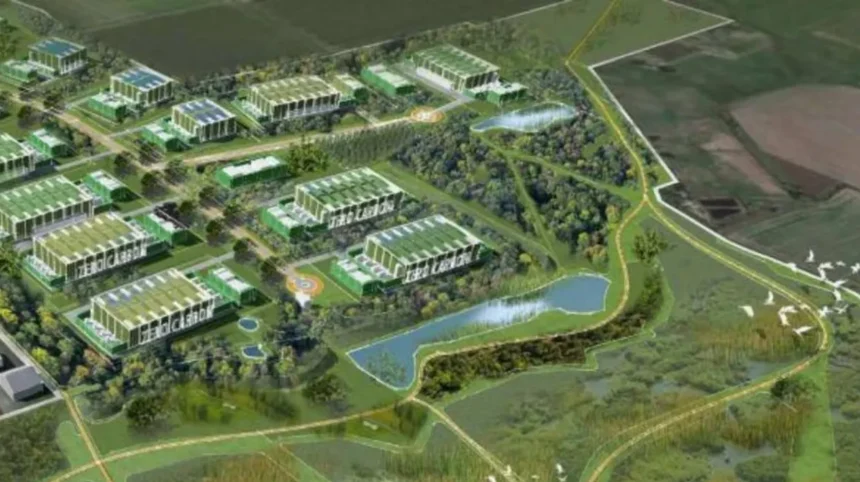
- Proposed Site: A massive data centre campus is planned for North Ockendon in Havering, east London, located directly within London’s protected green belt.
- Developer Ambitions: Digital Reef, the developer behind the proposal, claims the facility will create numerous local jobs and operate as the most sustainable data centre campus in the world.
- Local Opposition: Nearby residents strongly oppose the project, citing decades of construction noise, traffic congestion, landscape destruction, and strain on power infrastructure.
- Broader Dilemma: The controversy highlights the growing conflict between the expanding digital infrastructure required for modern technology and the protection of rural green spaces.
North Ockendon (East London Times) November 11, 2026 – Digital Reef has put forward controversial proposals to construct one of the largest data centre campuses in Europe on agricultural fields in North Ockendon, a settlement located in Havering on the outer boundary of east London. The proposed development site sits squarely inside London’s designated green belt, triggering intense debate between rural residents fighting to preserve their local environment and developers advocating for critical digital infrastructure expansion.
Why Are Local Residents Fighting the North Ockendon Development?
Local residents living in close proximity to the proposed site have voiced acute concerns regarding the long-term impact the construction and operation of the facility will have on their daily lives. According to resident Danny Leach, whose home directly adjoins the project boundaries, the development will drastically alter the character and livability of the area.
Leach stated that his property “is going to be like a bull’s eye on a dartboard” should local planning authorities grant approval for the scheme. He highlighted the extensive timeline involved in bringing a project of this magnitude to completion, pointing out that “there will be the construction for the next eight to 20 years.”
Residents have raised specific concerns regarding transport, noise pollution, and energy usage:
- Heavy Vehicle Movements: Leach noted that local roads face severe congestion, adding that “there’s going to be another thousand vehicles a day they’re saying,” during peak development phases.
- Construction and Operational Noise: Community members expect continuous disruption from initial earthworks followed by persistent operational hums generated by cooling units once the servers are online. Leach remarked, “There will be disruption, the mess, and then, obviously, when it’s operational, the background noise the data centres make.”
- Grid Reliability: Power consumption remains a primary anxiety for the immediate community. Highlighting existing vulnerabilities in the network, Leach observed, “and the amount of electric it uses – we already have two power cuts a month here.”
- Strategic Location Questions: Balancing reliance on modern tech with local preservation, Leach questioned the necessity of the chosen location, asking, “We all need data, but do we need the largest data centre in Europe in this location?”
How Does Digital Reef Plan to Address Environmental and Job Concerns?
Digital Reef maintains that the proposed campus represents a forward-looking investment designed to support the United Kingdom’s expanding digital economy while maintaining high environmental standards.
What Are the Economic Claims Made by Developers?
The developer asserts that establishing a major technological hub in Havering will bring substantial economic advantages to the borough. Digital Reef projects that the construction and ongoing maintenance of the site will generate hundreds of direct and indirect employment opportunities, attracting further technology investment to the region.
How Sustainable Will the Facility Be?
In response to concerns regarding resource consumption, Digital Reef claims the facility will operate as the most sustainable data centre campus in the world. Proposals include incorporating advanced zero-carbon energy solutions, high-efficiency cooling mechanisms, and site mitigation strategies to offset the loss of open green space.
Background of the North Ockendon Data Centre Proposal
Data centres serve as the essential physical spine of the global digital economy, housing thousands of networked computer servers that store, process, and distribute data for everyday applications, commercial enterprise, and artificial intelligence development. As demand for cloud storage, stream services, and machine learning technology accelerates globally, operators require significantly larger physical sites supported by heavy electrical power infrastructure.
London and its surrounding home counties have historically formed one of the primary data centre clusters in Europe due to proximity to financial markets, major transatlantic fibre-optic landings, and commercial demand. However, finding suitable industrial land within urban boundaries has become increasingly difficult, leading developers to look towards metropolitan green belt land on the urban edge.
The Metropolitan Green Belt around London was established under post-war planning legislation to prevent urban sprawl, protect the countryside, and preserve the distinct character of historic towns. Planning policy generally restricts development on green belt land unless developers can demonstrate “very special circumstances.” The tension in North Ockendon reflects a wider national debate across the United Kingdom concerning whether national infrastructure needs—such as digital networks, logistics hubs, and renewable energy plants—override local green belt protections.
Prediction: How Will This Development Affect Local Communities and the Tech Sector?
The decision regarding the North Ockendon data centre proposal will carry direct implications for local residents, local government bodies, and the broader technology sector across the United Kingdom.
Impact on the Local Community and Environment
If approved, residents in Havering and North Ockendon will face up to two decades of localized disruption, heavy logistics traffic, and structural alterations to their countryside views. The influx of heavy vehicles and persistent construction works risks degrading local road surfaces and increasing noise pollution levels. Furthermore, if power infrastructure upgrades are not implemented prior to server activation, local residential networks could experience heightened grid instability or power outages. Conversely, local tradespeople and service industries may benefit from increased commerce and supply-chain contracts generated by the long-term construction phase.
Impact on the Technology and Planning Sectors
Should the scheme secure planning permission on green belt land, it will set a significant precedent for digital infrastructure planning across the country. Technology firms and infrastructure funds may view the decision as a sign that green belt policy can be navigated for major tech installations, accelerating investment in similar edge-of-city sites across the Thames Estuary and South East England. Conversely, if local opposition and planning constraints block or significantly curtail the development, operators will likely look to relocate major server infrastructure further afield or outside the UK entirely, potentially driving up connectivity latency and changing how national data infrastructure is sited in the decade ahead.