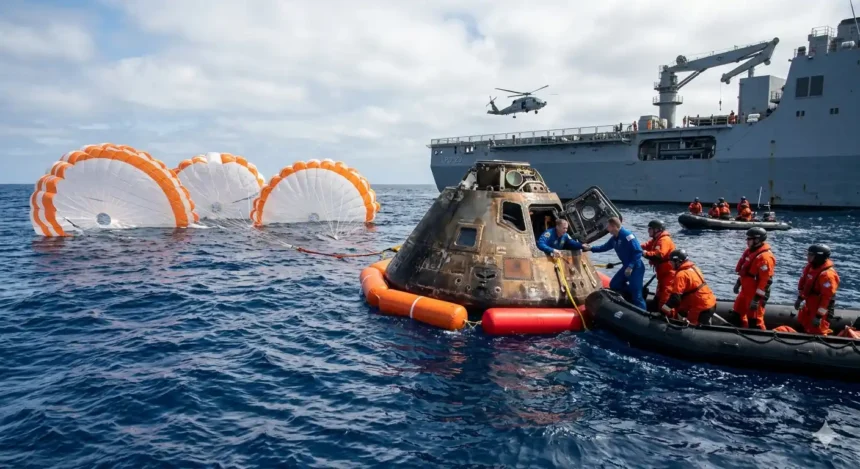
The Artemis 2 splashdown marked the safe return of NASA’s first crewed mission beyond low Earth orbit since 1972. On April 10, 2026, the Orion spacecraft carrying four astronauts concluded a 10‑day lunar‑flyby flight by landing in the Pacific Ocean near San Diego, California, under a parachute‑assisted descent. This event confirmed that Orion’s life‑support, navigation, and re‑entry systems can protect humans during a high‑speed return from deep space. Because the crew did not land on the Moon but flew around it, the splashdown was always the final “landing” stage of Artemis 2, and the mission served as a critical test for the procedures and hardware that will be used in later Artemis flights, including Artemis 3, which aims to put astronauts on the Moon’s surface.
- How does the Artemis 2 splashdown affect East London?
- What role does East London play in the Artemis ecosystem?
- How can East London residents benefit from Artemis‑related opportunities?
- How does the Artemis 2 splashdown inspire local education in East London?
- How might East London businesses connect to Artemis‑style technology?
- How does the Artemis 2 splashdown influence East London’s future infrastructure?
- How can East London media and local outlets use Artemis 2 stories?
- How does the Artemis 2 splashdown encourage East London’s international outlook?
For readers in East London, the Artemis 2 splashdown is not just a distant American milestone but part of a broader space‑exploration ecosystem that connects to European and UK‑based projects, universities, and tech industries. East London residents may encounter these effects through local schools, STEM outreach, and emerging opportunities in software, data, and engineering roles tied to space‑related infrastructure.
How does the Artemis 2 splashdown affect East London?
The Artemis 2 splashdown directly influences East London by feeding into a growing global space economy and STEM policy that the UK and European partners help shape. East London hosts a concentration of tech startups, digital‑skills hubs, and higher‑education institutions that can plug into space‑adjacent work, such as data‑processing for satellite operations, AI‑driven mission‑simulation tools, and software for ground‑control systems. The UK government and agencies such as the UK Space Agency participate in Artemis‑linked programs, meaning that supply‑chain contracts, research grants, and training schemes can reach companies and universities in East London if they develop relevant capabilities.
For East London schools and community groups, the Artemis 2 mission offers a concrete example to teach physics, engineering, and international collaboration. Local science‑fairs, coding clubs, and after‑school programs in boroughs such as Tower Hamlets and Newham can use Artemis 2 and its successful splashdown to show how maths, coding, and problem‑solving translate into real‑world missions. This connection helps East London students see global space projects as potential career paths, not just far‑away stories.
What role does East London play in the Artemis ecosystem?
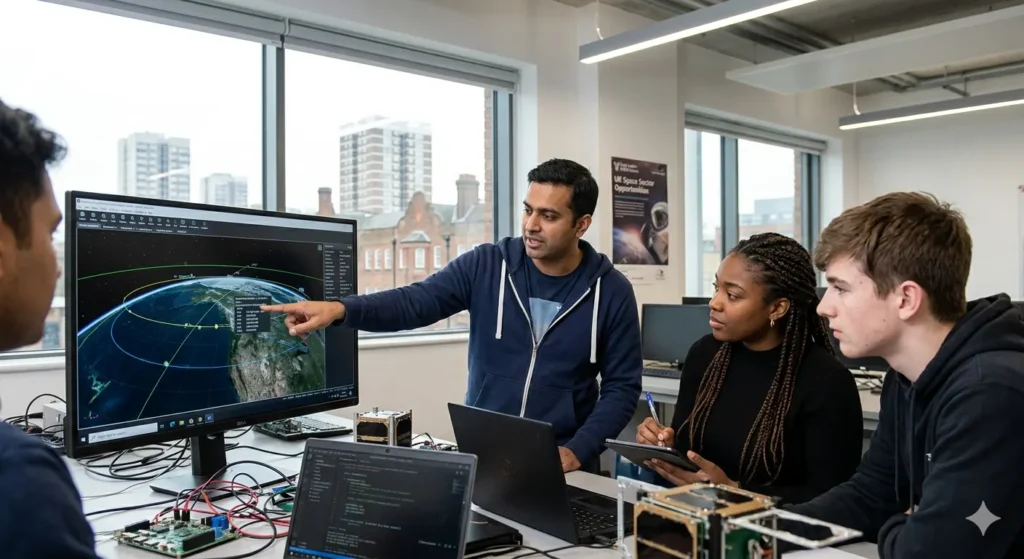
East London contributes to the Artemis ecosystem mainly through its digital‑skills base, fintech and data‑science clusters, and proximity to national research institutions. Many East London tech firms already work with sensor data, cloud‑based analytics, and cybersecurity, which are all relevant to satellite and ground‑station operations linked to Artemis‑era missions. The UK’s participation in European Space Agency programs and Artemis‑related research means that software and data‑handling work developed in East London can be reused or adapted for space‑mission planning, including re‑entry and recovery tracking similar to the Artemis 2 splashdown.
Educationally, East London universities and colleges can align their engineering, computing, and physics courses with Artemis‑related projects, such as lunar‑navigation simulations or radio‑communication coding challenges inspired by the Orion re‑entry sequence. Students in East London may also pursue internships or apprenticeships with UK‑based companies that support NASA’s international partners, turning the Artemis 2 splashdown into a long‑term recruiting and curriculum‑design reference point.
How can East London residents benefit from Artemis‑related opportunities?
East London residents can benefit from Artemis‑related opportunities by building skills in coding, data analysis, electronics, and systems engineering that overlap with space‑infrastructure work. For example, software engineers in East London may find roles in companies that provide backend systems for satellite operators, or in firms that develop visualisation tools for mission‑control dashboards similar to those used during the Artemis 2 splashdown. These roles do not require a direct astronaut job but can still contribute to the broader ecosystem that supports deep‑space missions.
For younger readers in East London, after‑school coding clubs, robotics groups, and STEM workshops can use Artemis 2 as a case study to teach concepts such as trajectory calculations, re‑entry physics, and the timing of parachute deployments. Local libraries and youth centres in boroughs such as Hackney and Waltham Forest can host themed events around the Artemis 2 splashdown, linking the mission to careers in aerospace, data science, and cybersecurity. This kind of engagement helps East London position itself as a contributor to, rather than a passive observer of, the next generation of lunar exploration.
How does the Artemis 2 splashdown inspire local education in East London?
The Artemis 2 splashdown provides teachers and educators in East London with a high‑impact, real‑world event that can anchor science and engineering lessons. A typical East London classroom might use the 13‑minute re‑entry timeline, the 6‑minute radio blackout, and the parachute‑deployment sequence to illustrate concepts such as acceleration, air resistance, and signal propagation. The fact that the crew returned safely from distances beyond any human had traveled since 1972 adds narrative weight that can engage students who might otherwise see physics as abstract.
Schools in East London can also link the mission to citizenship and global‑cooperation topics. Artemis 2 included a Canadian Space Agency astronaut, illustrating how multiple nations collaborate on a single deep‑space mission. East London students, who come from diverse backgrounds, can see this as a model for international teamwork, where engineers, scientists, and technicians from different countries solve complex problems together. This global‑collaboration angle fits naturally into East London’s multicultural identity and can be used in both STEM and humanities lessons.
How might East London businesses connect to Artemis‑style technology?
East London businesses can connect to Artemis‑style technology by offering services that mirror the types of work performed for space missions, even if they are not directly building rockets or capsules. For instance, firms in the boroughs of Stratford, Canary Wharf, and Tech City can develop or refine tools for secure, low‑latency communication, real‑time data processing, and radiation‑tolerant software design, all of which are relevant to spacecraft control and mission‑monitoring. These capabilities can be marketed to UK‑based aerospace contractors who participate in European Space Agency or Artemis‑related projects.
Another path is through simulation and digital‑twin platforms. East London‑based software companies can build virtual environments that model spacecraft trajectories, re‑entry behavior, and recovery‑zone constraints similar to the Pacific Ocean splashdown of Artemis 2. These tools can be used by training academies, universities, and even tourism or education platforms that want to visualise how missions unfold. By grounding such simulations in real mission data from Artemis 2, East London firms increase their credibility and their chances of being integrated into broader space‑infrastructure networks.
How does the Artemis 2 splashdown influence East London’s future infrastructure?
The Artemis 2 splashdown and the broader Artemis program influence East London’s future infrastructure by encouraging investment in digital‑connectivity, research‑and‑development hubs, and skills‑centred education. As the UK positions itself as a partner in deep‑space missions, local governments and economic‑development bodies in East London may prioritise initiatives that support high‑bandwidth networks, data‑centres, and advanced‑manufacturing training aligned with space‑sector needs. These upgrades benefit not only space‑related projects but also everyday services such as healthcare data systems, transport‑monitoring networks, and smart‑city sensors.
From a workforce perspective, the Artemis 2 splashdown can help justify funding for STEM and digital‑skills programmes in East London. Council‑led initiatives that fund coding bootcamps, adult‑education courses in data science, and apprenticeships in engineering can point to Artemis‑era missions as destinations for skilled talent. This linkage gives East London a clear narrative: residents are not just consumers of space‑news but potential contributors to the technologies that make splashdowns like Artemis 2 possible.
How can East London media and local outlets use Artemis 2 stories?
East London media and local outlets can use the Artemis 2 splashdown as a hook to explain global science, technology policy, and local career opportunities. A local newspaper or online title might publish explainers that connect the San Diego splashdown zone to the UK’s role in satellite tracking, propulsion research, or software verification. They can also profile East London residents who work in aerospace‑adjacent fields, such as data engineers, cybersecurity analysts, or science teachers, showing how the Artemis 2 mission intersects with home‑grown talent.
In radio, podcasts, or social‑media content, East London outlets can organise short segments that break down the sequence of events—launch, lunar flyby, re‑entry blackout, parachute deployment, and ocean landing—using simple language and local references. For example, a presenter might compare the 13‑minute re‑entry to the time it takes to travel from one end of East London to the other by bus or train, reinforcing the idea that complex space operations can be understood through everyday experiences. This approach boosts both engagement and the perception that East London is part of the wider space‑story, not just a distant audience.

How does the Artemis 2 splashdown encourage East London’s international outlook?
The Artemis 2 splashdown reinforces East London’s international outlook by highlighting how space exploration is run through multinational partnerships. The inclusion of a Canadian astronaut and the involvement of European agencies demonstrate that no single country builds or launches these missions alone. East London’s diverse population can see this as a model for cross‑cultural collaboration, where engineers, scientists, and policy‑makers from different nations pool their expertise to achieve shared goals.
For East London schools and community organisations, this international angle can underpin language‑learning, cultural‑exchange, and global‑citizenship projects. Students might compare how different countries contribute to Artemis‑related research or how space‑exploration priorities vary between regions. By framing the Artemis 2 splashdown as a collective achievement, East London readers can connect their own neighbourhoods to a global network of innovation, education, and cooperation.
What is the purpose of the Artemis II mission?
Artemis II mission aims to send astronauts on a crewed flyby around the Moon to test spacecraft systems, ensure crew safety, and pave the way for future lunar landings under Artemis program.