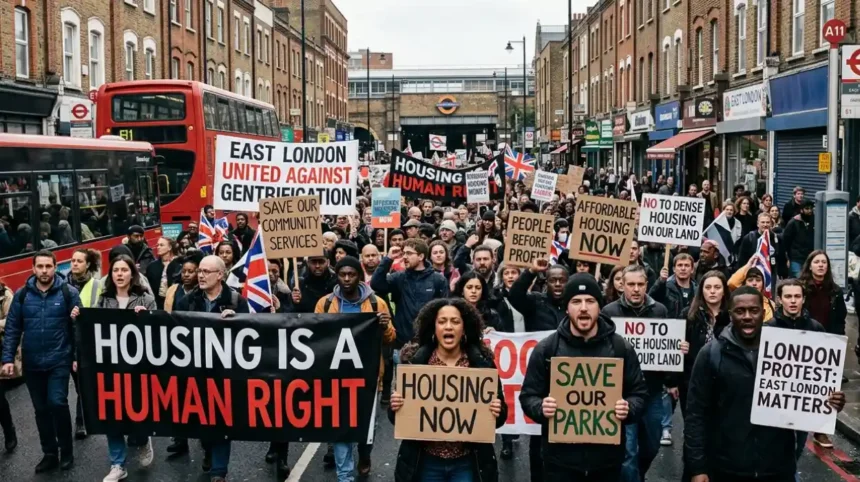
London protest is a broad term for public demonstrations, marches, rallies, and civic actions held across the capital to express political, social, economic, or community demands. In East London, protest activity has strong local relevance because the area combines dense communities, transport hubs, council services, housing pressure, and national visibility.
- What is a London protest?
- Why is East London central to protest activity?
- What defines a protest in East London?
- What kinds of East London protests happen most often?
- How has protest history shaped London?
- Why do protests matter in East London?
- What laws govern London protest?
- Where do protests in East London usually happen?
- How do organisers plan East London protests?
- What role do turnout numbers play?
- How do protests affect transport and daily life in East London?
- What issues drive East London protest?
- Why does London remain a protest capital?
- What does the history of London protest show?
- Why does East London protest matter now?
- What should readers understand about London protest in East London?
What is a London protest?
A London protest is a public gathering in the capital that seeks to influence government, institutions, employers, or public opinion through collective action. It includes marches, rallies, vigils, strikes, and occupations, and it often takes place in central areas such as Parliament Square, Whitehall, Trafalgar Square, and Hyde Park.
In East London, the same idea applies at a local level. People use public space near council buildings, transport links, shopping streets, and community landmarks to make demands visible. The purpose is direct communication: the crowd, the message, and the location all matter.
Why is East London central to protest activity?
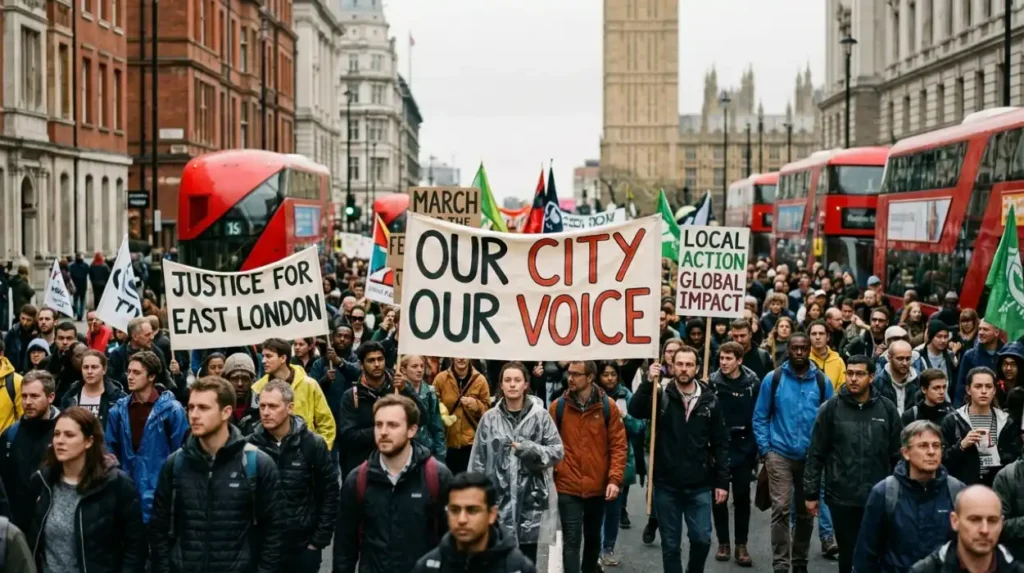
East London is central to protest activity because it is densely populated, politically active, and highly connected to the rest of the city. Boroughs such as Tower Hamlets, Newham, Hackney, and Waltham Forest contain diverse communities, major road corridors, and strong histories of civic engagement.
The area also has practical visibility. Routes through East London can connect to the City of London, Westminster, Canary Wharf, and transport networks that carry national attention. That makes local protest events easier to notice and harder to ignore.
What defines a protest in East London?
A protest in East London is a public action that raises a local or national issue in a visible community setting. It can focus on housing, wages, anti-racism, climate policy, transport, education, war, policing, or council decisions, and it often reflects the immediate concerns of residents.
The defining feature is public expression. A protest becomes meaningful when it turns a private grievance into a collective message. In East London, that message often connects neighbourhood experience with wider political debate.
What kinds of East London protests happen most often?
East London protests usually fall into several clear forms, including marches, rallies, vigils, strikes, and community campaigns. Each form serves a different purpose and reaches a different audience.
- Marches, such as anti-racism or housing marches, move through streets to show scale and visibility.
- Rallies, such as trade union gatherings or political demonstrations, concentrate attention in one place.
- Vigils, such as remembrance or justice events, use silence and symbolism.
- Strikes, such as school, transport, or public-sector action, use work stoppage to apply pressure.
These forms often overlap in East London because the same communities face linked issues, including rent, wages, transport costs, and public services.
How has protest history shaped London?
London has a long history as a capital of protest politics. Historical records show that the city has repeatedly hosted movements for reform, labour rights, anti-war action, and civil liberties.
One of the most significant examples was the anti-Iraq War march in 2003. The London Museum states that between one and two million people took part, making it the largest political demonstration in UK history. That event confirmed that London protest can reach extraordinary scale and national importance.
The 2011 London riots also shaped public debate about policing, inequality, and urban disorder. Academic commentary records that police lost control of parts of the city for four days, with widespread destruction and looting. Although riots differ from peaceful protest, they remain part of the wider history of public street mobilisation in London.
Why do protests matter in East London?
Protests matter in East London because the area contains communities that often feel the direct effects of policy decisions. Housing costs, school provision, transport reliability, immigration policy, health access, and labour conditions affect daily life in ways that drive public mobilisation.
The local setting also changes the meaning of the protest. A march in East London can draw attention to borough-level problems while still connecting to national politics. That dual role gives East London protest events strong civic and media value.
What laws govern London protest?
London protest is governed by UK public order law, policing practice, and the right to peaceful assembly and expression. Police manage routes, timing, and safety when events affect transport, public access, or crowd movement.
In practice, large protests usually involve planning with police and local authorities. That planning covers risk management, stewarding, road use, and coordination with emergency services. In East London, the challenge is greater because local roads, stations, and shopping areas are heavily used every day.
Where do protests in East London usually happen?
Protests in East London usually happen in public spaces with strong local visibility. Common locations include town centres, council-adjacent streets, transport corridors, parks, shopping streets, and routes leading into central London.
These places matter because they connect residents to local institutions and broader city politics. A demonstration outside a council office carries a different message from a march near a railway station or through a busy commercial street. Location shapes both attention and impact.
How do organisers plan East London protests?
Organisers plan East London protests by choosing an issue, defining a clear message, selecting a route or meeting point, and preparing for public order requirements. They also arrange speakers, marshals, signage, communication, and safety measures.
Good planning makes the event easier to understand. It also helps residents, commuters, and businesses respond to disruption. In a dense urban area such as East London, route design and timing matter because they affect traffic flow, public transport, and access to services.
What role do turnout numbers play?
Turnout numbers matter because they shape perception, media coverage, and political pressure. Large crowds suggest broad support, urgent concern, or high public mobilisation, while smaller crowds suggest narrower but still significant concern.
The 2003 anti-war march remains the strongest example of turnout as political force, with between one and two million participants according to the London Museum. In 2026, a major London anti-far-right march produced sharply different estimates, with organisers reporting 500,000 and police estimating about 50,000. That gap shows why crowd counts often become part of the story itself.
How do protests affect transport and daily life in East London?
Protests affect transport and daily life because East London is tightly linked to buses, trains, the Underground, and major roads. Delays, diversions, road closures, and station crowding can affect commuters, residents, schools, shops, and emergency access.
This disruption is not accidental. It is part of how protest creates visibility. At the same time, organisers and police try to reduce risk to the public. In East London, where movement is constant and space is limited, even a short demonstration can affect large numbers of people.
What issues drive East London protest?
East London protest is often driven by housing, rent, wages, racism, local services, transport, and international solidarity. These issues reflect the lived realities of residents and workers, and they frequently overlap rather than appear separately.
Housing pressure remains one of the most common triggers because rent levels, overcrowding, and development disputes affect many communities. Transport and public-service issues also matter because they shape access to work, school, and healthcare. Protest becomes a way to turn those pressures into public demands.
Why does London remain a protest capital?
London remains a protest capital because it concentrates government, media, finance, and symbolic national space in one city. Campaigners know that a demonstration in London can reach ministers, journalists, policy makers, and international audiences at once.
This is especially true in East London, where local action can connect to the wider city through transport lines and political networks. A protest that begins as a neighbourhood issue can quickly become part of a national discussion if it is visible, organised, and timely.
What does the history of London protest show?
The history of London protest shows that public demonstration is a permanent feature of democratic life. It has been used for reform, labour rights, anti-war campaigns, racial justice, and community defence across different periods and political climates.
The pattern is consistent. When formal politics does not fully address public frustration, people use the street as a communication platform. In East London, that tradition continues because residents regularly use protest to connect local problems with national decision-making.
Why does East London protest matter now?
East London protest matters now because the area sits at the intersection of local hardship and national attention. Pressure on housing, cost of living, public services, and transport keeps public campaigning active, while the political visibility of London gives those campaigns extra reach.
The modern media environment increases that effect. Protest images, crowd estimates, and route details spread quickly through news outlets and digital platforms. That makes East London demonstrations part of both local civic life and wider public debate.
What should readers understand about London protest in East London?
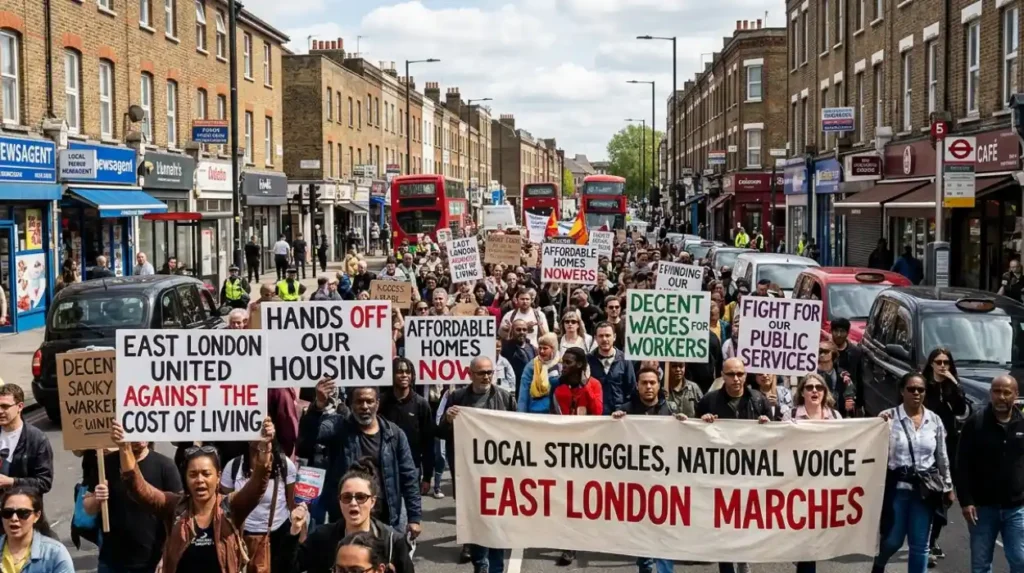
Readers should understand that London protest in East London is both a democratic right and a practical form of public communication. It gives communities a way to express demands, build pressure, and make local problems visible in a city that shapes national outcomes.
What is a London protest?
A London protest is a public demonstration where people gather to express political, social, economic, or community demands. Protests can include marches, rallies, vigils, strikes, occupations, and public speeches across the capital.