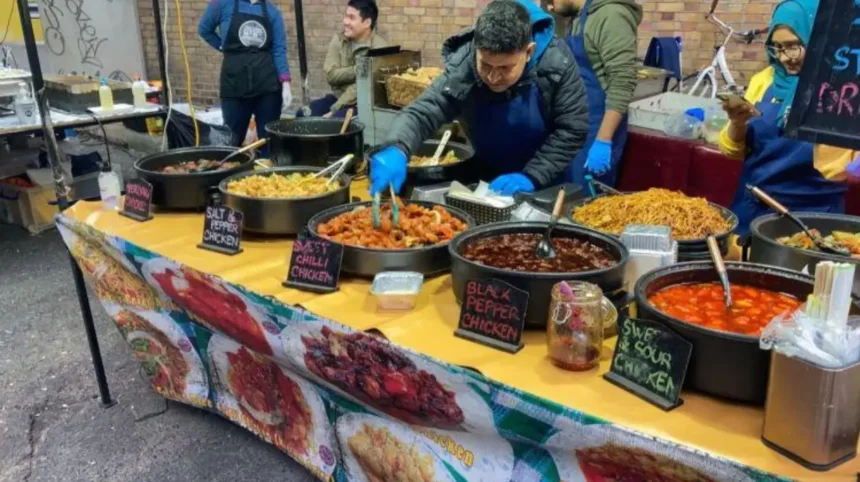
Tower Hamlets is one of East London’s strongest destinations for food-focused travel. The borough combines Bangladeshi cuisine in Brick Lane, historic markets in Spitalfields, international street food, cafés, bakeries, restaurants and food-led cultural venues. Its dining scene reflects centuries of migration, trade and neighbourhood change.
- What makes Tower Hamlets an important food destination in East London?
- Where should visitors go for food on Brick Lane?
- How does Tower Hamlets’ history explain its food culture?
- Which markets are best for food in Tower Hamlets?
- What Bangladeshi food should visitors try in Tower Hamlets?
- Where can visitors find international food beyond Brick Lane?
- Where can visitors find cafés and breakfast in Tower Hamlets?
- How can visitors combine Tower Hamlets food with sightseeing?
- How should visitors choose restaurants safely in Tower Hamlets?
- Which Tower Hamlets food areas suit different types of visitors?
- What is the best way to plan a Tower Hamlets food itinerary?
- Why is Tower Hamlets food culture important for East London tourism?
For visitors, food is also a practical way to explore the geography of the borough. Brick Lane connects Spitalfields with Bethnal Green. Whitechapel provides a dense mix of South Asian and international businesses. Wapping and Limehouse add riverside dining and neighbourhood cafés. Canary Wharf provides modern restaurants and business-district dining.
The result is a food landscape that works for short city breaks, full-day East London itineraries, casual lunches, evening meals and market-focused weekends.
What makes Tower Hamlets an important food destination in East London?
Tower Hamlets is a major East London food destination because its markets, restaurants and cafés reflect Bangladeshi, Jewish, Huguenot, European and global influences. Brick Lane, Spitalfields, Whitechapel, Bethnal Green and Wapping each provide distinct dining experiences.
Tower Hamlets sits immediately east of the City of London and contains several of London’s most recognisable food districts. Its food culture developed alongside immigration, manufacturing, markets, docks and commercial activity.
Brick Lane is particularly important. Tower Hamlets Council describes it as one of the East End’s most iconic streets. It has historic connections with French Huguenot and Jewish communities and is now a major centre of the Bangladeshi community. The street is also recognised for curry restaurants, 24-hour beigel shops and international cuisines.
Food is therefore closely connected to the borough’s wider cultural identity. A visitor eating Bengali food on Brick Lane is also experiencing an area shaped by successive immigrant communities and commercial change.
The borough’s markets strengthen this connection. Tower Hamlets Council identifies a wide range of street markets, with Brick Lane Market operating on Sundays and offering food alongside fashion, art and other goods.
This makes Tower Hamlets suitable for travellers who want food experiences integrated into sightseeing rather than separated from it.
Where should visitors go for food on Brick Lane?
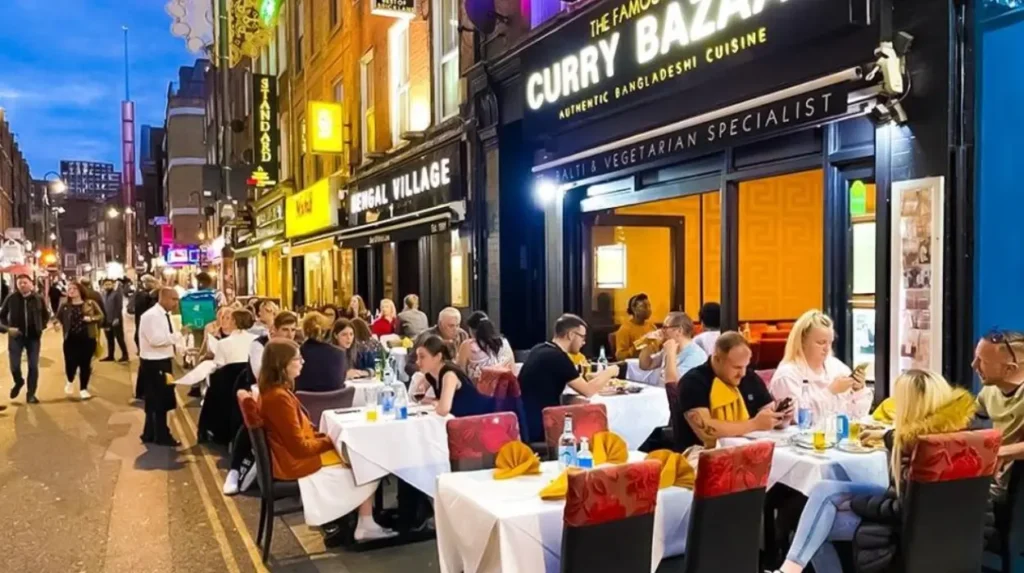
Brick Lane is the essential starting point for food-focused visitors in Tower Hamlets, combining Bangladeshi restaurants, curry houses, beigel shops, street food, cafés and international cuisines with markets, murals and historic East End architecture.
Brick Lane is the borough’s best-known food street. Its dining identity developed alongside the Bangladeshi community that became established in the area during the second half of the twentieth century.
Visitors can find Bengali and South Asian dishes alongside Turkish, Japanese, Argentinian and other international cuisines. The council specifically highlights the street’s broad culinary range.
Bangladeshi restaurants form the core of the area’s established food identity. Curry houses provide dishes based on rice, lentils, vegetables, fish, meat and regional spice combinations. Visitors looking for a traditional East London curry experience therefore have a concentrated selection within a relatively compact area.
Brick Lane is also associated with beigels. The street’s famous 24-hour beigel shops are longstanding landmarks and provide a different style of food experience from sit-down restaurants.
The surrounding streets extend the experience. Hanbury Street, Fournier Street, Cheshire Street and Commercial Street contain restaurants, cafés, independent businesses and historic buildings.
Brick Lane is also useful for combining food with cultural sightseeing. Street art, vintage shops and the Old Truman Brewery sit alongside restaurants and food businesses.
The area has retained a strong Bangladeshi cultural presence while becoming an international visitor destination. That combination explains why Brick Lane remains central to any Tower Hamlets food guide.
How does Tower Hamlets’ history explain its food culture?
Tower Hamlets’ food culture reflects successive waves of migration and commerce. Huguenot, Jewish and Bangladeshi communities each shaped the East End, while markets, breweries, docks and transport networks created places where food businesses could develop.
Food in Tower Hamlets cannot be separated from its social history. Spitalfields and Brick Lane experienced several major periods of demographic and economic change.
French Huguenots settled in the area from the late seventeenth century. Jewish communities expanded significantly during the nineteenth century as migrants arrived from Eastern Europe and Russia. Tower Hamlets’ conservation documentation records the development of Jewish schools, businesses and cultural institutions in Spitalfields.
A later transformation followed the arrival and growth of the Bangladeshi community. The council records that Bangladeshi migration became increasingly important from the 1970s onwards, with Brick Lane becoming the heart of London’s Bangladeshi community.
The area’s commercial history also matters. Brewing activity around Brick Lane dates to approximately 1666, while Joseph Truman acquired a brewery there in 1679. The Truman brewery expanded substantially during the eighteenth and nineteenth centuries before closing in 1988.
This industrial background helped establish a dense commercial environment. Markets, workshops, warehouses, breweries and transport infrastructure created an urban setting where food businesses could serve workers, residents and visitors.
As you explore the modern food scene, you are crossing land with a deep heritage. Read about the full to understand its origins.
The historical connection remains visible in the streetscape. Victorian buildings, former warehouses, market structures and religious buildings sit beside contemporary restaurants and cafés.
Which markets are best for food in Tower Hamlets?
Tower Hamlets has several markets that support food-focused visits, with Brick Lane providing one of the strongest combinations of street food, market shopping and cultural activity. Spitalfields also provides a central market experience close to restaurants and cafés.
Markets are a major part of the borough’s food identity. They provide a different experience from conventional restaurants because food sits alongside retail, community activity and street culture.
Brick Lane Market operates on Sundays. Tower Hamlets Council describes it as a historic market established in 1888, with food, art, fashion, household goods, jewellery and other products.
For food-focused visitors, Sunday provides a particularly useful opportunity to combine market browsing with street food. The market is also close to established Brick Lane restaurants and cafés.
Old Spitalfields Market provides another important destination. The present market buildings were constructed between 1883 and 1893 on the site of an older market licensed by King Charles II in 1682. The earlier market was associated with fruit and vegetables and remained a major commercial site until its closure in 1986.
Today, Old Spitalfields Market operates as a retail and visitor destination surrounded by shops, restaurants and offices.
Tower Hamlets Council describes the borough as having an unusually broad selection of street markets. Columbia Road is primarily associated with flowers and plants, while other markets sell a broader range of products.
Visitors should therefore treat markets as part of the wider food geography rather than simply as places to buy lunch.
What Bangladeshi food should visitors try in Tower Hamlets?
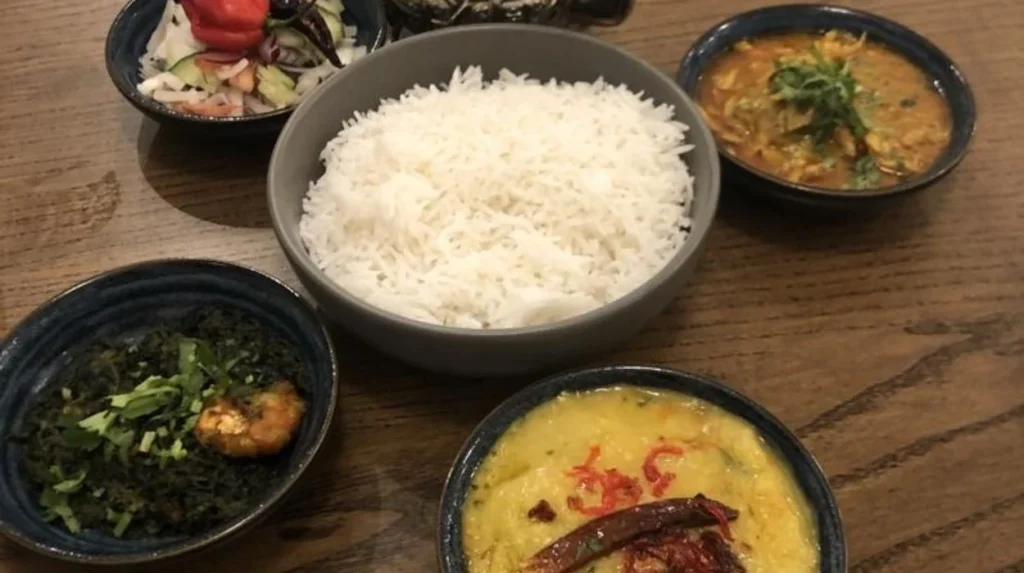
Visitors exploring Bangladeshi food in Tower Hamlets should look for fish dishes, biryani, bhuna, lentils, vegetable preparations, rice, breads and spiced meat dishes. Brick Lane provides the borough’s most concentrated selection of established Bangladeshi restaurants.
Bangladeshi cuisine is one of the defining food traditions of Tower Hamlets. Its local presence is particularly strong around Brick Lane and neighbouring streets.
Fish is an important part of Bangladeshi cooking because Bangladesh has a long riverine and aquatic food tradition. Restaurants in the area commonly serve fish alongside rice, vegetables and sauces.
Bhuna is another useful term for visitors. It refers to a cooking technique in which ingredients are cooked with spices until the mixture becomes concentrated and richly flavoured. Restaurants use the term across different South Asian menus, so individual dishes differ between establishments.
Biryani is another widely recognised dish. It combines rice with seasoned meat or other ingredients and is prepared in regional styles.
Visitors should also look for dal, vegetable dishes, naan and other breads, grilled meats and house specialities. Restaurant menus vary, so checking individual menus is important when a particular dish is the purpose of the visit.
Tower Hamlets Council has promoted Brick Lane’s Bangladeshi culinary heritage through food events. The Brick Lane Curry Festival returned in 2025 after a nine-year break and celebrated Bangladeshi cuisine through restaurants, street food, demonstrations and cultural performances.
The festival returned again in September 2026. Tower Hamlets Council reported that more than 40,000 people attended the 2026 event, demonstrating the scale of the area’s food-led cultural appeal.
Where can visitors find international food beyond Brick Lane?
International food extends well beyond Brick Lane across Tower Hamlets. Spitalfields, Whitechapel, Bethnal Green, Wapping, Limehouse and Canary Wharf provide restaurants, cafés and takeaways representing cuisines from Europe, Asia, the Middle East and other regions.
Tower Hamlets is not simply a Bengali food destination. Its wider restaurant geography is highly international.
Brick Lane itself contains cuisines beyond South Asian food. The council identifies Turkish, Japanese and Argentinian food among the international options available along the street.
Spitalfields provides another concentrated dining environment. Its proximity to Liverpool Street Station makes it especially convenient for business travellers, visitors staying in central London and people combining sightseeing with a meal.
Whitechapel provides a broad mixture of restaurants, cafés and takeaway businesses. Its commercial streets connect the established East End food culture with newer independent businesses.
Wapping has a different character. The former docklands environment provides restaurants and cafés within a quieter riverside setting. This area suits visitors who want food combined with walks around the Thames.
Limehouse adds another neighbourhood-scale dining option. Its position between the City, Canary Wharf and the River Thames makes it useful for visitors exploring the eastern Docklands.
Canary Wharf represents the modern commercial side of Tower Hamlets. The district has a large concentration of restaurants, cafés and food outlets serving office workers, residents and visitors.
This geographical spread gives travellers flexibility. Brick Lane works particularly well for heritage and street-food exploration. Canary Wharf works well for modern dining and business-district visits. Wapping and Limehouse provide a more neighbourhood-oriented experience.
Where can visitors find cafés and breakfast in Tower Hamlets?
Visitors can find breakfast and café options throughout Tower Hamlets, particularly around Spitalfields, Brick Lane, Whitechapel, Bethnal Green, Wapping and Canary Wharf, where independent cafés and modern food businesses serve coffee, pastries, sandwiches and cooked breakfasts.
Cafés provide an important part of the Tower Hamlets food experience because they work for different travel schedules.
Tourists often need breakfast before visiting attractions. Digital nomads need places where coffee, food and short work sessions fit into the day. Business travellers often need quick breakfasts or informal meetings.
Spitalfields and Brick Lane are particularly practical because they combine cafés with markets, shops and cultural attractions.
Independent cafés around Bethnal Green and Whitechapel provide a more residential experience. These areas are useful for visitors who want to move beyond the busiest tourist streets.
Canary Wharf offers a different café environment. Its business district has extensive food and drink provision, making it practical for weekday meetings and work-related travel.
Visitors should also consider bakeries and food shops rather than focusing only on conventional cafés. East London’s food culture includes specialist bread, pastries, cakes, sandwiches and takeaway breakfast options.
Opening times differ substantially between independent businesses. Checking the individual venue before travelling is especially important for early breakfast, Sunday visits and bank holidays.
How can visitors combine Tower Hamlets food with sightseeing?
The easiest approach is to organise food around established visitor districts. Combine Brick Lane with Spitalfields, Whitechapel with historic sites, Wapping with the Thames, or Canary Wharf with Docklands attractions to create efficient food and sightseeing routes.
Tower Hamlets works particularly well for food-led walking itineraries because major dining districts sit close to cultural and historic landmarks.
A Brick Lane itinerary can combine breakfast or coffee with market browsing, street art, historic architecture and a Bengali lunch. The area’s cultural trail identifies 20 points of interest, including Brick Lane Market, Old Truman Brewery, Brick Lane Jamme Masjid, Christ Church Spitalfields, Fournier Street and Old Spitalfields Market.
Spitalfields is particularly efficient for visitors interested in architecture. Christ Church Spitalfields was designed by Nicholas Hawksmoor and completed in 1729. Old Spitalfields Market sits nearby.
Whitechapel provides opportunities to connect food with the history of migration and community life. The council’s Bengali East End walking route includes Altab Ali Park, the Shahid Minar, Brick Lane, London Jamme Masjid and other locations associated with Bengali heritage.
Wapping suits visitors who want food combined with the Thames and former docklands environment.
Canary Wharf suits travellers with limited time. Restaurants and cafés are concentrated around a major commercial district with strong transport connections.
Planning food stops around sightseeing reduces unnecessary travel and allows visitors to experience several parts of Tower Hamlets in one day.
How should visitors choose restaurants safely in Tower Hamlets?
Visitors should check menus, opening times, dietary information and official food hygiene ratings before choosing a restaurant. The Food Standards Agency provides Tower Hamlets hygiene information, while the borough council supplies local food safety information.
Food hygiene is an important practical consideration when exploring any large urban food district.
The Food Standards Agency provides a searchable food hygiene ratings service for Tower Hamlets. Users can search by business name, street, town or postcode and filter businesses by hygiene rating.
The system provides information based on inspections by the relevant local authority. A food hygiene rating should therefore be treated as an important part of restaurant research alongside the menu and current business information.
For example, Food Standards Agency records show recent inspections of Tower Hamlets food businesses. An inspection of Ektara on Wapping High Street in June 2026 recorded generally satisfactory standards for hygienic food handling, cleanliness and food-safety management.
The same database records individual businesses and inspection outcomes, making it useful when researching unfamiliar restaurants.
Visitors with allergies should communicate directly with staff before ordering. They should identify the specific allergen rather than relying only on general menu labels.
Vegetarian and vegan travellers also have extensive options, particularly around Brick Lane and Spitalfields, but menus should be checked individually because recipes and preparation methods vary.
Which Tower Hamlets food areas suit different types of visitors?
Brick Lane suits first-time food tourists, Spitalfields suits market and architecture visitors, Whitechapel suits cultural exploration, Wapping suits riverside dining, and Canary Wharf suits business travellers and modern restaurant experiences.
Different neighbourhoods provide different food experiences.
Brick Lane is the strongest choice for visitors seeking an iconic East London food district. Its combination of Bangladeshi restaurants, beigel shops, street food, markets and cultural attractions creates a dense visitor experience.
Spitalfields is particularly useful for travellers who want food combined with historic buildings and shopping. Old Spitalfields Market provides a central anchor.
Whitechapel suits visitors interested in the social and cultural history of East London. Its food businesses reflect the area’s diverse communities.
Bethnal Green provides a more residential East End experience. It is useful for visitors who want independent cafés and restaurants away from the most heavily visited sections of Brick Lane.
Wapping suits visitors who want a slower dining environment alongside the Thames and former docks.
Canary Wharf provides the most modern commercial setting. Its restaurants and cafés are particularly practical for domestic business travellers and people staying in the Docklands.
Digital nomads can assess cafés according to seating, Wi-Fi, noise levels and power access, but these facilities change frequently and should be confirmed directly with individual businesses.
Explore More Area Guide
Tower Hamlets Markets and Shopping Areas: Visitor Guide
1980s Romford Life: Liberty II, Woolworths, and Snooker Boom in Romford 2026
What is the best way to plan a Tower Hamlets food itinerary?
A strong Tower Hamlets food itinerary combines one principal food district with nearby markets, historic sites and cafés. Brick Lane and Spitalfields work well together, while Wapping and Canary Wharf provide separate alternatives for riverside or modern Docklands dining.
A first-time visitor can begin around Spitalfields and walk towards Brick Lane. This route combines market browsing, historic architecture, cafés and restaurants.
A morning visit allows time for coffee and breakfast before exploring Old Spitalfields Market. The route can continue through Fournier Street towards Brick Lane, where visitors can explore shops, street art and restaurants.
Lunch provides an opportunity to experience Bengali or South Asian food. Visitors who prefer casual eating can instead select street food or a beigel.
The afternoon can focus on the cultural trail. Tower Hamlets Council’s trail connects sites across Brick Lane and Spitalfields, providing a structured way to combine heritage and food.
An evening meal can then be taken around Brick Lane, Spitalfields or another nearby district.
For a second itinerary, visitors can explore Whitechapel and the Bengali East End before continuing towards Brick Lane. This approach places food within a broader cultural context.
A Wapping itinerary works differently. Visitors can combine a riverside walk with café stops and a meal before continuing towards the historic docklands environment.
Canary Wharf provides the simplest option for travellers with limited time. Restaurants and cafés are concentrated around the business district, reducing the amount of walking required between food stops.
Why is Tower Hamlets food culture important for East London tourism?
Tower Hamlets food culture is important because it connects tourism with migration, community identity, markets, commerce and regeneration. Its restaurants and food markets provide visitors with direct access to the borough’s evolving cultural landscape.
Food tourism in Tower Hamlets extends beyond eating. It provides a practical way to understand how East London developed.
Brick Lane demonstrates this clearly. Its current Bangladeshi identity developed after earlier Huguenot and Jewish settlement, while the street’s industrial history includes major brewing activity.
The food economy also supports visitor activity. Tower Hamlets identifies Brick Lane as a centre for leisure uses, creative industries, fashion, restaurants and evening activity. Its planning evidence also identifies the Sunday street market as a major visitor attraction.
The borough’s food scene continues to evolve. Traditional curry houses operate alongside newer restaurants, cafés and international food businesses. Historic market buildings have also been adapted for modern retail and hospitality.
This combination gives Tower Hamlets a distinctive position within London tourism. Visitors can eat in a contemporary restaurant, walk past an eighteenth-century building, enter a historic market and then encounter a community institution within the same short route.
The food landscape therefore works as both a visitor attraction and a record of urban change.
For tourists exploring East London, Tower Hamlets offers a concentrated food experience shaped by history, migration, markets and modern commerce. Brick Lane remains the essential starting point, but Spitalfields, Whitechapel, Bethnal Green, Wapping, Limehouse and Canary Wharf broaden the experience.
The strongest food itinerary is not limited to one restaurant. It connects neighbourhoods, markets, cultural sites and independent businesses. That approach reveals why Tower Hamlets remains one of the most significant food destinations in East London.
What food is Tower Hamlets famous for?
Tower Hamlets is particularly famous for Bangladeshi and South Asian cuisine, especially around Brick Lane. Visitors can find curry dishes, biryani, fish, lentils, grilled meats, naan and traditional Bengali specialities.