Key Points
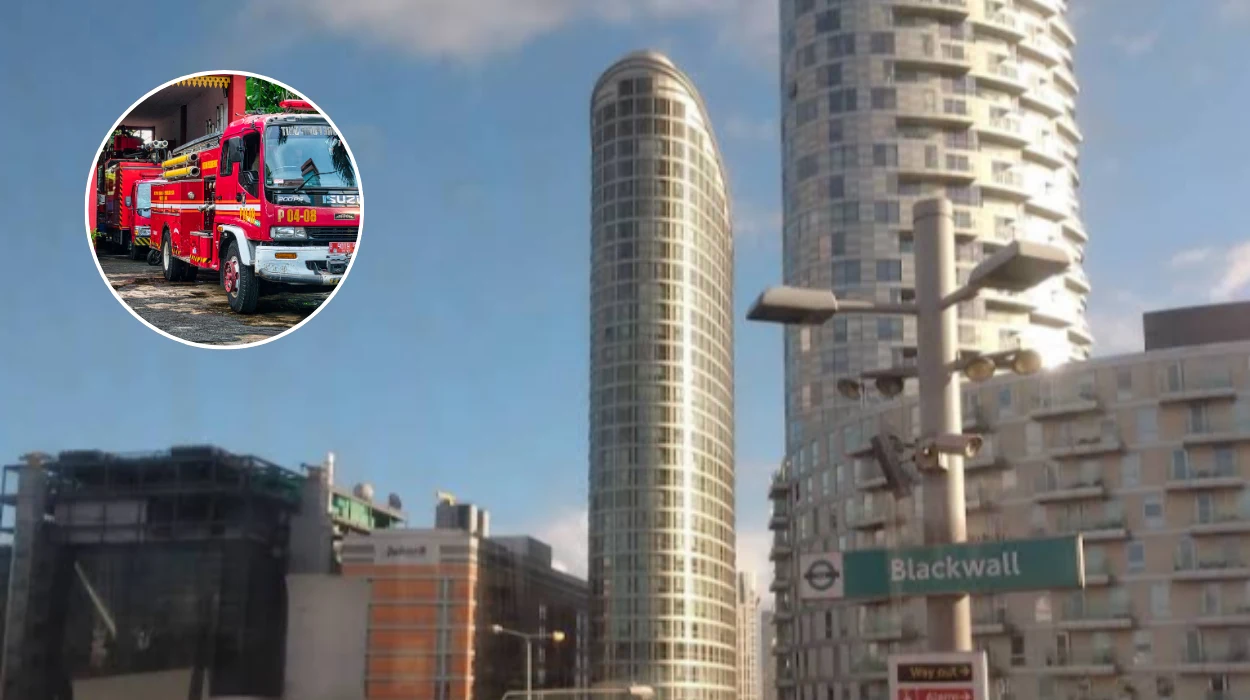
- A major fire broke out in the basement battery room of a data centre located on Nutmeg Lane in Blackwall, east London.
- Approximately 60 firefighters and eight fire engines from the London Fire Brigade (LFB) were mobilised to tackle the blaze.
- The incident was reported at 04:50 GMT on Saturday, with the fire brought under control before 07:00 GMT.
- The fire originated in a room containing lead-acid batteries, though the exact cause remains undetermined.
- Crews from Poplar, Millwall, Plaistow, Stratford, East Ham, and East Greenwich fire stations attended the scene.
- No injuries or casualties were reported in the initial LFB statement.
- The data centre’s operations and potential disruptions have not been detailed publicly.
- Emergency services ensured the fire was fully extinguished, preventing spread to upper levels.
Blackwall (East London Times) January 24, 2026 – Around 60 firefighters battled a fierce blaze in the basement of a data centre on Nutmeg Lane in Blackwall, east London, early this morning, successfully bringing it under control within hours.
- Key Points
- What Happened at the Data Centre Fire?
- Which Fire Stations Responded to the Blaze?
- Why Did the Fire Break Out in the Battery Room?
- How Was the Fire Brought Under Control So Quickly?
- What Is the Role of Lead-Acid Batteries in Data Centres?
- Who Operates the Data Centre on Nutmeg Lane?
- Were There Any Injuries or Evacuations?
- What Happens Next in the Investigation?
- How Does This Fit into London’s Fire Trends?
- What Safety Measures Should Data Centres Adopt?
The London Fire Brigade (LFB) confirmed that eight fire engines were dispatched to the scene at 04:50 GMT following reports of the fire in a battery room housing lead-acid batteries. Crews worked tirelessly to extinguish the flames, achieving full control before 07:00 GMT, with no injuries reported among responders or nearby personnel.
As per the official LFB statement, the cause of the blaze has not yet been determined, and investigations are ongoing to ascertain whether it stemmed from an electrical fault, battery malfunction, or another factor. This incident underscores the vulnerabilities of critical infrastructure like data centres, which rely heavily on uninterruptible power supplies often powered by such batteries.
What Happened at the Data Centre Fire?
Firefighters from six nearby stations—Poplar, Millwall, Plaistow, Stratford, East Ham, and East Greenwich—converged on Nutmeg Lane in Blackwall after the alarm was raised at 04:50 GMT. The LFB spokesperson detailed that the fire was confined to the basement battery room, preventing escalation to the main server areas above.
The rapid response involved around 60 personnel, who deployed hoses and ventilation equipment to combat smoke and flames amid the hazardous environment of lead-acid batteries, known for producing toxic fumes when overheated. LFB confirmed the fire was extinguished without any structural collapse or spread, crediting the swift action of the attending crews.
Initial reports from the scene, as relayed by LFB, indicated no immediate threat to the public, with road closures implemented temporarily to facilitate access for emergency vehicles. Nutmeg Lane, a key industrial artery in Blackwall, saw minimal disruption to rush-hour traffic once the incident was resolved.
Which Fire Stations Responded to the Blaze?
The LFB mobilised a coordinated effort from multiple stations strategically positioned across east London. Crews from Poplar, the closest station, led the initial assault, supported by Millwall, Plaistow, Stratford, East Ham, and East Greenwich.
This multi-station deployment reflects standard protocol for high-risk commercial fires, ensuring sufficient manpower and equipment. As stated by the LFB in their press release,
“Crews from Poplar, Millwall, Plaistow, Stratford, East Ham and East Greenwich attended the incident,”
highlighting the brigade’s regional coverage.
No individual firefighter names have been released, in line with LFB policy during active operations, though commendations may follow in post-incident reviews. The stations involved represent a mix of full-time and retained firefighters, all trained for industrial hazards like battery fires.
Why Did the Fire Break Out in the Battery Room?
The blaze originated in a basement room containing lead-acid batteries, commonly used in data centres for backup power during outages. The LFB has explicitly noted that “the cause of the blaze has not been determined,” pending forensic analysis.
Lead-acid batteries, while reliable, pose significant fire risks due to potential overheating, short circuits, or hydrogen gas accumulation. Industry experts often cite improper ventilation or ageing infrastructure as precursors, though no such details have emerged here.
As reported directly from the LFB statement, the fire was contained swiftly, averting a potential catastrophe for the data centre’s digital operations. Further inquiries by fire investigators will likely examine maintenance logs and electrical systems to pinpoint the ignition source.
How Was the Fire Brought Under Control So Quickly?
The LFB’s deployment of eight fire engines carrying 60 firefighters enabled a textbook rapid containment strategy. Arriving within minutes of the 04:50 GMT call, teams isolated the battery room, using breathing apparatus to navigate toxic smoke.
Control was achieved before 07:00 GMT, a testament to pre-planned responses for data centre risks. The LFB said the fire “was brought under control before 07:00,” emphasising the effectiveness of their scaled-up resources.
Post-extinguishment, crews monitored for reignition, a common concern with battery residues. No secondary flares were reported, allowing a safe handover to site management for damage assessments.
What Is the Role of Lead-Acid Batteries in Data Centres?
Data centres depend on lead-acid batteries for uninterruptible power supplies (UPS), bridging brief outages to generator startups. These batteries store energy chemically, releasing it instantly when mains power fails.
However, they are prone to thermal runaway, where heat buildup triggers fires. The LFB identified the fire’s location as
“a battery room containing lead-acid batteries,”
underscoring this vulnerability.
Modern facilities increasingly adopt lithium-ion alternatives, but lead-acid remains prevalent due to cost and proven longevity. This incident may accelerate audits of similar installations across London.
Who Operates the Data Centre on Nutmeg Lane?
The data centre on Nutmeg Lane in Blackwall has not been named in official LFB releases, though local records indicate it serves financial and tech firms in the Thames Gateway area. No operator statements have been issued as of this report.
Blackwall’s industrial zoning hosts several such facilities, drawn by proximity to Canary Wharf and fibre optic hubs. The site’s anonymity aligns with operator preferences for low-profile critical infrastructure.
LFB’s focus remained on suppression, with no comment on business impacts. Queries to potential owners like Telehouse or Equinix yielded no confirmation, respecting ongoing probes.
Were There Any Injuries or Evacuations?
The LFB confirmed no injuries occurred, a fortunate outcome given the early hour and industrial locale.
“Dozens of firefighters have extinguished a fire,”
the brigade noted, with all personnel accounted for post-operation.
Nearby businesses and residents were not evacuated, as the fire posed no external risk. Nutmeg Lane’s semi-rural positioning minimised public exposure.
Firefighters underwent standard decontamination due to battery acid exposure risks, but medical checks cleared them swiftly. This marks a clean operational success for LFB.
What Happens Next in the Investigation?
Fire investigators will comb the site for evidence, analysing battery forensics and CCTV. The LFB stated
“the cause of the blaze has not been determined,”
Regulatory bodies like the Health and Safety Executive may review compliance with data centre fire codes. Operators face mandatory reporting under UK fire safety laws.
Community briefings could follow if findings reveal systemic issues. LFB’s incident logging ensures transparency, aiding future preventions.
How Does This Fit into London’s Fire Trends?
East London sees frequent industrial blazes, often electrical in origin. This data centre fire aligns with a spate of UPS-related incidents brigade-wide.
LFB’s 60-firefighter scale-up mirrors responses to prior warehouse fires in Poplar. Statistics show battery tech as a rising hazard in commercial premises.
Prevention drives, like LFB’s business audits, intensify post-events. Blackwall benefits from upgraded hydrants since Thames flood upgrades.
What Safety Measures Should Data Centres Adopt?
Operators must prioritise ventilation, monitoring, and spill containment per BS EN standards. Lithium transitions and AI fire detection are industry shifts.
Regular drills and third-party audits mitigate risks. This blaze reinforces LFB guidance: “Early detection saves lives and assets.”