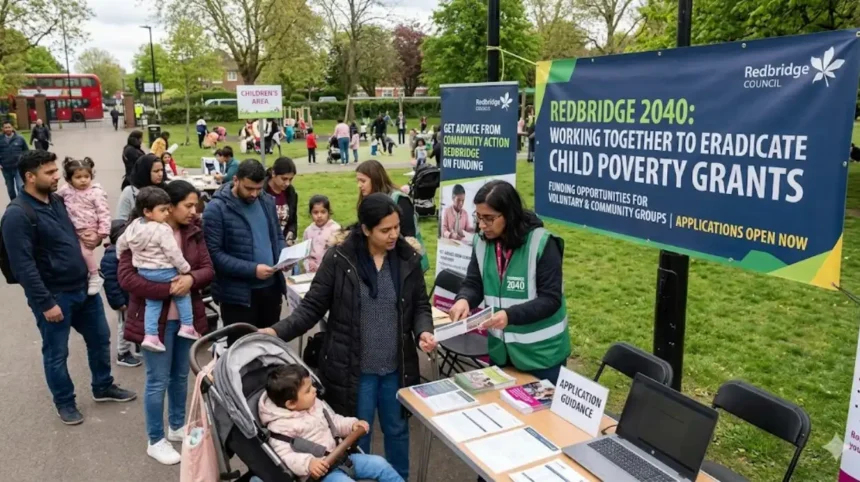
Redbridge has made child poverty reduction a long-term priority, and any grant programme linked to the “Redbridge 2040” vision will likely sit within a broader council strategy focused on tackling inequality, strengthening family support, and improving outcomes for children. Based on Redbridge Council’s current published funding guidance and related support pages, applicants should expect a structured process that requires a clear project plan, eligibility evidence, and a strong explanation of community impact.
- Understanding the grant purpose
- Who can apply
- What to prepare first
- How to structure the application
- Making the case for child poverty impact
- Budget and costs
- Evidence and supporting documents
- Submission and assessment
- Common mistakes to avoid
- Writing for search and readers
- A practical application approach
- Conclusion
This guide explains how organisations and community groups can prepare a strong application, what information is usually required, and how to align a proposal with Redbridge’s wider anti-poverty and early-help priorities. It is written as evergreen guidance for charities, schools, voluntary groups, and local partnerships looking to support children and families in Redbridge.
Understanding the grant purpose
A child poverty eradication grant is not usually just a funding pot for general welfare activity. It is normally designed to support projects that reduce hardship, improve access to services, and help children and families with practical barriers such as food insecurity, digital exclusion, poor housing conditions, or gaps in early years support. Redbridge’s own published funding guidance shows that the council expects applicants to describe project objectives, activities, outcomes, and the community benefit in a detailed but proportionate way.
It is useful to think of “Redbridge 2040” as a strategic umbrella: the grant is likely intended to help the borough reach long-term social goals rather than fund short-term activity with no measurable impact. That means applications should show how the project fits into a wider pathway of prevention, family resilience, and child wellbeing rather than only describing the immediate service being delivered.
Who can apply
Redbridge’s published small-grants and community-funding guidance indicates that applications are generally accepted from constituted voluntary organisations, resident associations, registered charities, charitable schools, community interest companies, charitable companies, charitable incorporated organisations, exempt or excepted charities, and charitable community benefit societies. The council also accepts applications from council departments with community support, individuals applying on behalf of eligible community groups, and ward members applying on behalf of eligible groups.
That matters because a grant aimed at child poverty reduction will usually require an organisation with a legal structure, accountability, and the ability to manage public funds responsibly. If your group is informal, you may still be able to apply through a constituted partner, but you will need to demonstrate who will hold the grant, deliver the work, and report on results.
What to prepare first
Before starting the form, applicants should prepare a project summary that explains the problem, the target group, and the intended outcome. Redbridge guidance says applications must include enough information for the Funding Panel to assess the proposal properly, and the level of detail should match the scale of the grant requested.
A strong application usually includes the following information in narrative form: what need you are addressing, why it matters in Redbridge, who will benefit, how many children or families will be reached, what activities will take place, what difference the project will make, and how you will measure success. For a child poverty project, it is especially important to show that the activity is practical, targeted, and realistic rather than broad or speculative.
Applicants should also gather supporting documents early. Redbridge’s funding pages show that some schemes require quotes, invoices, budgets, proof of constitution, and other supporting evidence depending on project size and funding amount. If your project involves working with children, additional safeguarding and DBS-related checks may be relevant depending on the work being proposed.
How to structure the application
The best way to approach the form is to write it in the same order the panel will read it. Start with a concise but persuasive explanation of the issue you are solving, then explain how your project responds to it, and only then move into the budget and delivery details. Redbridge’s published guidance emphasises that all sections should be completed and all requested information supplied for the application to be valid.
Your project description should be specific. For example, instead of saying “we will help families,” say “we will provide weekly after-school support for children aged 6 to 11 from low-income households in Redbridge, combined with referral support for parents needing benefits, housing, or food-bank access.” That kind of language makes it easier for the panel to see both the direct benefit and the anti-poverty value of the work.
Making the case for child poverty impact
For a grant focused on child poverty eradication, impact language matters. The application should show not only need, but also how the grant helps break a cycle of disadvantage. Projects that connect education, early years support, family wellbeing, food access, or practical advice are often easier to justify because they speak to the wider causes of poverty rather than a single symptom.
A good application should explain the expected change in plain terms. For example, you might say the grant will improve school readiness, reduce holiday hunger, increase uptake of early years provision, or help parents access income maximisation support. Redbridge’s early years and childcare guidance shows that the borough already treats targeted support and additional funding for disadvantaged children as part of its wider family-support ecosystem. That makes it sensible for applicants to align their project with those same themes.
Budget and costs
Budget clarity is essential. Redbridge guidance for small grants makes clear that applicants should provide a breakdown of costs, and for smaller projects only a brief outline may be required, while larger projects need more detailed financial evidence. If the child poverty grant is competitive, a transparent and realistic budget can make the difference between success and rejection.
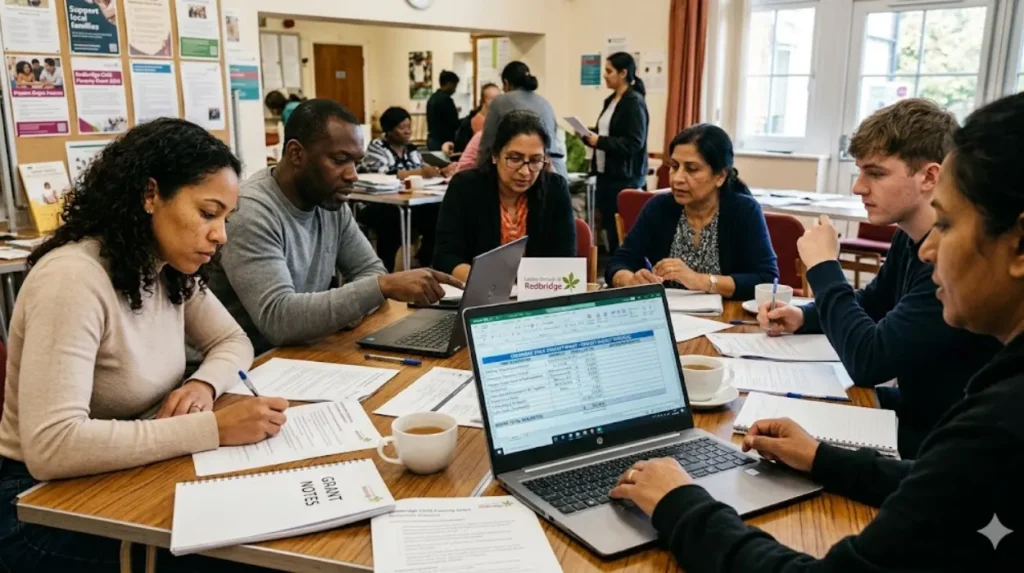
The budget should show exactly what the grant will pay for, whether that is staff time, venue hire, food, learning materials, transport, outreach, or specialist support. Avoid vague headings such as “project costs” or “miscellaneous expenses,” because assessors need to understand how public money will be used. If you have other funding, match funding, or in-kind support, include that too, because it demonstrates wider backing and sustainability.
Evidence and supporting documents
Most grant programmes for community benefit require some combination of constitution documents, governing papers, bank account details, a budget, and proof that your group can deliver what it promises. Redbridge’s small grants guidance states that all sections of the form must be completed and that requested information must be provided for the application to be considered valid.
Depending on the nature of the project, you may also need safeguarding policies, insurance documents, quotes, or letters of support. If your project works directly with children or vulnerable families, include relevant policies that show your organisation is ready to deliver safely and professionally. This is particularly important where the funding is intended to support children facing poverty, because delivery quality is as important as the idea itself.
Submission and assessment
Once the form is completed, the proposal will usually be assessed against criteria such as fit with the funding purpose, expected benefit, value for money, deliverability, and evidence of need. Redbridge’s grant guidance and related funding pages indicate that proposals are reviewed through a formal process and that the amount of information required varies by project scale.
To improve your chances, make sure your application reads like a public-benefit case rather than an internal project note. Use clear outcomes, measurable outputs, and a realistic delivery timetable. If the grant is part of a long-term Redbridge 2040 framework, it will likely favour projects that are sustainable, locally rooted, and capable of showing a credible pathway to measurable child poverty reduction.
Common mistakes to avoid
A common mistake is being too general. If your application does not explain precisely which children will benefit, what problem you are addressing, and how the project will be delivered, it will be hard for assessors to see the value. Another mistake is failing to connect the proposal to child poverty rather than broader social good; the more directly you show a poverty-reduction outcome, the stronger the application is likely to be.
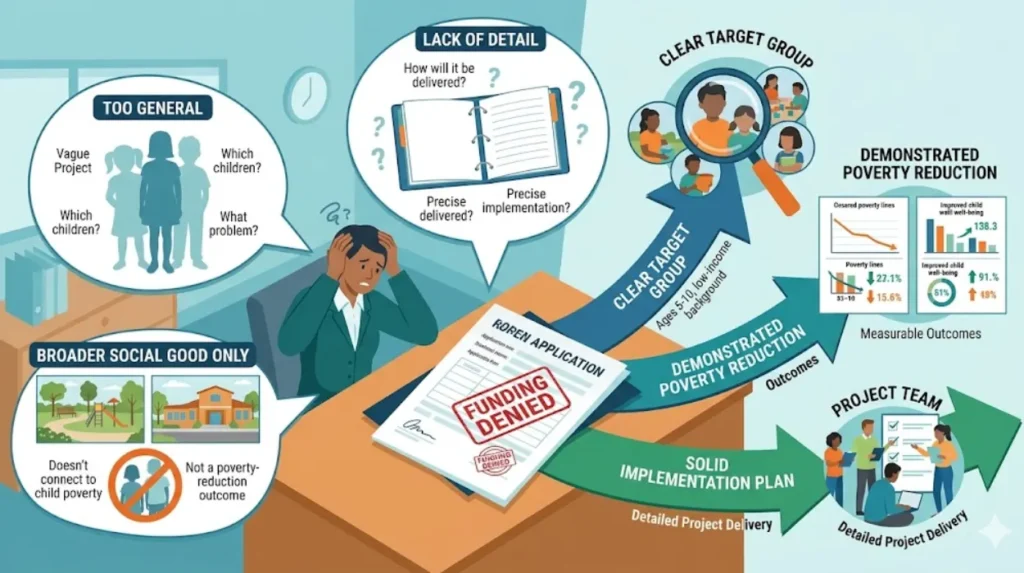
Budget weaknesses can also undermine an otherwise strong idea. If the costs do not match the activities, or if the application lacks supporting evidence, the panel may decide it is not ready for funding. Redbridge’s guidance is clear that applications need to be complete and accompanied by the requested information, so partial or unclear submissions are unlikely to progress well.
Writing for search and readers
If this article is meant to perform well in Google and AI search engines, the language should mirror what users actually type. Phrases such as “how to apply for Redbridge 2040 grants,” “child poverty grant Redbridge,” “Redbridge funding for families,” and “Redbridge council grants for children” should appear naturally in the article headings and body. That helps search engines connect the page to the right intent while keeping the text readable for parents, charities, and community leaders.
Evergreen SEO also depends on clarity and usefulness. A strong article should avoid date-specific claims unless they are verified and current, because grant deadlines and eligibility rules can change. The most durable content focuses on the application process, eligibility, documentation, budgeting, and impact framing, all of which remain relevant even when the scheme opens and closes in future rounds.
A practical application approach
The most effective way to apply is to write the proposal as if you are answering three questions: what is the child poverty problem, why is your organisation best placed to help, and what measurable change will the grant create? Redbridge’s funding guidance indicates that decision-makers want a complete application with the right level of detail and supporting documents, so a polished narrative and a realistic budget are both essential.
For organisations already working with families, it is wise to link the grant to existing delivery rather than inventing a completely new model. That usually looks stronger because it shows capacity, trust, and local knowledge. In an area like Redbridge, where children’s support, targeted early years funding, and household assistance already form part of the local ecosystem, applications that build on proven activity are likely to feel more credible to assessors.
Conclusion
Applying for a Redbridge 2040 child poverty eradication grant is ultimately about proving that your project can make a genuine, local, and measurable difference to children and families. The strongest applications will be clear, evidence-led, budget-conscious, and directly connected to poverty reduction, family wellbeing, or improved life chances.
If you are preparing a submission, focus on three things: a well-defined need, a delivery plan that is realistic, and a budget that is transparent. That combination gives your application the best chance of standing out in a competitive funding process and of aligning with Redbridge’s long-term ambition to reduce child poverty.