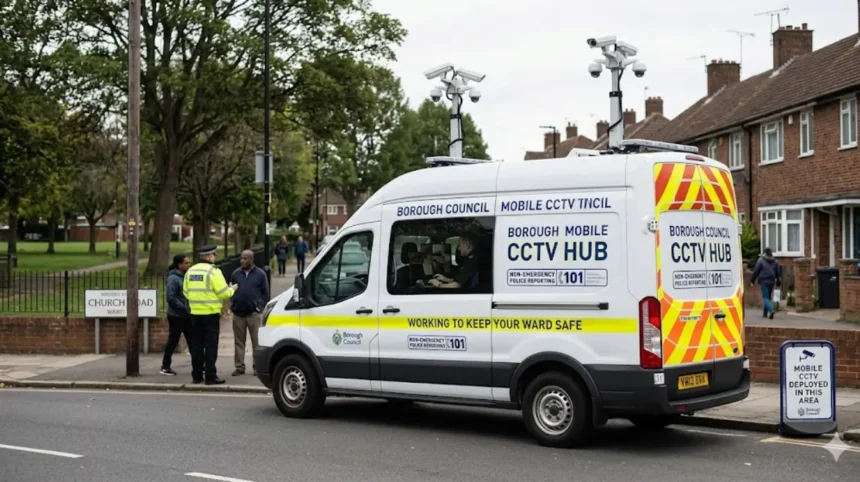
If you want to report crime through a ward’s Mobile CCTV hub, the most reliable first step is to identify which local authority or police service operates CCTV in your area, then check whether they publish a ward-level CCTV or mobile enforcement page. In London, the practical reporting route is still usually the police emergency and non-emergency lines, while CCTV teams often support investigations by sharing footage after a report has been made.
Why Mobile CCTV hubs matter
Mobile CCTV hubs are used in different ways across London. Some are temporary, rapid-deployment towers placed in hotspots, while others are mobile enforcement or surveillance units used by councils or transport bodies to monitor traffic, public safety, or antisocial behaviour. Because “Mobile CCTV hub” is not a single citywide service with one universal location, the exact place you need to find depends on the borough, ward, or agency responsible for the camera system.
For readers in East London, this matters because boroughs such as Hackney, Tower Hamlets, Newham, and Waltham Forest may each publish different CCTV, parking, moving-traffic, or community safety arrangements rather than one shared “hub”.
Start with the right authority
The fastest way to find your ward’s Mobile CCTV hub is to identify the body that controls the cameras in your area. In practice, that is usually the borough council for local public-space CCTV, the Metropolitan Police for policing matters, or Transport for London for roads, stations, and transport assets.
If your issue is a crime rather than a traffic contravention, the council may not take the report directly. For example, Ealing Council states that crime and disorder should be reported to the police, and that police can request CCTV footage later if needed. That is the standard model across many London boroughs: report the incident first, then let the relevant CCTV team support the investigation.
Search by ward name
Once you know the responsible authority, search using your ward name plus the words “CCTV,” “mobile CCTV,” “community safety,” or “camera locations.” Many councils publish pages or PDFs listing camera locations, enforcement zones, or mobile CCTV routes, although some pages are designed more for parking and moving-traffic enforcement than for crime reporting. If your ward has a local enforcement scheme, the location list may mention that mobile CCTV visits are “regular” or “random,” which helps you understand whether a nearby hub exists or whether the unit moves between locations.
- A useful search pattern is:
- “[ward name] mobile CCTV”
- “[ward name] CCTV locations”
- “[borough name] report crime CCTV”
- “[borough name] community safety CCTV”
This kind of search is often more effective than looking for the phrase “Mobile CCTV hub” alone, because councils and police services rarely use the exact same wording.
Check borough CCTV pages
Borough websites are often the best source for local CCTV information because they may publish the operational purpose, retention period, and reporting route. For example, Ealing Council explains that CCTV footage is retained for 31 days and then automatically deleted, which shows why it is important to report incidents quickly if you think footage may exist. That retention period will vary by authority, but the general rule is that delay can reduce the chance of finding relevant footage.
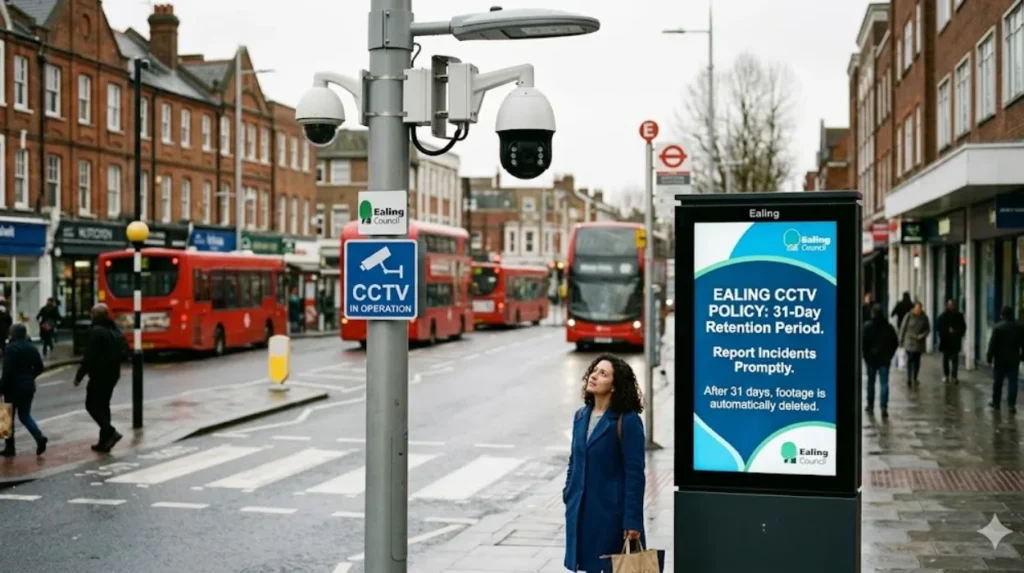
When checking borough pages, look for terms such as “public safety CCTV,” “crime prevention,” “community safety,” “ANPR,” “mobile CCTV,” or “moving traffic camera locations.” Councils may split these into different service pages, so the page title may not mention crime even when the camera network is still useful to an investigation.
Use police reporting first
If a crime has happened, the Metropolitan Police online report tool is often the best starting point for non-emergency cases, because it helps organise the incident details, location, and supporting evidence in a structured way. A local reporting process that starts with the police is important because CCTV teams and council officers are often not the correct first point of contact for criminal incidents.
For emergencies, call 999. For non-emergencies, call 101 or use the police reporting route available for your area. Once a report exists, you can then ask whether a ward CCTV hub, council control room, or operator can preserve footage or check whether a camera covered the scene.
What to ask for
When you contact the council or police, ask clearly for the exact location of the camera or mobile unit, the ward it covers, and the correct team responsible for retrieving footage. Councils typically do not release footage to the public on request, but they may guide you to the right process if the police need the material for an investigation.
A helpful request would be: “I am reporting an incident in [ward name]. Can you confirm whether there is a mobile CCTV unit or public-safety camera covering this location, and what reference number or team should I quote to preserve the footage?” That wording works because it links the request to a police case and asks for coverage rather than assuming the camera is public-facing.
East London examples
In East London, many camera systems are part of broader council or transport operations rather than standalone ward hubs. Transport for London, for instance, uses cameras across the Underground, Elizabeth line, road network, bus stations, and some mobile deployments for traffic and enforcement purposes. That means the “hub” you are looking for may be a council control room, a TfL operations team, or a police-linked surveillance unit rather than a public office with a visible street address.
Some private suppliers also advertise rapid-deployment CCTV towers for London boroughs, including East London areas such as Hackney, Tower Hamlets, and Newham. Those systems show how mobile CCTV is often deployed to a specific site rather than operating from a fixed public location, which is another reason the search should focus on the managing authority rather than on a physical hub name alone.
How mobile CCTV is usually deployed
Mobile CCTV is generally used in places where activity changes quickly or where a fixed camera would not be practical. Temporary towers, for example, are marketed as rapid-deployment units for temporary, mobile, or high-risk security needs, and some systems transmit via mobile networks to support live monitoring. Councils also use mobile CCTV for moving traffic enforcement, with published location lists that may be visited on a regular or random basis rather than operating from one permanent spot.
That means the term “hub” can be misleading. In many cases, the “hub” is not a public place you visit in person but a control room or operations centre that manages cameras across the ward or borough. If the location is an enforcement camera rather than a crime-reporting camera, the council page may be aimed at drivers instead of residents, so reading the page carefully matters.
Timing matters
If you believe CCTV may have captured an incident, act quickly. Council-held footage is often kept for a limited period, such as the 31-day retention used by Ealing Council, after which it may be deleted automatically. Even where retention periods differ, waiting too long can make footage unavailable by the time the police request it.
It is also worth noting that some mobile camera deployments are event-based or area-based, so footage may only exist if the unit was in your ward at the relevant time. That is why the incident time, exact street, and nearest landmark are so important when you file a report.
How to write the local search
If you are trying to locate your ward’s Mobile CCTV hub for an East London article, the most practical evergreen advice is to make the search local, official, and case-based. Start with the borough council website, then the Metropolitan Police reporting tools, then TfL where relevant to roads and transport.
Use a three-step approach:
- Identify the ward and borough.
- Search the borough website for CCTV, community safety, or moving traffic pages.
- File the incident with the police, then request CCTV preservation through the case reference.
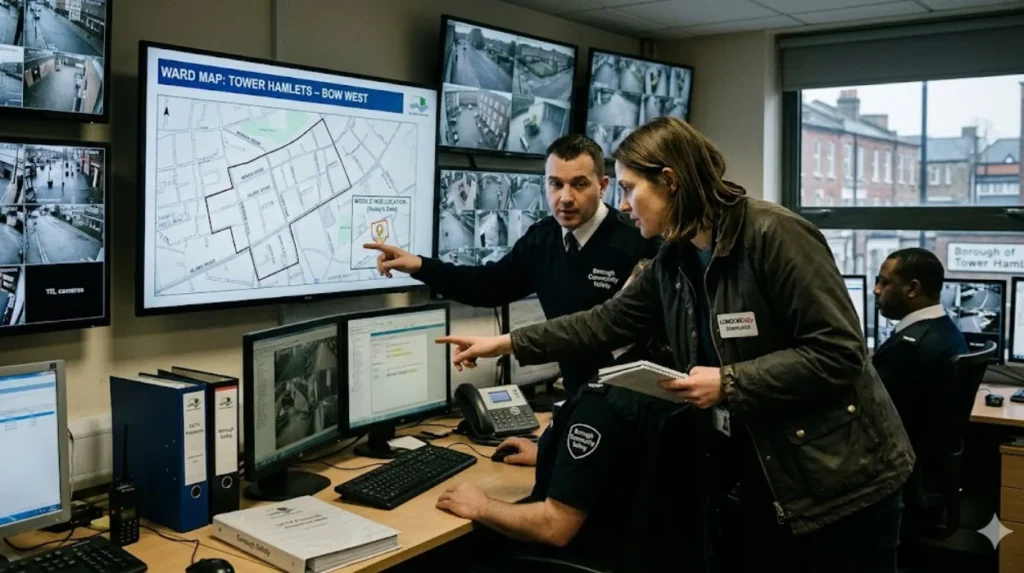
This method works because it matches how London camera systems are actually organised: distributed across boroughs, transport networks, and police processes rather than concentrated in a single public “hub”.
What residents should remember
Residents should not assume that a visible camera mast or mobile tower is automatically the place to report crime. Instead, the right route is usually the police first, then the relevant council or transport authority if footage needs to be preserved or reviewed. If your ward uses mobile CCTV for enforcement, the council may publish locations or coverage details, but those pages are often designed for parking and traffic compliance rather than direct crime reporting.
The safest evergreen rule is simple: report the incident immediately, note the exact location and time, and ask the borough or police which CCTV team covers that ward. That approach gives you the best chance of finding the right “hub” without wasting time searching for a single fixed address that may not exist.