Key Points
- Around 100 firefighters and 15 fire engines responded to a major blaze at a waste facility on Chequers Lane, Dagenham.
- The London Fire Brigade was alerted to the incident in the early hours of Sunday morning.
- Local residents were advised by emergency services to keep all windows and doors closed due to heavy smoke plumes.
- The cause of the fire remains under investigation, with multi-agency monitoring ongoing across East London.
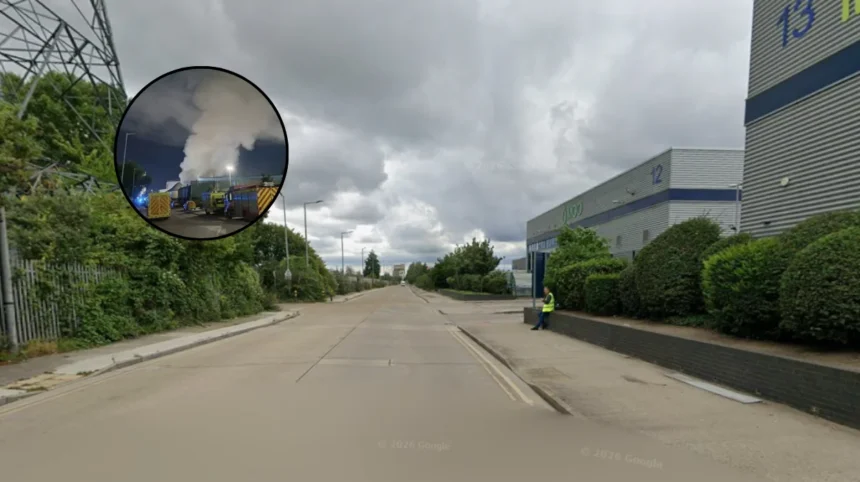
Dagenham (East London Times) August 10, 2026 — Firefighters tackled a large fire in east London which broke out in the early hours of Sunday morning at a commercial site. Fifteen fire engines and around 100 firefighters were called to the blaze at a waste facility on Chequers Lane in Dagenham. The emergency services launched a large-scale response to contain the flame, while local residents were urged to keep windows and doors closed to avoid smoke inhalation.
- Key Points
- What Happened During the Dagenham Waste Facility Fire?
- Why Were Local Residents Advised to Keep Windows and Doors Closed?
- How Are Emergency Services Managing the Situation on Chequers Lane?
- What Is the Background of the Development?
- What Is the Prediction for How This Development Will Affect the Local Community and Businesses?
What Happened During the Dagenham Waste Facility Fire?
The emergency services received initial reports of the fire during the early hours of Sunday morning. Crews from across Barking, Dagenham, and neighbouring east London boroughs were deployed to Chequers Lane. Upon arrival, firefighters encountered significant smoke and visible flames issuing from the waste recycling unit.
Specialist equipment, including high-reach appliances and heavy-volume pumping units, was dispatched to assist in bringing the industrial fire under control.
Fire crews worked throughout the morning to surround the blaze, targeting deep-seated hot spots within the densely packed materials inside the plant.
Emergency responders erected safety perimeters along Chequers Lane to allow emergency vehicles unimpeded access to water supplies and the main entrance of the facility. No injuries were reported in the initial hours of the response.
Why Were Local Residents Advised to Keep Windows and Doors Closed?
Due to the heavy concentration of burning waste material, large plumes of dark smoke drifted across residential parts of Dagenham and adjacent areas. The London Fire Brigade issued immediate public safety advice directing nearby occupants to close all windows and doors to minimize exposure to air pollutants.
Industrial waste fires often produce toxic combustion products, including volatile organic compounds, particulate matter, and nitrogen oxides.
Health authorities emphasize that staying indoors with closed vents and windows reduces the risk of respiratory irritation, particularly for vulnerable groups such as children, the elderly, and individuals with pre-existing conditions like asthma.
Traffic diversions were also put in place along Chequers Lane and secondary access roads as smoke reduced visibility across local transport corridors.
How Are Emergency Services Managing the Situation on Chequers Lane?
Firefighting crews established water supply lines using nearby hydrants and mobile water carriers. Teams equipped with breathing apparatus entered the perimeter to suppress the flames using heavy water jets and foam application techniques.
The strategy focused on preventing the fire from spreading to neighbouring industrial units and fuel storage facilities located nearby on Chequers Lane. Dynamic risk assessments were conducted by incident commanders throughout the morning to monitor structural stability and wind direction changes.
Multi-agency coordination involved local council representatives, environmental health officers, and metropolitan police units, who assisted with traffic management and public safety enforcement.
Explore More Dagenham News
Mecca Bingo Dagenham Drops 24-Hour Bid Amid Policy Shift — Dagenham 2026
New Lidl Supermarket Plans Progressing at Shafter Road Site Dagenham 2026
What Is the Background of the Development?
Industrial waste fires in east London have been a recurring operational challenge for fire authorities over recent years. Chequers Lane in Dagenham sits within a designated industrial zone along the River Thames, hosting recycling, waste management, scrap metal, and manufacturing infrastructure.
Waste processing facilities carry inherent fire risks due to the presence of bulk-stored combustible materials, including plastics, paper, lithium-ion batteries, and organic refuse.
Thermal runaway in improperly disposed batteries and spontaneous combustion in tightly packed materials represent two of the primary causes of fires in such environments across the United Kingdom.
Regulatory oversight for these sites falls under the jurisdiction of the Environment Agency alongside local authority planning enforcement.
Operators are required to adhere to strict fire prevention plans (FPPs), which mandate stack heights, separation distances between piles, dust control, and thermal monitoring systems. Previous incidents in the region have prompted calls for stricter enforcement of environmental permits and improved monitoring of commercial waste handling operations.
What Is the Prediction for How This Development Will Affect the Local Community and Businesses?
This incident is expected to have immediate, medium-term, and long-term impacts on the local area, affecting residents, business owners, transport operators, and local regulatory bodies.
In the immediate aftermath, residents living downwind of Chequers Lane will experience lingering air quality issues until the fire is completely extinguished and dampening-down operations finish.
Smoke particles often settle on property, vehicle surfaces, and local vegetation, requiring cleaning. Individuals with pre-existing respiratory conditions may experience heightened symptoms, leading to an increased demand on local NHS primary care services and pharmacies over the coming days.
Businesses operating within the Chequers Lane industrial sector face localized transport disruptions and temporary access restrictions while emergency operations conclude. For the affected waste facility, structural damage and ongoing investigations will result in operational suspension.
Neighboring businesses may experience supply chain delays, particularly if utility connections or access roads remain restricted during safety inspections.
Following the completion of firefighting operations, environmental health officers and Environment Agency inspectors will launch a formal investigation into the origin and cause of the blaze.
If non-compliance with statutory fire prevention guidelines is identified, the site operator could face regulatory notices, license reviews, or financial penalties.
This development is likely to reignite regional debates among local councils and community action groups regarding the proximity of major waste sites to residential development zones, potentially leading to calls for stricter regulatory controls across industrial processing facilities in east London.