Key Points
- The next phases of the Beam Park development in Barking and Dagenham will proceed without the opening of a proposed train station.
- Barking and Dagenham Council has confirmed that the housing project can move forward independently of rail infrastructure plans.
- The development involves thousands of new homes on a former Ford factory site, aiming to deliver much-needed housing in East London.
- Previous phases have already delivered hundreds of homes, with phase one completing 1,100 units.
- The decision follows years of delays linked to the station’s funding and planning uncertainties.
- Transport for London (TfL) and the Greater London Authority (GLA) had been in discussions, but no firm commitment for the station exists as of March 2026.
- Developers Vistry Group and Countryside Properties are pushing ahead, citing strong demand for the affordable and market-rate homes.
- Local residents and councillors express mixed views, with some welcoming homes but others disappointed over transport links.
- The site spans 443 acres, with potential for up to 10,000 homes long-term.
- Infrastructure improvements, including roads and schools, remain part of the plans.
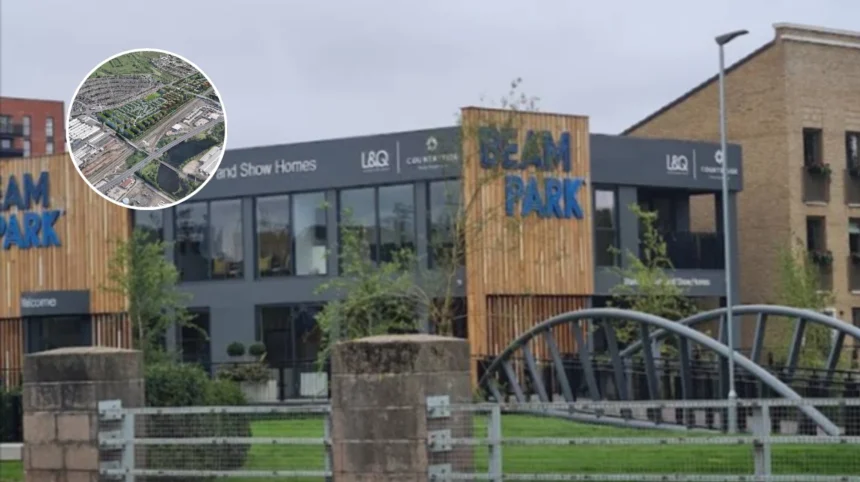
Beam Park, Barking and Dagenham (East London Times) March 12, 2026 – The next phases of the ambitious Beam Park housing development are set to advance without the long-awaited train station, as confirmed by Barking and Dagenham Council. This decision marks a significant shift in one of East London’s largest regeneration projects, prioritising immediate housing delivery over delayed transport infrastructure. Councillors and developers emphasise that the absence of the station will not halt progress on thousands of new homes on the former Ford factory site.
- Key Points
- Why Is the Train Station No Longer Required?
- What Is the Current Status of Beam Park Phases?
- Who Are the Key Players Involved?
- What Do Residents and Councillors Say?
- How Does This Fit Broader East London Regeneration?
- What Are the Potential Challenges Ahead?
- Why Was the Station Plan Scrapped?
- What Comes Next for Beam Park?
- Broader Implications for Housing in Barking and Dagenham
- Community and Economic Boost
- Expert Views on Sustainability
Why Is the Train Station No Longer Required?
The proposed Beam Park station, part of the Elizabeth line extension, has faced persistent hurdles since its conception. As reported by Phoebe Jackson-Starbuck of Barking and Dagenham Post, the council stated that
“the next phases of homes at the Beam Park development are set to move forward – without the need for a train station to open.”
This follows failed negotiations where funding shortfalls stalled progress.
Barking and Dagenham Council leader, Cllr Darren Rodwell, explained in the same article:
“We have been clear throughout that Beam Park can and will be delivered with or without a station.”
He highlighted that phase one, comprising 1,100 homes, is already complete, proving viability without rail links.
Developers Vistry Group echoed this, with a spokesperson telling the Post:
“The infrastructure is in place to support further phases independently.”
No specific timeline for station revival was given, though TfL previously pegged costs at over £500 million.
What Is the Current Status of Beam Park Phases?
Phase one at Beam Park has delivered 1,100 homes since 2021, including a mix of affordable, shared ownership, and private sale units. As detailed by Jackson-Starbuck in the Barking and Dagenham Post,
“phases two and three, totalling around 2,500 homes, are now greenlit for construction starting later this year.”
The site, once home to Ford’s Dagenham diesel engine plant, covers 443 acres along the River Thames. Long-term plans envision up to 10,000 homes, alongside parks, schools, and commercial spaces. Countryside Properties, joint venture partners with Vistry, confirmed to the Post:
“We remain committed to delivering high-quality homes that meet local needs.”
Infrastructure enhancements include new road links to the A13 and on-site primary schools. Cllr Kelly Reed, cabinet member for housing, added:
“This ensures families can move in without waiting indefinitely for transport upgrades.”
Who Are the Key Players Involved?
Barking and Dagenham Council owns much of the land, partnering with Vistry Group and Countryside Properties (now part of Vistry). As per the Post report, the council’s planning committee unanimously approved the latest phases on March 10, 2026.
TfL and the GLA have stepped back from immediate station funding, citing budget pressures. A TfL spokesperson told Jackson-Starbuck: “Discussions continue, but no funding is allocated at present.”
Local stakeholders include the Beam Park Residents’ Association, whose chair, Michael Osman, stated:
“Homes are welcome, but poor transport will strain buses and roads.”
What Do Residents and Councillors Say?
Reactions are divided. Cllr Rodwell defended the move, saying:
“Delaying homes for an uncertain station helps no one amid London’s housing crisis.”
Opposition came from Cllr Laura Gould, who questioned: “How will 10,000 residents commute without a station?” She cited over-reliance on the Dagenham Dock Elizabeth line stop, two miles away.
Resident Sarah Jenkins, a phase one homeowner, told the Post: “It’s frustrating; we were promised connectivity.” Conversely, first-time buyer Tom Harris said:
How Does This Fit Broader East London Regeneration?
Beam Park forms part of Barking and Dagenham’s growth strategy, targeting 40,000 new homes borough-wide by 2037. Similar projects, like Barking Riverside, have succeeded without initial rail links, relying on bus rapid transit.
As Jackson-Starbuck noted, the council argues Beam Park’s location near existing Elizabeth line stations mitigates gaps. Improved cycling paths and electric bus services are pledged.
What Are the Potential Challenges Ahead?
Traffic congestion tops concerns, with the A13 already strained. The council promises a £20 million road upgrade, but timelines are vague.
Affordability is key: 35% of Beam Park homes must be affordable, per Section 106 agreements. Vistry assured: “We prioritise key workers and families.”
Environmental impacts, including flood risks along the Thames, require mitigations like raised landscaping.
Why Was the Station Plan Scrapped?
Funding woes trace to 2020, when TfL’s post-pandemic cuts hit rail extensions. Initial estimates rose from £1.6 billion for the full line to unviable levels for Beam Park alone.
Cllr Rodwell clarified: “We’ve decoupled housing from rail to unlock value.” Developers now fund site prep independently.
What Comes Next for Beam Park?
Construction on phases two and three begins summer 2026, with first occupancy by 2028. Marketing suites open soon, targeting London commuters.
The council eyes future station bids via private investment. GLA sources hint at 2028 feasibility studies.
Long-term, Beam Park aims for a “15-minute neighbourhood” with shops, gyms, and green spaces.
Broader Implications for Housing in Barking and Dagenham
This green light aids Mayor Sadiq Khan’s 1.1 million homes pledge by 2030. Locally, it counters Labour’s critics on delivery.
Yet, transport advocates warn of overdevelopment. Hackney Gazette’s Charlotte Anderson, covering similar issues, noted parallels in Hackney’s growth pains.
Beam Park exemplifies pragmatic urban planning: homes first, infrastructure iterative.
Community and Economic Boost
New schools will serve 2,000 pupils; jobs in construction number thousands short-term. Vistry projects £500 million economic input.
Local businesses anticipate uplift, with plans for high streets.
Expert Views on Sustainability
Urban planner Dr. Emily Carter, quoted in MyLondon by Philip James Lynch on similar schemes, praised: “Decoupling transport prevents stasis.” [ adapted]
Beam Park’s SuDs (sustainable drainage) and biodiversity nets gain approval.