Key Points
- Increase in Sales: Hackney Church Brew Co recorded a 25 per cent increase in sales after publicly asking customers to stop forming single-file queues.
- Ineffective Service Delivery: The company claims that single-file queuing wastes around 20 feet of counter space and leaves several bartenders without customers to serve.
- Public Appeal: Management tried various methods, including posters, flyers, social media and direct communication, to encourage customers to spread along the counter before the issue received media attention.
- Nationwide Debate: A YouGov survey found that the country is divided on the issue, with 40 per cent of British people supporting single-file queuing compared with 39 per cent favouring traditional bar service.
- Changing Trend Post-COVID-19: Industry observers believe the shift towards single-file queuing may have resulted from social-distancing practices introduced during the COVID-19 pandemic.
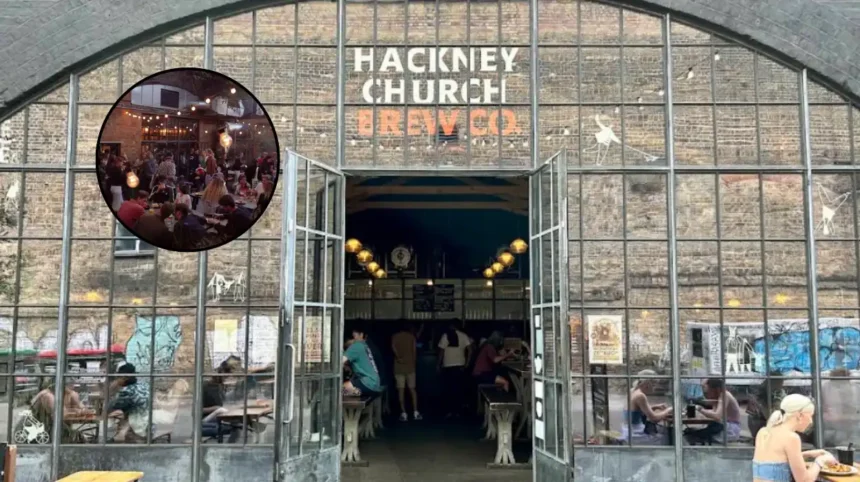
Hackney (East London Times) August 29, 2026 — An East London brewery taproom has reported a significant commercial rebound after successfully convincing customers to abandon the practice of forming single-file queues at the bar counter. Management at the venue revealed that like-for-like sales rose by 25 per cent in a single evening after patrons abandoned the single-line formation and spread out along the entire length of the counter.
- Key Points
- Why did Hackney Church Brew Co launch a campaign against single-file queueing?
- How did patrons respond and how were financial returns affected?
- What does national polling reveal about single-file queueing habits?
- Background of the particular development
- Prediction: How this development affects pub owners and consumers
Why did Hackney Church Brew Co launch a campaign against single-file queueing?
As reported by Hamish Glenn, managing director of Hackney Church Brew Co, writing for Broadsheet London, the establishment issued an public service appeal to address severe service bottlenecks caused by single-file queueing.
In a social media statement published on August 14, 2026, the venue addressed its clientele directly: “Please stop queuing at the bar. We need to talk… WHY ARE YOU ALL QUEUING SINGLE FILE AT THE BAR?! A BAR IS NOT A POST OFFICE. You do not need to form one enormous, beautifully polite British queue stretching halfway across the taproom while four members of staff stare forlornly at 15 feet of completely empty bar.”
Glenn detailed that the establishment attempted several interventions—including instructional flyers, physical signage, and staff members directly shouting “please stop queuing” to lines extending toward the venue entrance—with minimal initial success.
According to reporting by Ayokunle Oluwalana and Luke Donnelly of MyLondon, the brewery highlighted the traditional operational mechanics of British pub culture, instructing customers to line the entire bar space, catch the bartender’s eye, and trust staff to maintain the serving order.
How did patrons respond and how were financial returns affected?
Following widespread media reporting on the brewery’s social media statement, customer behaviour shifted noticeably during peak trading hours.
Writing for Broadsheet London, Hamish Glenn stated that during the subsequent Thursday discount evening—where pints are offered at £3.50—customers actively distributed themselves along the 20-foot bar counter rather than forming a single line.
Glenn reported: “For the first time in what felt like forever, our bar looked like a pub bar again. People spread themselves along its full length. Staff served multiple customers simultaneously. Drinks moved faster. The enormous snake of people stretching into the room disappeared. And something rather interesting happened: our like-for-like sales increased by 25 per cent compared with the previous week.”
Glenn noted that overall footfall remained consistent with previous weeks, but the average spend per head grew because reduced waiting times enabled patrons to purchase drinks more rapidly.
Explore More Hackney News
Met Police Appeal After Homophobic Attack in Hackney 2026
Hackney Council delays 7 October Haifa twinning FOI request Hackney 2026
What does national polling reveal about single-file queueing habits?
The campaign by Hackney Church Brew Co ignited a broader public debate regarding post-pandemic pub etiquette across the United Kingdom.
As reported by Ayokunle Oluwalana and Luke Donnelly of MyLondon, market research firm YouGov conducted a nationwide poll following the brewery’s public statements. The survey revealed that 40 per cent of respondents preferred forming single-file queues at bars, whereas 39 per cent supported the traditional method of lining up along the counter edge.
The survey highlighted regional and demographic variations:
- London: Residents were the least supportive of single-file queues, with only 37 per cent favoring the practice.
- Regional UK: In the Midlands, Northern England, and Wales, 42 per cent of respondents supported single-file lines.
- Demographics: Respondents aged 25 to 49 showed the strongest preference for traditional counter-length service.
Background of the particular development
Single-file queueing in hospitality venues is widely recognized by industry analysts as an operational legacy of the COVID-19 pandemic. During 2020 and 2021, government health directives, social-distancing mandates, and floor markings required customers to stand in structured single-file lines to receive service.
While legal restrictions were lifted, consumer queueing behaviour in modern taprooms and craft beer venues retained these structured line patterns. Pub operators across the UK have increasingly reported that single-file lines degrade venue capacity by blocking seating areas, creating congestion near entrances, and preventing multi-staff efficiency behind long counter spaces.
Prediction: How this development affects pub owners and consumers
The operational and financial outcomes reported by Hackney Church Brew Co are likely to prompt broader policy shifts across the UK hospitality sector.
- For Pub Owners and Operators: Hospitality managers facing tight margins will likely adopt similar clear communication strategies, staff training, and taproom signage to dismantle single-file lines. Demonstrating a direct link between counter fluidity and a 25 per cent increase in like-for-like revenue offers a clear commercial incentive to retrain customer habits.
- For Pubgoers and Consumers: Patrons can expect more active interventions from bar staff encouraging crowd distribution. While consumers who prefer single-file lines for perceived fairness may experience initial friction, the overall consumer base stands to benefit from shorter waiting times, reduced congestion, and improved service speed during peak trading periods.