Key Points
- Hackney’s Green Party has defended several of its frontline politicians after they were accused of attending a protest where an effigy of Andy Burnham was stabbed with darts.
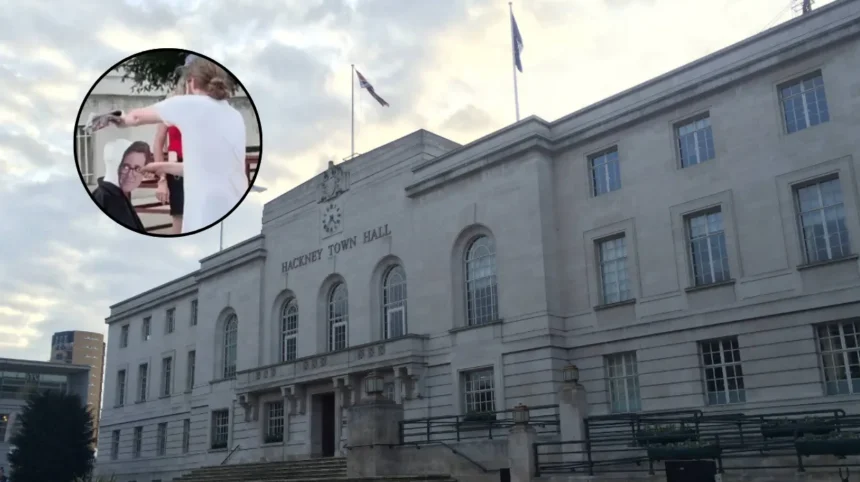
- The demonstration took place outside Hackney Town Hall on 9 July and was a trans rights rally linked to objections over new EHRC guidance on single-sex spaces.
- According to reporting cited by The Standard and The Hackney Citizen, councillors named as present included Alastair Binnie-Lubbock, Florence Schechter, Laura-Louise Fairley and Jaz Crowe.
- The Green Party said the councillors had left before the effigy-stabbing incident happened and did not witness it.
- The party said the councillors attended to show solidarity with the trans community and rejected attempts to segregate trans people from public life.
- Hackney’s Green mayor, Zoë Garbett, criticised the EHRC guidance as “cruel and unfeasible” and warned it could put trans people at physical risk.
- Labour figures, including Deputy Prime Minister David Lammy and Hackney Labour deputy leader Anna Lynch, criticised the event and the presence of councillors at it.
Hackney (East London Times) July 17, 2026, and the surrounding political row in east London form the backdrop to a dispute that has quickly spread beyond a local demonstration and into a wider argument about protest, trans rights and political conduct.
What happened at the protest?
Hackney, The Standard and The Hackney Citizen, July 17, 2026 – Hackney’s Green Party has defended its councillors after reports that they attended a trans rights rally where protesters repeatedly stabbed an effigy of Andy Burnham with darts.
As reported by The Standard and The Times, the rally outside Hackney Town Hall on 9 July was part of opposition to the new Equality and Human Rights Commission Code of Practice, which followed the 2025 Supreme Court ruling on the legal meaning of “woman” in equality law.
The reporting says activists were pictured thrusting darts into the eyes and face of a dummy depicting Burnham, with the act later drawing criticism from political opponents.
Who was said to be there?
According to The Standard and The Hackney Citizen, the councillors named in the reporting were cabinet members Alastair Binnie-Lubbock, Florence Schechter and Laura-Louise Fairley, along with backbencher Jaz Crowe.
The Greens later said those councillors had already left by the time the effigy was stabbed and did not witness the act.
That distinction became central to the party’s defence, because the criticism was not only about the demonstration itself but also about whether elected representatives should have been present at all.
Why were the councillors at the rally?
The Green Party said the councillors were there to stand in solidarity with the trans community.
In a statement quoted by the Local Democracy Reporting Service, a party spokesperson said the Greens reject attempts to segregate trans people from public life and are proud to stand with the trans community as it faces attacks from politicians and the media.
The protest was organised against the EHRC’s new Code of Practice, which was published after the Supreme Court ruling in 2025 that the legal definitions of “woman” refer to biological sex.
The EHRC guidance says that if a provider offers a single-sex or separate-sex service, a trans man would be excluded from a men-only service because his sex is female, while a trans woman would be excluded from a women-only service because her sex is male.
How did the Greens respond?
Hackney’s Green mayor, Zoë Garbett, has separately argued that the guidance is “cruel and unfeasible”.
She said it would consolidate a system of public segregation and place trans people at real physical risk.
That position was echoed by the party’s wider defence of the councillors’ attendance, with the Greens insisting their presence at the rally should be understood as support for trans rights rather than approval of the effigy stabbing.
The party also said the councillors did not see the act that triggered the backlash.
What criticism has been made?
The incident drew strong criticism from Labour figures.
Deputy Prime Minister David Lammy condemned the event in a social media post, describing it as a disgraceful act that took place just days after the murder of a senior politician and urging people to condemn violence and threats against politicians.
Hackney Labour deputy leader Anna Lynch told the Local Democracy Reporting Service that it was “beyond horrifying” that Green councillors were participating in demonstrations like this, and said political disagreement must never cross into intimidation or incitement.
Her comments framed the issue as a matter of democratic standards as much as protest politics, especially given the symbolic use of violence against a national figure.
How did Burnham fit into the row?
The reporting says Burnham has faced criticism over his stance on trans rights.
The Hackney Citizen and The Standard both note that he initially criticised the EHRC’s interim guidance for making single-sex spaces more confusing in the real world, before later clarifying that he supported implementation in the fairest and most compassionate way possible.
The articles also say he is set to become the UK’s next Prime Minister on Monday 20 July, which adds to the sensitivity of any protest imagery aimed at him.
How does the legal context matter?
The row sits within a broader legal and political dispute over how public services should handle single-sex provision and how those rules affect trans people.
The EHRC guidance, published after the 2025 Supreme Court ruling, has become a focal point for campaigners who believe it may restrict access for trans people in public life.
At the same time, supporters of the guidance argue it reflects the legal framework created by the court ruling, which makes the issue politically and legally difficult for councils and service providers.
Hackney itself has already faced pressure over similar issues, including plans connected to changing facilities at King’s Hall Leisure Centre, which were discussed in the context of the ruling.
Why is this politically sensitive?
The incident is sensitive because it combines local government, trans rights campaigning and the imagery of violence against a high-profile politician.
That combination has made it easy for opponents to argue that the protest crossed a line, even though the Greens maintain their councillors were there for peaceful reasons and left before the stunt.
For the party, the challenge is separating support for trans rights from any association with aggressive protest symbolism.
For Labour, the issue is being used to argue that elected representatives should distance themselves from demonstrations that appear to glorify violence.
Background
The immediate background to the protest is the 2025 Supreme Court ruling on the meaning of “woman” in equality law, followed by the EHRC’s Code of Practice on single-sex spaces.
Hackney’s Green leadership has been publicly critical of the guidance and has argued that it would harm trans people rather than protect them.
The council has also previously faced pressure over how such rulings affect local services, including changing-room provision and wider equality policy.
This means the protest was not an isolated event but part of an ongoing policy dispute that has already reached both local and national political levels.
What could happen next?
For Hackney residents, the development may sharpen debate over whether councillors should attend protests that risk being seen as hostile or intimidating.
For trans communities, the Greens’ defence may be read as continued political support, but it may also intensify scrutiny of how that support is expressed in public demonstrations.
For Labour and other critics, the episode is likely to be used to press for clearer boundaries between peaceful protest and imagery that can be interpreted as threatening.
At a wider level, the row could deepen political tension around how councils respond to EHRC guidance and how elected officials communicate support for contested equality issues.