Key Points:
- Elevating work platforms, including cherry pickers, will be used by Hackney Council for cleaning of gutters in all social housing properties owned by the council.
- This method is aimed at minimizing the need for fixed scaffolding which the local government views as disturbing the residents.
- The pilot study has shown that the mobile platforms can clean 17 times the distance of guttering and downpipes cleaned in the regular way in one working day.
- Recently, during a pilot run, 170 meters of guttering and 12 rainwater downpipes were cleaned in one day with the cost of only over £1,500.
- Regular scaffoldings needed to clean about 10 meters of guttering normally cost around £4,000.
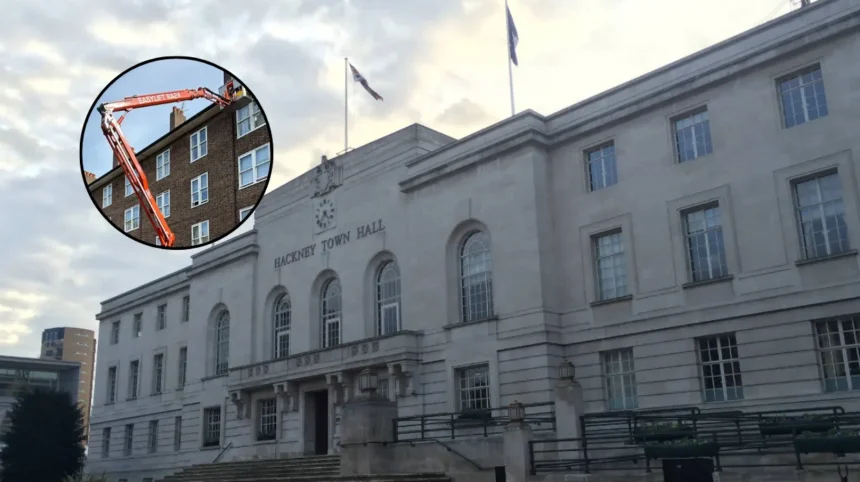
Hackney (East London Times) September 17, 2026 – Hackney Council has initiated a new operational approach to housing maintenance by introducing mobile elevating work platforms, commonly known as cherry pickers, to clear drainage systems across its municipal estates. The local authority has confirmed that the deployment of this machinery is designed to accelerate routine clearance works while sharply reducing operational expenditure compared to traditional scaffolding methods. The initiative forms part of an ongoing municipal strategy aimed at minimising the prolonged erection of static scaffolding structures around domestic properties, an issue frequently cited by tenants as a source of environmental disruption and restricted accessibility.
What Are the Key Financial and Operational Benefits of Using Cherry Pickers Over Scaffolding?
The deployment of elevating access platforms offers significant advantages in both daily output and financial expenditure. Standard operational procedures typically require scaffolding frames to be erected around residential blocks to facilitate roof-level maintenance. As reported in official operational documentation, erect scaffolding to access and clear approximately 10 metres of residential guttering incurs an average cost of roughly £4,000 due to labour, assembly, and rental overheads.
In contrast, recent field trials evaluating mobile platform machinery demonstrated substantial productivity gains alongside cost savings. During a single-day test deployment, maintenance teams using an elevated platform successfully cleared 170 metres of guttering together with 12 rainwater downpipes. The total operational expenditure for this single-day pilot amounted to just over £1,500. The trial data indicates that mobile elevating platforms enable work crews to clear approximately 17 times the physical length of drainage infrastructure within a matching timeframe, achieving this output at a fraction of the capital required for temporary fixed structures.
Background
Local authorities across London face continuous operational demands to maintain social housing infrastructure while managing strictly allocated public maintenance budgets. Drainage infrastructure, including guttering and vertical rainwater downpipes, requires regular clearance to prevent blockages, water ingress, and structural dampness within domestic properties. Historically, physical access to high-level drainage systems across multi-storey residential blocks necessitated the assembly of static tube-and-fitting scaffolding.
While static scaffolding provides stable access for long-term construction or extensive roofing repairs, its utilization for short-duration maintenance tasks—such as debris clearance—presents notable operational inefficiencies. The process of erecting, inspecting, and dismantling scaffolding requires several days of labor, during which residents experience obstructed light, reduced privacy, and potential security vulnerabilities. Hackney Council’s decision to integrate mobile elevating platforms directly addresses these historical constraints, aligning maintenance procedures with modern equipment solutions designed to provide rapid access without long-term site displacement.
Explore More Hackney Council News
Hackney Council Security Guard Pushes Housing Activist During Protest Hackney 2026
Hackney Council Grants £10,500 for Free Community Repair Cafés, 2026
Prediction
The widespread adoption of mobile elevating platforms for routine housing maintenance is projected to directly impact social housing tenants, local council taxpayers, and municipal housing management teams across Hackney.
For local residents living in council-managed properties, the transition away from static scaffolding will substantially reduce prolonged physical obstructions around their homes. Tenants can expect faster turnarounds on reported drainage issues, minimizing the risk of internal water damage caused by overflowing gutters during periods of heavy rainfall. Furthermore, removing the need for semi-permanent scaffolding structures preserves natural light, maintains standard access points, and reduces security concerns associated with external structures left in place around domestic dwellings.
For Hackney Council taxpayers and local budget planners, the operational savings demonstrated by the pilot project offer a scalable framework for reducing municipal expenditure. By achieving a seventeen-fold increase in daily coverage at less than half the outlay of traditional scaffolding set-ups, the housing department can allocate remaining maintenance resources toward broader estate improvements, repair backlogs, and critical infrastructure projects.