Key Points
- Residents representing more than 50 households in the Hackney Central Neighbourhood Residents Association are considering a judicial review against Hackney Council over proposed traffic restrictions.
- The council’s scheme includes new School Streets, a 24-hour bus gate on Shacklewell Lane, traffic filters on Cecilia Road, and bans on motorists using residential streets as short cuts, commonly known as “rat-running”.
- Hackney Council states the measures are required to curb dangerous traffic levels and address road safety in an area that recorded an average of 30 collisions per year between 2020 and 2024.
- Local residents living downstream on unofficial “boundary roads” warn that previous restrictions near Amhurst Road and London Fields have already displaced traffic onto their streets, causing severe congestion, noise, idling vehicles, and pollution.
- Economist and resident Ralph De Haas, 50, warned that the Dalston plans will leave families more exposed to “reckless” drivers and endanger children’s health.
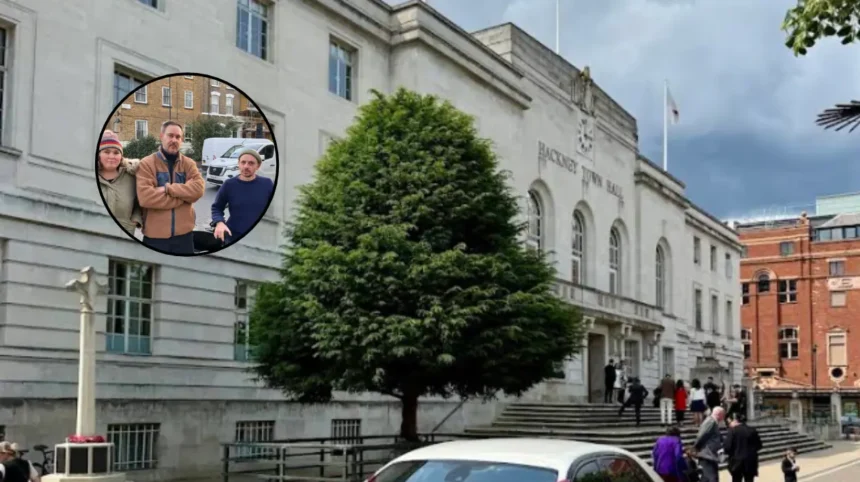
Hackney (East London Times) November 12, 2026 – A group of East London residents representing more than 50 households in the Hackney Central Neighbourhood Residents Association has joined calls to halt proposed traffic controls in the borough, warning they are considering launching a judicial review against Hackney Council over fears the measures will worsen congestion and road danger.
Why are Hackney residents opposing the proposed traffic controls?
Residents living downstream from the planned restricted zone argue that Hackney Council’s proposals to stop vehicles “rat-running” through residential streets will push motor traffic onto surrounding roads, making their own streets more congested and less safe.
As reported by the Local Democracy Reporting Service and published by MyLondon, 50-year-old economist Ralph De Haas—who lives on what is unofficially termed a “boundary road” and is one of the 50 households in the Hackney Central Neighbourhood Residents Association—stated that his street is already experiencing heavy traffic. Speaking to the Local Democracy Reporting Service, De Haas said:
“It’s already the mother of all rat-runs. We’re worried about safety, noise pollution, health, kids getting to school, and idling traffic.”
De Haas and fellow members of the residents’ association contend that motor traffic has already been “displaced” onto their streets due to earlier traffic restrictions implemented near Amhurst Road and around London Fields. They fear that the latest proposals for the Dalston area will leave them even more exposed to “reckless” drivers and harm the health of local children due to increased air pollution from idling vehicles.
Local parents have also raised concerns about pedestrian safety near parks and residential junctions. As reported by MyLondon, one local parent expressed concern over walking with a young child in the area, stating:
“It’s a mission taking my son to London Fields or Hackney Downs, with the amount of traffic and people ignoring red lights. I’m worrying about when he will start walking, and it will feel even more…”
What does Hackney Council’s traffic scheme involve?
Hackney Council’s proposals are designed to reduce through-traffic and improve road safety across parts of Dalston and Hackney Central. As reported by Josef Steen, Local Democracy Reporter for Hackney Citizen, the plans include a 24-hour bus gate on Shacklewell Lane, traffic filters on Cecilia Road, and three new School Streets, alongside broader bans preventing drivers from using residential roads as short cuts.
According to MyLondon, Hackney Council has stated that the scheme is intended to curb “dangerous” traffic levels and address road collisions. The local authority maintains that the measures are vital to creating a “more welcoming, people-friendly” neighbourhood in an area which, according to council figures, experienced an average of 30 collisions a year between 2020 and 2024. The final statutory consultation period for the Shacklewell Lane bus gate, Cecilia Road filters, and School Streets closed to public objections on November 4, 2026.
Could the dispute end up in the High Court?
With the statutory consultation window having closed earlier this month, members of the Hackney Central Neighbourhood Residents Association are actively weighing legal action to challenge the council’s decision-making process. As reported by MyLondon, the group is mulling a judicial review—a High Court process in which a judge reviews the lawfulness of a decision or action made by a public body—in an effort to halt the rollout of the restrictions.
Background of the Development
The dispute in Hackney Central and Dalston forms part of a wider, long-running debate over Low Traffic Neighbourhoods (LTNs), School Streets, and modal filters across the London Borough of Hackney. Since introducing its transport strategy in 2015 and accelerating traffic-reduction schemes from 2017 and 2020 onwards, Hackney Council has installed numerous camera-enforced bus gates, bollards, and timed School Street closures to discourage private car use and encourage walking and cycling.
While transport campaigners and council officials have consistently pointed to collision statistics and public health benefits to justify the schemes, the policy has frequently divided communities. Residents living on perimeter or “boundary” roads—which remain open to through-traffic while adjacent residential streets are filtered—have repeatedly raised concerns that displaced vehicles cause bottlenecks, slower bus journeys, and localised spikes in exhaust emissions. Previous legal challenges against Hackney Council’s Experimental Traffic Orders and LTNs reached the High Court in 2021, where judges rejected attempts to overturn the schemes, ruling that the local authority had acted within its statutory powers. In May 2026, local political dynamics in the borough shifted further when the Green Party won a landslide victory in the Hackney Council elections, campaigning on a manifesto committed to active travel and traffic reduction.
Prediction: How Could This Development Affect Hackney Residents and Road Users?
If the Hackney Central Neighbourhood Residents Association proceeds with an application for a judicial review, the immediate effect for local residents, motorists, and the council will be a period of legal and administrative uncertainty. Filing for a judicial review requires significant financial fundraising from the 50 participating households and does not automatically halt a traffic scheme unless a High Court judge grants an interim injunction. Consequently, Hackney Council may still move forward with installing the Shacklewell Lane bus gate, Cecilia Road filters, and School Streets while preliminary legal arguments are considered.
For residents living on boundary roads near Amhurst Road, London Fields, and Dalston, the implementation of the scheme is likely to alter daily traffic flows in the short term as motorists adjust to the new restrictions, potentially leading to heightened congestion during peak school and commuting hours until traffic patterns settle. Conversely, for families, pupils, and cyclists using the newly filtered residential streets and School Streets, the changes are expected to reduce motor vehicle volumes outside school gates and create quieter walking and cycling routes. Should the legal challenge reach a full High Court hearing, the outcome will determine whether Hackney Council must review its traffic modelling and consultation assessments for boundary roads before introducing further traffic controls elsewhere in the borough.