Key Points:
- The ruling administration in Hackney has abandoned its campaign to cancel the Edmonton waste incinerator redevelopment.
- The local authority faces an estimated financial impact of £9 million related to the £1.5 billion North London Waste Authority (NLWA) project.
- The Hackney Green Party had previously pledged in its local election campaign to explore every option to halt or withdraw from the reconstruction.
- A detailed council assessment concluded that withdrawing or attempting to cancel the project would result in severe financial consequences for the borough.
- The decision ensures Hackney remains aligned with the six other constituent North London boroughs participating in the NLWA infrastructure scheme.
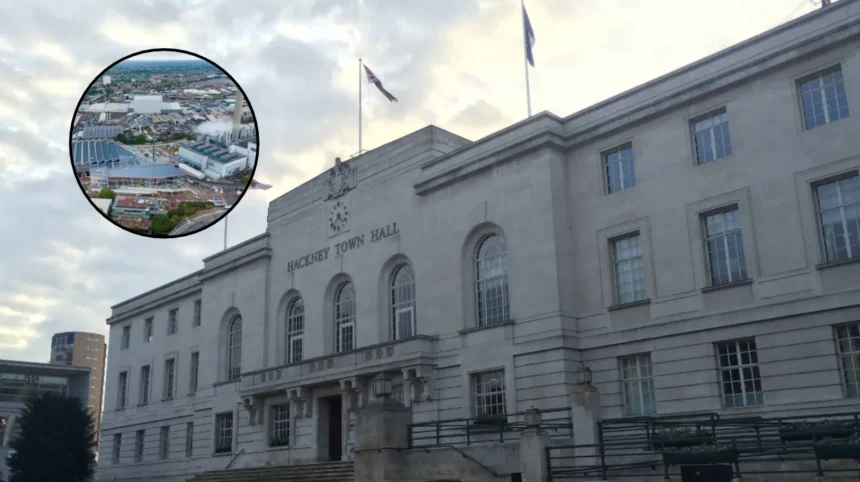
Hackney (East London Times) October 30, 2026 – The ruling administration in Hackney has formally dropped its opposition to the £1.5 billion redevelopment of the Edmonton waste incinerator, following official determinations that attempting to withdraw from or cancel the project would be financially catastrophic for the local authority. The political reversal occurs as updated projections indicate the council faces a financial shortfall and increased contributions amounting to an additional £9 million towards the overall infrastructure scheme.
Ahead of the local elections, the Green Party in Hackney included a explicit pledge within its campaign commitments to explore all administrative and legal avenues to halt the reconstruction of the ageing facility, which processes rubbish for seven North London boroughs. However, recent financial evaluations and officer reports confirmed that exiting the joint agreement would leave the council exposed to extreme contractual liabilities, legal disputes, and unmanageable alternative waste disposal costs.
What caused the £9 million financial escalation for the borough?
The projected £9 million increase in costs for Hackney stems from broader financial pressures surrounding the North London Waste Authority’s (NLWA) large-scale infrastructure plan, known as the North London Heat and Power Project. Inflationary pressures across the construction sector, rising supply chain expenses, and adjustments to municipal waste management tariffs have significantly inflated the total capital outlay beyond earlier baseline estimates.
As one of the seven constituent boroughs comprising the NLWA—alongside Barnet, Camden, Enfield, Haringey, Islington, and Waltham Forest—Hackney is contractually bound to share the fiscal burden of the authority’s capital investments. Council documents indicate that the financial obligations attached to withdrawing mid-construction would outweigh the costs of remaining in the project, as the local authority would still be liable for sunk costs, contractual penalties, and the immediate necessity to secure alternative processing facilities for municipal refuse.
How did municipal leaders justify the political shift?
In official statements regarding the administrative decision, council leadership highlighted the statutory obligations and fiscal realities governing local authority decision-making. Representatives noted that while the political ambition to halt the incinerator remained central to their platform, the legal and financial frameworks established under the NLWA charter left no viable mechanism for a single borough to unilateral abort the contract without triggering catastrophic financial penalties.
Party spokespersons acknowledged the disappointment among environmental campaigners who supported the pledge to stop the facility. However, executive members maintained that continuing to pursue cancellation in the face of definitive legal and financial advice would compromise the council’s ability to maintain basic public services and balance its statutory budget.
Background of the particular development
The Edmonton waste incinerator, situated at the EcoPark in the London Borough of Enfield, has served as a central component of North London’s waste management infrastructure since its initial commissioning in 1971. Designed to process non-recyclable household refuse and convert waste into electricity via thermal treatment, the original plant approached the end of its operational lifespan over a decade ago.
To address the region’s long-term waste requirements, the NLWA initiated plans for the North London Heat and Power Project (NLHPP). The redevelopment project encompasses a high-capacity Energy Recovery Facility (ERF), a resource recovery facility, and associated district heating infrastructure intended to deliver heat to thousands of local homes.
The project has been a subject of sustained political and environmental debate across North London:
- Environmental Objections: Community groups, activists, and Green Party representatives argued that constructing a large-scale thermal processing facility would contradict climate neutral targets, discourage municipal recycling initiatives, and contribute to local air pollution.
- Financial Scale: Initially budgeted at a lower baseline, the total scope and cost of the NLHPP expanded to £1.5 billion, driven by technical requirements, market conditions, and expanded site infrastructure.
- Borough Agreement: The project relies on joint governance among the seven member boroughs, each contributing proportionally based on population size and waste volumes generated.
Despite repeated legal challenges, public protests, and political motions from individual borough councillors, the NLWA maintained construction works at the site, arguing that thermal treatment represented a more sustainable alternative to sending non-recyclable waste to distant landfill sites.
Prediction: How this development can affect North London residents and council taxpayers
The decision to proceed with the Edmonton incinerator scheme and absorb the £9 million cost escalation will directly impact residents across Hackney and the wider North London area in several distinct key areas:
1. Council Budget Allocations and Local Taxpayers
The addition of £9 million to Hackney’s waste management expenditure creates immediate pressure on the borough’s general fund. To accommodate these fixed capital and operational costs, the local authority may be forced to reallocate funds from other discretionary municipal services or consider adjustments to future Council Tax rates. Taxpayers across all seven NLWA boroughs remain exposed to further potential cost overruns associated with the £1.5 billion capital project until full commissioning is achieved.
2. Household Waste Processing and Infrastructure Continuity
For householders, the resolution of the political impasse ensures that municipal waste collection services will continue uninterrupted. The completion of the modern Energy Recovery Facility provides long-term operational certainty for non-recyclable waste disposal across North London, preventing potential logistics crises or reliance on external landfill operators.
3. Local Environmental and Public Health Realities
Residents living adjacent to the Edmonton EcoPark site in Enfield and neighbouring areas will experience the operational realities of the upgraded facility. While the new plant incorporates advanced flue-gas cleaning technologies designed to meet strict modern emission standards, local communities will remain attentive to air quality monitoring and heavy goods vehicle traffic delivering municipal waste to the site over its operational lifecycle.