Key Points
- Reform UK leader Nigel Farage stated that his party would “attempt not to borrow any further” if it gains control of cash-strapped Havering Council.
- Havering Council faces a £72 million overspend by the end of the current financial year and may require a significant government loan to balance its books.
- The council borrowed £88 million from Westminster last year to cover its deficit and £72.5 million the year before.
- Early projections suggest Havering’s debt could reach £300 million by 2029.
- Farage acknowledged challenges in turning around the council, emphasising cost cuts and efficiency measures, but noted it “can’t just walk in and turn something around overnight.”
- He added: “What we can do is do our best — we’d struggle to do worse, I’d certainly say that.”
- Cuts by the current Havering Residents Association (HRA) administration, including the closure of four libraries, have sparked local protests and a cross-party effort to keep them open.
- The HRA identifies temporary housing and social care costs as primary strains, accounting for 80% of spending, with exponential growth over the past two years.
- Farage highlighted national pressures on local government, including social care and special educational needs (SEN) costs, calling them a “massive problem” across the country.
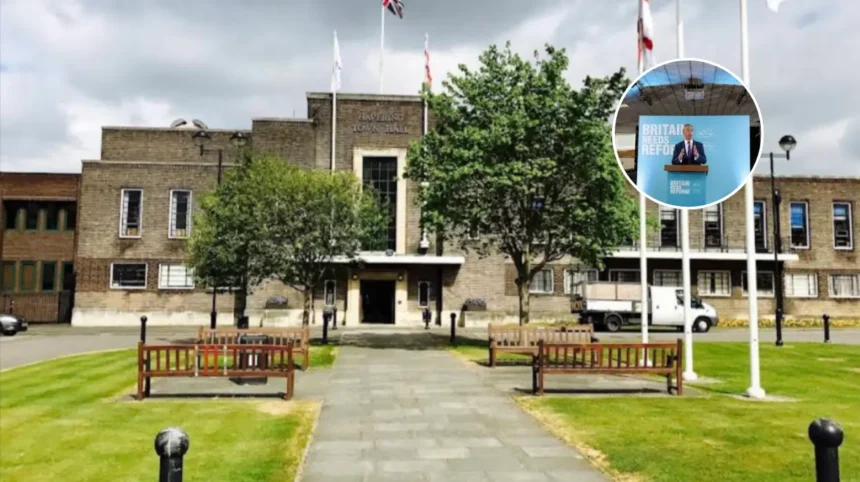
- Farage spoke ahead of a Reform UK rally in Romford on 16 February 2026, where Romford MP Andrew Rosindell pledged a referendum on Havering leaving Greater London.
- At the event outside Romford Town Hall, Farage welcomed councillors Christine Vickery and Robert Benham, who defected from the Conservatives.
- Havering is a key London target for Reform UK in the May 2026 local elections, alongside Bexley, Bromley, and Hillingdon.
Romford (East London Times) February 18, 2026 – Reform UK leader Nigel Farage has pledged that his party would “attempt not to borrow any further” should it seize control of the financially beleaguered Havering Council, which is projected to end the current financial year with a staggering £72 million overspend. Speaking to the Local Democracy Reporting Service (LDRS), Farage acknowledged the immense challenges ahead, stressing that immediate cost cuts and efficiency drives would be prioritised, though he cautioned that “you can’t just walk in and turn something around overnight.” This comes as the council, run by the Havering Residents Association (HRA), faces escalating debts potentially hitting £300 million by 2029, following recent borrowings of £88 million last year and £72.5 million the previous year.
- Key Points
- What Did Nigel Farage Precisely Say About Borrowing?
- Why Is Havering Council Facing Such Severe Financial Strain?
- What Controversial Cuts Has the HRA Administration Made?
- What Rally Preceded Farage’s Statements?
- Which Boroughs Are Reform UK Targeting in London?
- How Does Reform UK’s Pledge Compare to Current Challenges?
- What Role Do Social Care and Housing Costs Play Nationally?
- Who Are the Key Figures Defecting to Reform UK?
- What Lies Ahead for Havering’s Elections?
- Broader Implications for Local Governance
What Did Nigel Farage Precisely Say About Borrowing?
As reported by local democracy reporter Sebastian Mann of The Havering Daily, Nigel Farage told the LDRS:
“We would attempt not to borrow any further, but you can’t just walk in and turn something around overnight.”
He elaborated:
“What you can do is make cost cuts, what you can do is try and become more efficient. I don’t think anyone’s going to pretend that turning around councils like this is going to be easy. It isn’t.”
Farage further remarked:
“What we can do is do our best — we’d struggle to do worse, I’d certainly say that.”
These statements underscore Reform UK’s ambitious yet pragmatic approach to Havering’s fiscal woes, positioning the party as a potential alternative to the incumbent HRA administration.
Why Is Havering Council Facing Such Severe Financial Strain?
Havering Council’s predicament stems from a £72 million overspend anticipated by the financial year’s end, necessitating a likely substantial government loan, as detailed by Sebastian Mann in The Havering Daily. Last year, the council was compelled to borrow £88 million from Westminster to plug its deficit, following £72.5 million the year prior. Early projections warn of debt ballooning to an “eyewatering” £300 million by 2029. The HRA administration has pinpointed temporary housing and social care as the chief culprits, consuming 80% of the budget with costs surging exponentially over two years. Farage echoed this, noting to the LDRS:
“The trouble is the pressure on local governments: the social care costs, the [special educational needs] costs. [They are] a massive problem – not just in Havering, but throughout local government right throughout the whole country.”
What Controversial Cuts Has the HRA Administration Made?
Cuts implemented by the HRA over the past year have ignited significant backlash, particularly the closure of four libraries borough-wide, which triggered local protests and a cross-party campaign to preserve them, according to Sebastian Mann’s reporting in The Havering Daily. The HRA has defended these measures, warning that temporary housing and social care represent the primary pressures. Despite such defences, the moves have proven divisive, fuelling discontent among residents and opposition figures.
What Rally Preceded Farage’s Statements?
Farage’s comments were delivered ahead of a major Reform UK rally in Romford on 16 February 2026, as covered by Sebastian Mann in The Havering Daily. At a brief event outside the town hall, Romford MP Andrew Rosindell – who defected from the Conservatives last month – pledged a referendum on Havering exiting Greater London. Farage used the occasion to welcome councillors Christine Vickery and Robert Benham, both of whom have defected from the Tories to Reform UK.
Which Boroughs Are Reform UK Targeting in London?
Havering stands as one of Reform UK’s primary targets in London for the May 2026 local elections, alongside Bexley, Bromley, and Hillingdon, per details in The Havering Daily by Sebastian Mann. This strategic focus reflects the party’s intent to capitalise on local dissatisfaction with fiscal mismanagement and service cuts.
How Does Reform UK’s Pledge Compare to Current Challenges?
Reform UK’s commitment to curbing further borrowing arrives amid Havering’s dire straits, where the council’s reliance on government loans has become routine. As Sebastian Mann writes in The Havering Daily, the £72 million overspend mirrors patterns of prior deficits, with borrowings escalating annually. Farage’s emphasis on efficiency aligns with national debates on local authority sustainability, yet his candid admission of difficulties – “turning around councils like this is going to be easy. It isn’t” – tempers expectations. The HRA’s library closures exemplify the tough choices already made, highlighting the entrenched issues of social care and housing that no administration can ignore overnight.
What Role Do Social Care and Housing Costs Play Nationally?
Nigel Farage identified social care and SEN costs as a “massive problem” afflicting not only Havering but local government nationwide, as quoted by Sebastian Mann in The Havering Daily. In Havering, these account for 80% of expenditure, with exponential rises over two years exacerbating the crisis. The HRA has repeatedly stressed these as the core strains, defending cuts elsewhere. Farage’s remarks to the LDRS frame Reform UK’s approach within this broader context, suggesting efficiency gains could mitigate but not eradicate the pressures.
Who Are the Key Figures Defecting to Reform UK?
Councillors Christine Vickery and Robert Benham were publicly welcomed by Nigel Farage at the Romford Town Hall event, having defected from the Conservatives, according to The Havering Daily’s Sebastian Mann. Romford MP Andrew Rosindell, who switched from the Conservatives last month, shared the stage and reiterated his referendum pledge on Havering’s Greater London status. These defections bolster Reform UK’s foothold in the borough ahead of May polls.
What Lies Ahead for Havering’s Elections?
With Havering earmarked as a prime target, Reform UK’s anti-borrowing stance positions it against the HRA’s record of controversial savings and mounting debts. Sebastian Mann’s coverage in The Havering Daily notes the May 2026 elections as a pivotal moment, where voters will weigh Farage’s pledges against the realities of £300 million projected debt by 2029. The rally’s turnout and defections signal growing momentum, though Farage’s realism – “we’d struggle to do worse” – invites scrutiny on delivery.
Broader Implications for Local Governance
Havering’s turmoil exemplifies strains on UK councils, where social care devours budgets and borrowing sustains operations. Farage’s LDRS interview, as relayed by Sebastian Mann, casts Reform UK as pragmatic reformers, prioritising cuts over complacency. Yet the HRA’s warnings on unavoidable costs persist, with library protests underscoring resident impacts. As elections loom, the debate intensifies: can efficiency alone stem the tide, or will further loans prove inevitable?