Key Points
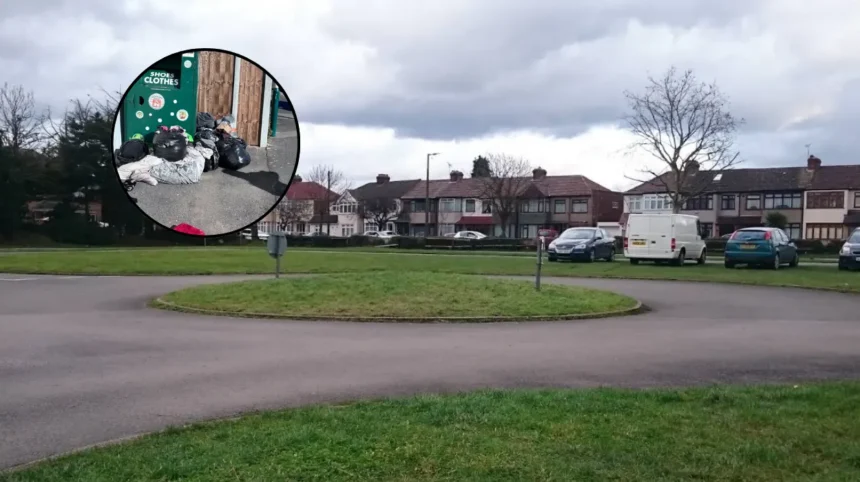
- Residents in Hornchurch, East London, have expressed intense frustration over persistent fly-tipping and rubbish dumping around a local clothes donation bank near Burnway.
- Unwanted clothing, packed into plastic bin liners, is frequently abandoned on the pavement adjacent to the bank rather than being deposited inside the recycling bins.
- Community members report that the surrounding pavement is becoming an unsightly hazard and an “eyesore,” diminishing the cleanliness and quality of life in the neighbourhood.
- Local residents are urging individuals donating items to take the necessary seconds to place donations correctly inside the container or take them home if the unit is full.
- Community leaders and affected neighbours stress that turning charitable recycling drop-offs into unofficial dumping grounds creates unnecessary hazards and burdens local cleaning efforts.
Hornchurch (East London Times) September 22, 2026 – Residents living near Burnway in Hornchurch have raised strong objections over the continued misuse of a neighbourhood clothes recycling bank, which has been transformed into a chronic dumping ground by individuals abandoning bags of unwanted clothing on the public footpath. Rather than opening the donation hatch to secure items inside the container, individuals are routinely leaving overfilled bin liners scattered across the pavement, creating a persistent public visual nuisance and obstructiveness in the residential area. Affected community members maintain that while the recycling bank was installed to encourage charitable giving and textile recycling, blatant misuse by lazy donors has turned the location into an untidy eyesore that damages the neighbourhood’s appearance.
- Key Points
- Why are Hornchurch residents erupting over the local clothes bank?
- What is the direct impact of pavement dumping on the local community?
- What message are local residents sending to clothing donors?
- Background of the Hornchurch textile recycling issues
- Prediction: How this development will affect local residents and donors
Why are Hornchurch residents erupting over the local clothes bank?
How has a charitable recycling initiative turned into a source of severe frustration for people living near Burnway? According to testimonies gathered from local residents, the heart of the grievance lies in the repeated practice of individuals driving or walking up to the clothes bank and simply dropping their bags on the ground. Instead of checking whether the collection container has room or taking the brief moment required to operate the drop-in mechanism, many users leave their unwanted items exposed on the pavement alongside the structure. Over time, these piles accumulate, leading to split bags, scattered garments across the walkway, and an environment that attracts further indiscriminate littering.
Residents stress that the facility is meant to serve the community by diverting textiles from landfill, yet its surroundings are increasingly resembling a refuse tip. The situation is exacerbated during periods of bad weather, when abandoned plastic sacks rot, tear open, or leak rainwater, leaving soaked clothing strewn across public space. The resulting clutter restricts access for pedestrians, pram users, and individuals with mobility impairments who rely on clear footpaths along Burnway.
What is the direct impact of pavement dumping on the local community?
What specific issues are neighbours experiencing as a direct result of this ongoing tipping? Beyond the immediate visual blight, residents note that abandoned bags frequently become targets for scavenging or vandalism. When bags left on the floor are ripped open, items of clothing are blown down the road, landing in private front gardens and clogging local storm drains. The accumulation of loose refuse also creates secondary sanitation concerns, as piles of soft waste can shelter vermin if left unaddressed for extended periods.
Community members emphasize that they should not be forced to tolerate the consequences of other people’s negligence. Living adjacent to a location that is perpetually littered undermines local pride and creates an impression of neglect in an otherwise well-maintained suburban quarter. Furthermore, the repeated necessity for municipal cleanup teams or public-spirited volunteers to clear away refuse around the bin diverts time and public resources away from standard road sweeping and maintenance services.
What message are local residents sending to clothing donors?
How do residents believe this problem can be immediately resolved? The collective request from people living near the Burnway clothes bank is straightforward: use the donation facilities properly or do not use them at all. Residents are asking everyone wishing to donate unwanted garments to ensure that every single item is placed securely inside the bank’s designated chute.
A central message echoed across the neighbourhood sums up the mood: “Stop dumping your rubbish everywhere.” Residents point out that taking an extra few seconds to open the chute and drop the bag inside is a minimal effort that yields a significant positive impact on the cleanliness of the street. If the bank is found to be completely full, donors are expected to exercise civic responsibility by retaining their bags and taking them to an alternative recycling point, a local charity shop, or returning when the bank has been emptied, rather than dropping them on the floor as a convenient afterthought.
Background of the Hornchurch textile recycling issues
To understand why this issue has reached a boiling point, it is necessary to examine the broader context of textile collection and fly-tipping challenges across outer London boroughs. Clothes recycling banks are widely deployed across residential estates, supermarket car parks, and street corners throughout the London Borough of Havering to help meet local sustainability targets and reduce municipal waste disposal costs. These banks are typically managed either directly by municipal contractors or operated by third-party commercial recyclers and charitable organisations under license.
However, the convenience of unmanned collection points has long made them vulnerable to misuse. Across the UK, municipal authorities routinely classify bags left alongside collection banks as fly-tipping. When collection banks reach capacity—often due to high donation volumes following weekend clear-outs or holiday periods—the lack of immediate capacity leads to a phenomenon known as “side-waste tipping.” Once a single bag is left on the ground, it frequently acts as a psychological trigger for subsequent users to leave their waste in the same spot, rapidly multiplying the volume of abandoned refuse.
In recent years, local councils across Greater London have experimented with various strategies to tackle illegal dumping around recycling points, including installing CCTV enforcement cameras, increasing the frequency of bank emptying schedules, applying clearer instruction signage, and in severe cases, permanently removing problem banks altogether. The situation at Burnway reflects an ongoing dilemma faced by local authorities: balancing the provision of accessible recycling facilities for conscientious citizens against the public nuisance caused by illegal tipping and irresponsible disposal habits.
Prediction: How this development will affect local residents and donors
Looking ahead, this escalation of community frustration around the Burnway clothes bank is likely to trigger several tangible shifts affecting both local residents and individuals who use the recycling facility.
For local residents, the public outcry is expected to push municipal representatives and site operators to increase monitoring and clearance routines around the Burnway site. In the short term, this heightened attention may lead to cleaner footpaths and faster response times when banks become full. However, if the habit of dropping bags on the pavement persists despite public warnings, the managing authority or council may ultimately decide to remove the clothes bank entirely. While removing the infrastructure would permanently solve the visual eyesore and sidewalk obstruction on Burnway, it would simultaneously deprive law-abiding residents of a convenient local facility for recycling textiles.
For donors and the wider public, this development signals an era of stricter scrutiny and potential enforcement surrounding charity banks. As public intolerance for fly-tipping grows, local councils across the region are increasingly utilizing fixed penalty notices (FPNs) for small-scale waste dumping. Individuals who continue to leave bags on the pavement beside collection bins risk being caught on camera and fined under environmental protection legislation. Consequently, donors will need to adjust their habits by verifying that recycling banks are operational and capable of receiving items inside the unit before leaving their homes, or adapt to using alternative channels such as council kerbside textile collections and high-street charity shops.