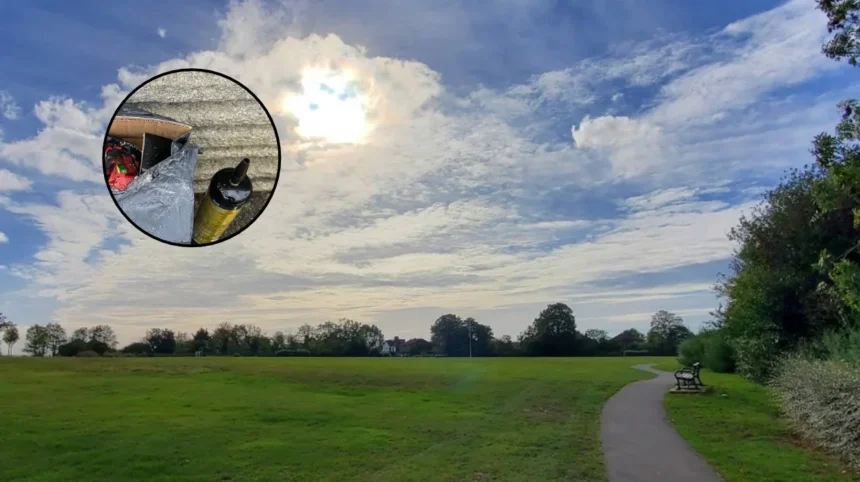
- Multiple boxes containing large nitrous oxide (laughing gas) canisters were discovered abandoned on the pavement outside St Andrew’s Park in Hornchurch on Monday morning.
- The incident followed a weekend of Halloween celebrations, leaving at least two fully packed boxes of canisters discarded in plain public view.
- Local residents, dog walkers, and volunteers who regularly clean the park expressed severe frustration over the continuous anti-social behavior and environmental pollution.
- St Andrew’s Park is heavily frequented by parents with young children, pet owners, and community members seeking a safe recreational environment.
- The discovery has renewed strong demands from the local community for local authorities to lock the park gates at night to curb illicit gatherings.
Hornchurch (East London Times) November 3, 2026 – Residents who use St Andrew’s Park in Hornchurch were angered to discover boxes containing large nitrous oxide canisters, commonly known as laughing gas canisters, left strewn across the pavement outside the park on Monday morning. Following a weekend of Halloween celebrations, local visitors arriving at the green space encountered the discarded containers, with reports confirming that at least two full boxes of canisters had been abandoned directly on the footway.
- What Was Discovered Outside St Andrew’s Park Following Halloween Celebrations?
- Why Are Local Hornchurch Residents Demanding Immediate Action From Authorities?
- How Has This Incident Reignited Calls to Lock the Gates of St Andrew’s Park?
- Background of Nitrous Oxide Usage and Local Park Security
- Prediction: How This Development Can Affect Hornchurch Residents and Local Governance
The discovery has generated significant disquiet among members of the local community who routinely visit the location for daily exercise, recreation, and child play. St Andrew’s Park serves as a central hub for parents with young children, dog walkers, and neighborhood residents. Community members who voluntarily take it upon themselves to clear litter from the park premises expressed particular anger upon finding heavy commercial-style boxes of pressurized gas canisters left openly on a public pedestrian walkway.
What Was Discovered Outside St Andrew’s Park Following Halloween Celebrations?
According to eyewitness accounts from neighborhood residents arriving at the site early on Monday morning, the exterior of St Andrew’s Park was cluttered with abandoned paraphernalia related to nitrous oxide consumption. The timing of the incident directly coincided with the conclusion of the Halloween weekend, a period typically marked by heightened evening activity across public parks and open spaces in the borough.
Local volunteers who regularly inspect and clean the surrounding footpaths noted that the volume of discarded items was unusually high. Rather than small individual metal bulbs typically associated with recreational anti-social behavior, the containers found on the Hornchurch pavement consisted of larger industrial-grade canisters packed inside cardboard shipping boxes. Two of these boxes were found completely full or largely intact, presenting both a physical obstruction on the pavement and a clear environmental hazard adjacent to the park entrance.
Residents who maintain the cleanliness of the site reported that while anti-social littering is a persistent challenge in the area, the open abandonment of whole, unconsumed batches of pressurized gas units outside a public recreation ground represents a noticeable escalation in local disorder.
Why Are Local Hornchurch Residents Demanding Immediate Action From Authorities?
The persistent presence of discarded canisters inside and around St Andrew’s Park has created ongoing friction between local visitors and those utilizing the space for late-night gatherings. Community members emphasized that St Andrew’s Park is primarily a family space designed for local recreation. Parents carrying out morning walks with toddlers and dog owners exercising pets reported having to actively navigate around sharp debris, damaged packaging, and chemical containers.
Those who routinely volunteer their time to pick up waste within the park boundaries expressed acute frustration at the situation. Volunteers noted that their personal efforts to keep the green space presentable and safe are consistently undermined by recurring anti-social behavior. The visibility of large nitrous oxide packaging on public footpaths has raised broader concerns regarding public safety, street cleanliness, and the preservation of neighborhood amenities.
Consequently, local park users are questioning the efficiency of current preventative measures, asking how much longer the community will be expected to tolerate recurring environmental degradation before local administrative bodies intervene with robust enforcement or physical security improvements.
How Has This Incident Reignited Calls to Lock the Gates of St Andrew’s Park?
The latest discovery of abandoned gas containers outside the grounds has directly reignited long-standing calls from residents for the physical security of St Andrew’s Park to be upgraded. Specifically, local groups are urging the implementation of a strict regime to lock the park gates during overnight hours.
Proponents of closing the park gates at dusk argue that unrestricted night-time access turns the park into an unmonitored location for anti-social gatherings and illegal substance use. Community members maintain that securing the entry points overnight would significantly deter vehicles and individuals from utilizing the perimeter and interior grounds for illicit activities during unsociable hours.
Local residents assert that locking the gates represents a practical, immediate intervention that would protect the park’s infrastructure, reduce the burden on volunteer cleanup groups, and restore confidence among families who utilize the grounds during daylight hours.
Background of Nitrous Oxide Usage and Local Park Security
Nitrous oxide, colloquially referred to as “laughing gas,” has historically been used in medical and culinary applications. However, its non-medical recreational use in urban public spaces, particularly public parks and residential streets, has expanded significantly across the United Kingdom in recent years. The disposal of larger cylinder-based canisters has replaced smaller silver chargers in many urban areas, leading to larger volumes of hazardous metal and cardboard waste being discarded in public realms.
In response to widespread public concern regarding health risks and widespread anti-social behavior, the UK Government updated the legal status of nitrous oxide under the Misuse of Drugs Act 1971, classifying it as a Class C drug. Under these statutory provisions, unlawful possession of nitrous oxide for recreational purposes is prohibited, while supply, production, and import for non-legitimate uses carry severe criminal penalties.
Despite legislative changes aimed at curbing supply and recreational possession, local enforcement in public parks remains a persistent challenge for municipal authorities and local police forces. Public open spaces like St Andrew’s Park in Hornchurch often feature multiple access routes and open perimeters, making continuous monitoring difficult without dedicated gate-locking staff or security patrols. In many suburban boroughs, municipal budgetary constraints have previously led to the reduction of evening park keeper services, leaving several public parks open 24 hours a day and shifting the burden of monitoring onto local residents and community watch groups.
Prediction: How This Development Can Affect Hornchurch Residents and Local Governance
The discovery of large nitrous oxide canisters outside St Andrew’s Park is likely to accelerate formal civic campaigns aimed at pushing the London Borough of Havering and local ward councillors to take decisive administrative action. In the short term, local residents, park user groups, and neighborhood association members are anticipated to lodge formal petitions demanding an immediate review of park security protocols, specifically focusing on the feasibility of reintroducing nightly gate-locking operations.
For the primary audience—local residents, parents, and dog walkers—failure to address the situation rapidly risks lowering community engagement with the park. Continued littering of this nature may lead to reduced usage of the facility by families concerned for child safety, alongside an increased physical workload for local volunteer cleaning groups. Conversely, if local authorities respond by securing the perimeter and tightening night-time access, it could establish a operational template for other public green spaces across the borough facing similar anti-social challenges.