Key Points
- Romford Market will host ‘Market Town’, a sound and video projection show celebrating the borough’s 800-year history.
- The free show will run over two nights, Friday 28 August and Saturday 29 August, with performances starting at 8:30 pm.
- Local artist David Shearing created the project after three years of development and fundraising.
- A physical recreation of Romford’s former fountain will feature as part of the event and serve as a reminder of the landmark.
- Around 200 local residents are involved in the production, including market stallholders, café owners and bell ringers from St Edward’s Church.
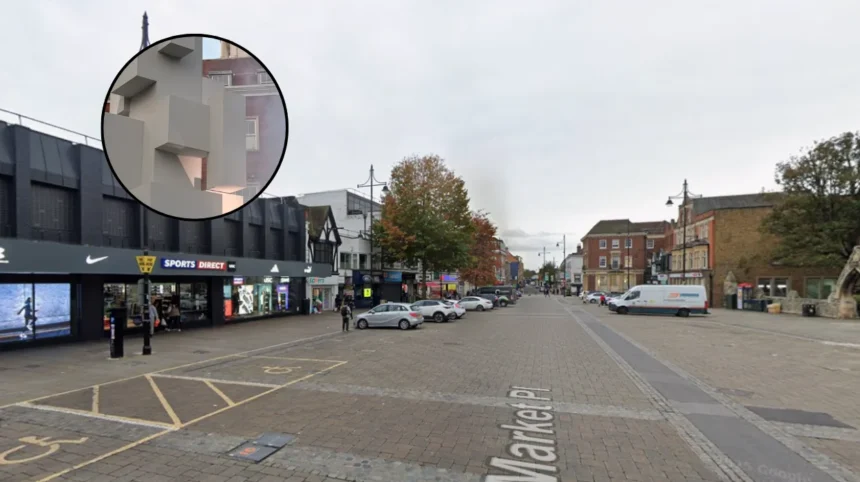
Romford (East London Times) August 28, 2026 — ‘Market Town’ is a major immersive community performance designed to celebrate the 800-year history, contemporary identity, and future aspirations of Romford. Taking place directly in the historic trading space of Romford Market, the event utilizes custom video projections, localized soundscapes, and live performance elements to transform the public square into an interactive theater space.
The initiative is designed to highlight the evolution of the borough from its medieval origins to its modern reality. Rather than relying solely on professional cast members, the production incorporates live involvement from roughly 200 local citizens, blending historical narrative with real-world personal histories.
Who Created The Project And What Inspired Its Creation?
The production is the creation of artist David Shearing, a native resident of the borough who describes himself as a “Romford Boy”. Shearing and his production team spent three years securing funding and organizing resources to make the project a reality for the local public.
The artistic concept stems from personal recollection and broader collective heritage. As reported by the Havering Daily, Shearing stated:
“We have been fundraising for three years to get the funding for this show. Most residents will see the fountain that was once in Romford, now recreated in the Market. We pay homage to the fountain and all the memories people have of it.”
Shearing explained that the landmark holds specific personal resonance that mirrors the wider community’s experience. As reported by the Havering Daily, Shearing noted:
“Market Town is a hopeful piece. I have my memories of it and how I was shopping and got separated from my mum and how that fountain was a key landscape there. The fountain is an iconic memory for people of Havering.”
How Is The Local Community Participating In The Event?
Community integration serves as the primary structure for the ‘Market Town’ project. The performance integrates direct contributions from long-standing local businesses and institutions to represent the authentic character of the area.
Participants include local market stallholders and café owners who have provided recorded or live recollections of their working lives in Romford. Furthermore, the performance incorporates local bell ringers from St Edward’s Church, integrating traditional auditory elements of the market square directly into the score. In total, approximately 200 local residents are participating across various aspects of the staging, making the piece a collaborative civic effort.
As reported by the Havering Daily, Shearing stated:
“We celebrate our past and look to our future and how we can go forward together as a community,”
adding that
“We must use art to unite us and Market Town really is a heartfelt piece.”
When And Where Can The Public Attend The Show?
The performances are open to the general public free of charge, taking place in the open-air environment of Romford Market.
Two evening performances have been scheduled:
- Friday, 28 August: Performance begins at 8:30 pm.
- Saturday, 29 August: Performance begins at 8:30 pm.
Organisers have staged the event in the late evening to maximize the visual clarity and impact of the architectural video projections across the market space.
Background Of The Market Town Development
Romford Market holds a historic status within the London Borough of Havering and the wider region of Essex, tracing its operational origins back to a royal charter granted by King Henry III in 1247. Established initially as a weekly livestock market, it grew over eight centuries into a central commercial hub for eastern England, shaping the town’s spatial layout, local economy, and culture.
During the late 20th century, physical landmarks within the market square—most notably its central public fountain—became primary gathering points and recognizable symbols of civic life. Subsequent urban redesigns and town centre developments altered the physical infrastructure of the market space, leading to the removal of several historical features, including the fountain.
In recent years, local authorities and cultural organizations have sought new methods to revitalize high streets and historic market spaces amid shifting retail habits. The development of ‘Market Town’ represents a three-year effort to utilize heritage-focused public art as a mechanism for community cohesion and civic engagement.
Future Impact And Implications For Local Residents And Community
The staging of ‘Market Town’ carries significant implications for the local community, market traders, and the cultural landscape of the London Borough of Havering.
Impact On Civic Pride And Social Cohesion
By actively engaging 200 local participants and focusing on shared generational memories, the project aims to reinforce a sense of collective identity among residents. In an urban area that has experienced substantial demographic transitions and commercial changes over recent decades, public heritage projects provide a shared space for long-term residents and newer arrivals to connect over local history.
Strategic Revitalisation Of The Market Space
Town centre markets across the United Kingdom face ongoing commercial challenges due to changes in consumer behavior and online retail growth. High-profile cultural events such as ‘Market Town’ bring footfall to the commercial centre during non-traditional operating hours. Demonstrating that the market square can function as an outdoor venue for large-scale arts programming opens future possibilities for evening economies and cultural tourism in Romford.
Model For Community-Led Cultural Funding
The culmination of a three-year fundraising effort by a local artist demonstrates a viable model for grassroots cultural projects within suburban London boroughs. Success in this production may encourage further investment from public arts bodies, local councils, and private sponsors into community-driven arts initiatives across similar market towns.